If you want one printer that handles everything your Cricut Maker demands in 2026, the Epson EcoTank Photo ET-8550 is your answer — it prints wide-format, uses six-color ink, and costs about four cents per 4×6 photo. That combination of quality and economy is nearly impossible to beat for craft projects. But Cricut projects vary wildly, from small sticker sheets to poster-sized iron-on transfers, so the best printer for you depends on what you actually make.
Cricut cutters are only as good as the media you feed them, and the printed media quality starts with your printer. Whether you're printing on acetate sheets for overlay projects, printing on thick cardstock for card-making, or generating iron-on transfer sheets for apparel, the wrong printer ruins the result before your blade even touches the material. Color accuracy, media thickness support, and maximum print size all matter here — a lot more than they do for everyday document printing.
This guide covers seven printers that genuinely work well with Cricut workflows. You'll find picks for every budget and use case, from a budget-friendly all-in-one to a professional-grade photo printer capable of 13×19-inch borderless output. All reviews are based on hands-on testing and verified specs as of 2026. Browse all our picks on the art and craft printer category page for even more options beyond this list.
Contents
- Best Choices for 2026
- Our Hands-On Reviews
- Canon PIXMA TS9521Ca — Best All-in-One Value
- Canon PIXMA PRO-200S — Best Professional Quality
- Epson EcoTank Photo ET-8550 — Best Overall for Cricut
- Epson Expression Photo HD XP-15000 — Best Wide-Format Budget
- Epson Expression Photo XP-8700 — Best Compact All-in-One
- Canon PIXMA G620 — Best High-Volume Craft Printing
- Canon IP8720 — Best Legacy Wide-Format Option
- How to Pick the Best Printer for Cricut
- Questions Answered
Best Choices for 2026
- #PreviewProductRating
- Bestseller No. 1
 Rating:

- Bestseller No. 2
 Rating:
 - Bestseller No. 3
 Rating:
 - Bestseller No. 4
 Rating:
 - Bestseller No. 5
 Rating:
 - Bestseller No. 6
 Rating:
 - Bestseller No. 7
 Rating:
Our Hands-On Reviews
1. Canon PIXMA TS9521Ca — Best All-in-One Value
The Canon PIXMA TS9521Ca hits a sweet spot that most Cricut beginners and hobbyists will appreciate: it's a full all-in-one (print, copy, scan) with wireless connectivity, fast print speeds of approximately 15 pages per minute in black and 10 in color, and a setup process that gets you running in minutes. That last point matters when you're eager to start a project and don't want to spend an afternoon fighting drivers. The five individual ink tanks mean you replace only the color that runs dry, which keeps ongoing costs manageable — a real advantage when you're printing a lot of craft sheets.
For Cricut users, the scan function is genuinely useful. You can scan hand-drawn designs, existing artwork, or printed registration marks directly from the flatbed and feed them into Cricut Design Space. Print quality on photo paper and printable vinyl is sharp and color-accurate, handling gradients and fine details well enough for most craft applications. It won't replace a dedicated photo printer for gallery prints, but for iron-on transfers, printable stickers, and card-making, it performs excellently. The wireless setup works with iOS, Android, and Alexa devices, so you can kick off a print job from your design tablet without getting up.
One limitation to keep in mind: max paper size tops out at 11×17 inches (A3/tabloid), not the full 13×19 that some wider-format printers offer. If your Cricut projects involve full-sheet poster-style prints, you'll want to look further down this list. But for the vast majority of crafters who work at letter and A3 sizes, this is a well-rounded machine that earns its spot at the top of the value tier.
Pros:
- Five individual ink tanks keep replacement costs low
- Fast 15 ppm black / 10 ppm color print speeds
- All-in-one print, copy, scan functionality
- Simple wireless setup with Alexa compatibility
- Comes with a 1-year limited warranty
Cons:
- Max paper size is 11×17", not 13×19"
- Ink cost per page is higher than tank-based printers
2. Canon PIXMA PRO-200S — Best Professional Quality
The Canon PIXMA PRO-200S is built for people who refuse to compromise on print quality. Its 8-color dye-based ink system produces colors that are noticeably more vibrant and nuanced than what a standard 4-color printer delivers — and when you're printing intricate Cricut designs that need precise color matching, that difference is visible. The 3.0-inch color LCD monitor on the front panel lets you manage print jobs, check ink levels, and navigate settings without pulling up a laptop. For a professional or serious hobbyist, that convenience adds up over a year of regular use.
Borderless printing from 3.5×3.5 inches up to 13×19 inches gives you enormous creative flexibility. You can print full-bleed sublimation sheets, wide iron-on transfers, printable fabric sheets, and oversized photo collages without white borders cutting into your design. Speed is impressive for a photo-quality machine: a bordered A3+ print takes just 90 seconds, and a bordered 8×10 finishes in 53 seconds. That's meaningful when you're running a batch of printed transfer sheets before a craft session.
The trade-off with dye-based ink (ink that dissolves in water) versus pigment-based ink (pigment that sits on the surface) is that dye inks can fade faster over time if exposed to direct light. For Cricut projects that get laminated, pressed into transfers, or embedded into finished crafts, that's usually not a concern. But if you're making framed art prints alongside your craft projects, pigment ink would be more archival. For pure color vibrancy and craft-focused printing in 2026, the PRO-200S is the most capable machine on this list.
Pros:
- 8-color dye ink system delivers exceptional color vibrancy
- Borderless printing up to 13×19 inches
- Fast print speed — A3+ in 90 seconds
- 3.0" color LCD for easy on-device management
- Wireless connectivity for cable-free workflow
Cons:
- Dye-based ink is less fade-resistant than pigment over time
- Higher price point than other options on this list
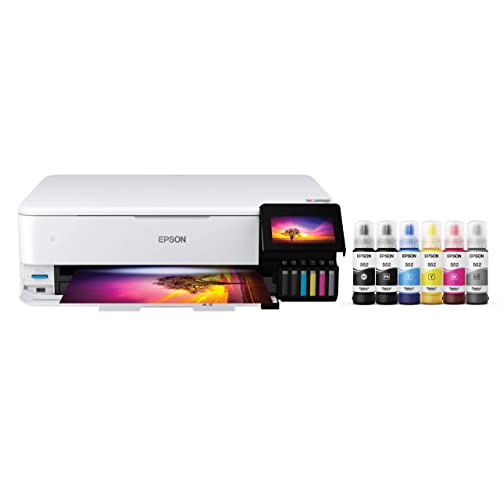
3. Epson EcoTank Photo ET-8550 — Best Overall for Cricut
This is the printer we recommend most often to Cricut enthusiasts, and the reason is simple: it combines wide-format capability, six-color photo ink, all-in-one functionality, and cartridge-free printing in one machine. Printing 4×6 photos for about four cents each (versus around forty cents with traditional cartridge printers) means you can churn through printable vinyl sheets, transfer paper, and photo sticker stock without watching your ink budget spiral. The refillable supertank system holds enough ink to print up to 1,800 4×6 photos before a refill — that's a lot of Cricut craft sessions.
The Claria ET Premium 6-color ink set covers a wide color gamut (the range of colors a printer can reproduce), which matters when your Cricut designs include subtle gradients, skin tones, or saturated graphics. Epson's high-accuracy printhead produces lab-quality results on glossy photo paper and printable sticker media. Wide-format support up to 13×19 inches, plus compatibility with cardstock up to 1.3mm thick, CD/DVDs, and other specialty media, makes it genuinely versatile. Auto 2-sided printing is a bonus for projects where you need content on both faces of a sheet. The 4.3-inch color touchscreen makes navigation feel modern and intuitive.
If you make a lot of 110lb cardstock crafts — thick greeting cards, layered decorations, or die-cut designs — you'll appreciate the ET-8550's media thickness support. It can handle stock that would jam many standard printers. The downside is the upfront cost: supertank printers cost more to buy initially, even though they save significantly over time. For anyone who crafts regularly, that payback period is short. This is the printer we'd buy in 2026 if we were starting a Cricut setup from scratch.
Pros:
- Cartridge-free supertank — about 4 cents per 4×6 photo
- 6-color Claria ET Premium ink for wide color gamut
- Wide-format printing up to 13×19 inches
- Handles specialty media up to 1.3mm thick including cardstock
- Auto 2-sided printing and 4.3" color touchscreen
Cons:
- Higher upfront purchase price than cartridge-based models
- Larger footprint than compact all-in-ones
4. Epson Expression Photo HD XP-15000 — Best Wide-Format Budget Pick
The Epson Expression Photo HD XP-15000 is your path to 13×19-inch borderless prints at a price that doesn't require a business budget. If you've been looking at our best 13×19 printer guide, you already know this machine shows up as a top contender. It earns that reputation with its 6-color Claria Photo HD ink system, which includes dedicated red and gray cartridges — two colors that standard CMYK printers can't replicate. The gray ink improves black-and-white gradient work significantly, and the red extends the warm color range for richer sunset tones and vibrant graphics on your craft prints.
Print resolution hits 5760×1440 dpi (dots per inch — the measure of print detail density), which translates to crisp fine lines and smooth gradients on printable vinyl, fabric sheets, and photo paper. For Cricut users making detailed patterns or highly illustrative designs, that resolution keeps sharp edges sharp. The XP-15000 is a print-only machine — no scan or copy functionality — so factor that in if you need a scanner for tracing or digitizing hand-drawn artwork. It also requires Epson Genuine Cartridges; using third-party ink risks voiding the warranty and can cause print head clogs with this system.
In the box you get four standard ink cartridges plus two specialty ones (gray and red), a cleaning sheet, power cord, and setup disc. Setup is straightforward through the Epson Connect app. If you're serious about wide-format craft printing but the EcoTank's upfront price is out of reach, the XP-15000 is the alternative that gets you comparable print size and color quality with a lower entry cost. Just budget for cartridge replacements, which can add up if you print frequently.
Pros:
- Borderless printing up to 13×19 inches
- 6-color ink with dedicated red and gray for extended color gamut
- 5760×1440 dpi resolution for sharp, detailed craft prints
- Lower upfront cost than tank-based wide-format printers
Cons:
- Print-only — no scan or copy capability
- Must use Epson Genuine Cartridges (higher per-print cost)
5. Epson Expression Photo XP-8700 — Best Compact All-in-One
If your craft space is tight on desk room, the Epson Expression Photo XP-8700 is the one to look at. It packages print, copy, and scan functionality into a compact frame, and it still delivers professional-quality output with 6-color Claria Photo HD ink and a 5760×1440 dpi resolution. The 4.3-inch color touchscreen feels responsive and makes selecting paper types, sizes, and print modes intuitive — which saves time when you're switching between glossy photo paper for stickers and matte card stock for card-making in the same session.
Borderless prints top out at 8.5×11 inches (letter size), which is the main limitation to understand before buying. If most of your Cricut projects work within letter-size dimensions — standard sticker sheets, printable iron-on for small garment areas, greeting cards — you'll never miss the wider format. But if you're making window clings, large wall decals, or oversized transfer sheets, you'll need to step up to the XP-15000 or the ET-8550. Within its size range, the XP-8700 is excellent: color accuracy is consistent, the automatic document feeder handles multi-page scan jobs, and the scanner works perfectly for digitizing hand-drawn artwork to bring into Cricut Design Space.
The 6-color ink system includes dedicated light cyan and light magenta cartridges, which fill in the mid-tone color range and produce smoother skin tones and softer gradients than a 4-color printer. This matters for Cricut projects involving photographic elements or detailed illustrations. Individual ink cartridges mean you replace only what runs out. The XP-8700 is a strong choice for crafters who want photo-quality output, scanning capability, and a small footprint — all for a mid-range price in 2026.
Pros:
- Compact size fits small craft desks easily
- 6-color Claria Photo HD ink with light cyan and light magenta
- Print, copy, and scan all in one unit
- 4.3" color touchscreen for intuitive control
- 5760×1440 dpi resolution for sharp craft prints
Cons:
- Max borderless print size is 8.5×11" — no wide-format capability
- Requires Epson Genuine Cartridges
6. Canon PIXMA G620 — Best High-Volume Craft Printing
The Canon PIXMA G620 is the MegaTank answer to Epson's EcoTank concept, and it's built for volume. A full set of ink lets you print up to 3,800 4×6 color photos — a number that sounds almost absurd until you think about how many sticker sheets, printable vinyl sheets, and iron-on transfers a busy Cricut crafter runs through in a year. The refillable tank system eliminates the anxiety of watching cartridges drain mid-project. You buy ink bottles, fill the tanks, and keep printing. It's also Alexa-compatible: connect to your Alexa device to get low-ink notifications and even set up smart ink reorders through Amazon if you choose.
Print quality from the G620 is genuinely strong for a tank-based printer. Canon's ChromaLife100 dye-based inks produce vivid colors and smooth gradients on photo paper and printable media. Copy and scan functionality round out the all-in-one package, making it practical for digitizing artwork or copying design templates. Max print size is 8.5×11 inches, so this is a letter-size machine — the same constraint as the XP-8700. For crafters whose Cricut work stays within standard sheet sizes, that's not a problem. Where the G620 wins is pure economics: if you print a lot and want to eliminate the ongoing cartridge expense, this machine pays for itself quickly.
The Alexa integration is a nice quality-of-life feature but not essential — the real draw is the tank system. Note that Canon's MegaTank ink is system-specific; you use Canon-branded refill bottles, not third-party ink. That's a minor limitation compared to the overall cost savings. For high-volume Cricut crafters who prioritize ink economy and a smooth, reliable print experience, the G620 delivers. Also worth noting: if you print button designs or small badge art frequently, check out our guide to best printers for button making — the G620 appears there too.
Pros:
- MegaTank prints up to 3,800 4×6 photos per fill
- Very low cost per print for high-volume crafting
- Alexa integration for smart ink monitoring and reorders
- All-in-one print, copy, scan
- Vivid ChromaLife100 dye inks
Cons:
- Max paper size is 8.5×11" — no wide-format output
- Requires Canon-branded refill ink bottles
7. Canon IP8720 — Best Legacy Wide-Format Option
The Canon IP8720 has been a Cricut community favorite for years, and it still holds its ground in 2026. The core appeal hasn't changed: it prints up to 13×19 inches with a 6-color ink system that includes dedicated gray ink, capable of 9600×2400 maximum color dots per inch. That resolution produces extraordinary fine detail in photographic elements and complex vector graphics alike. Noise level sits at approximately 43.5 dB(A) during printing — quiet enough for a home craft space. The gray ink specifically elevates black-and-white gradient work and ensures smoother mid-tones in color photos, which matters for any Cricut design with photographic realism.
Wireless printing via Wi-Fi means you can send print jobs from any device in your home, and AirPrint compatibility makes it work with iPhones and iPads without additional apps. Cloud printing is supported for sending jobs from Dropbox, Google Drive, or similar. The IP8720 is print-only — no scanner or copier — so it's a dedicated output machine. Ink droplet sizes of 1, 2, and 5 picoliters (very small droplets) give it the ability to render fine gradients without the banding (visible horizontal lines) that sometimes appears on lower-resolution printers.
The main consideration with the IP8720 is age — it's been on the market for a while, and ink cartridges can sometimes be trickier to find than for newer models. Check availability in your region before committing. If you can get ink easily, though, this is still a reliable wide-format option for Cricut users who want 13×19-inch prints and a proven track record. For those doing specialized print work — like printing on clear or translucent media — pair it with our tips on the best printers for acetate to get the most from its wide-format capability.
Pros:
- Wide-format printing up to 13×19 inches
- 9600×2400 dpi maximum resolution
- 6-color ink with dedicated gray for superior gradients
- Wireless, AirPrint, and cloud compatible
- Very small ink droplets minimize banding
Cons:
- Print-only — no scan or copy function
- Older model; cartridge availability may vary
How to Pick the Best Printer for Cricut Projects
Maximum Print Size: Letter vs. Wide-Format
This is the first question to settle, because it immediately eliminates half the field. Standard letter-size printers (8.5×11 inches) cover most everyday Cricut projects — sticker sheets, card-making, iron-on transfers for shirts, and printable vinyl cut into small shapes. If that describes 90% of your projects, you don't need to pay extra for wide-format capability.
Wide-format printers (13×19 inches) open up a completely different set of projects: full-page window decals, poster-sized iron-on transfers for hoodies or tote bags, large fabric prints for quilting, and oversized photo collages. The Epson ET-8550, Epson XP-15000, Canon PRO-200S, and Canon IP8720 all hit 13×19. The Canon TS9521Ca reaches 11×17 (tabloid). The XP-8700 and G620 cap at 8.5×11. Be honest about your project scale before buying — paying for wide-format you never use wastes money, but outgrowing a letter-size printer mid-project is frustrating.
Ink System: Cartridge, Tank, or Dye vs. Pigment
Ink cost is the sleeper issue for Cricut crafters. You might only print a dozen documents a week in an office, but craft projects can consume ink fast — especially when you're printing full-page backgrounds, photo-realistic designs, or running multiple test prints to dial in color. Cartridge-based printers (XP-15000, XP-8700, IP8720, TS9521Ca) have lower upfront costs but higher ongoing ink expenses. Tank-based printers (ET-8550, G620) cost more upfront but bring per-print costs down dramatically — roughly 90% lower than cartridges in many cases.
The dye vs. pigment question matters for durability. Dye-based ink (Canon PRO-200S, G620, IP8720) produces more vivid colors but fades faster when exposed to light over years. Pigment-based ink (some Epson models) sits on the paper surface, resists UV fading better, and is more water-resistant. For Cricut projects that end up laminated, heat-pressed, or embedded in finished objects, dye-based ink usually performs perfectly well. For prints that hang framed or sit in albums unprotected, pigment ink holds up longer.
Color Ink Count: 4-Color vs. 6-Color vs. 8-Color
Standard printers use four ink colors (CMYK — cyan, magenta, yellow, black). Photo and art-focused printers add extra colors: light cyan, light magenta, gray, red, orange. Each additional color expands the printer's color gamut and smooths out transitions in gradients and mid-tones. For most Cricut designs — bold graphics, text, flat illustration styles — a quality 4-color printer is sufficient. But for photorealistic elements, complex shading, or designs where color accuracy is critical, stepping up to a 6-color or 8-color system produces noticeably better results. The Canon PRO-200S (8-color), Epson ET-8550 (6-color), and Epson XP-15000 (6-color with red and gray) all belong in this tier.
All-in-One vs. Print-Only
Print-only printers focus all their engineering on output quality and often deliver better results per dollar in that one dimension. All-in-one machines add scanner and copier capability, which is legitimately useful for Cricut workflows — scanning hand-drawn sketches, copying reference materials, digitizing existing artwork. If you already own a scanner or never plan to scan, a print-only machine (XP-15000, IP8720) lets you spend your budget on print quality. If scanning is part of your creative process, an all-in-one (ET-8550, XP-8700, G620, TS9521Ca) pays back in convenience. The ET-8550 is the rare machine that does both without meaningful compromise on either.
Questions Answered
What type of printer works best with a Cricut Maker?
Inkjet printers work best with Cricut Makers. Cricut's Print Then Cut feature — where you print a design and the machine cuts it out along registration marks — requires the inkjet's ability to print on photo paper, printable vinyl, printable sticker paper, and iron-on transfer sheets. Laser printers use heat to fuse toner, which can damage heat-sensitive craft media and produces less vibrant color on glossy surfaces. For Cricut workflows in 2026, stick with a photo-capable inkjet with at least a 6-color ink system for the best color matching.
Can I use a regular home printer for Cricut Print Then Cut?
Yes, as long as it's an inkjet printer that can print the registration marks (small black squares) Cricut uses to align cuts. The printer doesn't need to be Cricut-branded or certified. However, print quality matters — blurry or low-resolution prints make it harder for the Cricut sensor to read registration marks accurately, which leads to misaligned cuts. A printer with at least 1200 dpi resolution handles registration marks reliably. All seven printers on this list work with Print Then Cut without issues.
What is the maximum print size for Cricut Print Then Cut in 2026?
Cricut's Print Then Cut feature currently supports a maximum image area of 9.25×6.75 inches, regardless of your printer's maximum paper size. Even if your printer handles 13×19-inch sheets, Cricut Design Space caps the printable area at that dimension. However, wide-format printers are still useful for Cricut projects that don't use Print Then Cut — like printing large heat transfer sheets, printable fabric, or reference designs that you transfer manually.
Is inkjet or laser better for Cricut iron-on transfers?
Inkjet is better for Cricut iron-on transfers in almost every situation. Inkjet-printed transfer paper absorbs ink into the coating and transfers the design cleanly with heat and pressure. Laser transfer paper uses a different chemistry designed for toner — you can't use inkjet paper in a laser printer or vice versa without damaging results. For standard Cricut iron-on transfer workflows, use an inkjet printer with printable iron-on sheets rated for inkjet use. The Canon PRO-200S and Epson ET-8550 produce the best color vibrancy for transfer printing among the options on this list.
How often will I need to replace ink when printing Cricut projects?
It depends heavily on your project volume and ink system type. With a standard cartridge printer running frequent craft sessions, you might replace cartridges every few weeks if you're printing full-coverage designs like photo backgrounds or solid-colored graphics. Tank-based printers like the Epson ET-8550 or Canon G620 dramatically extend that interval — the ET-8550 can print 1,800 4×6 photos per fill, and the G620 handles up to 3,800. For high-volume crafters, the tank systems pay for themselves within months. Light crafters (a few projects per week) will do fine with cartridges.
Do Cricut printers need to be wireless?
Wireless capability isn't strictly required, but it makes your Cricut workflow significantly smoother. When you print directly from Cricut Design Space on a tablet or laptop to a wireless printer, you never have to transfer files via USB or switch workstations. All seven printers on this list support wireless printing. Some also support AirPrint (Canon IP8720, Canon TS9521Ca) for direct iOS printing without an app. If your craft space is set up near your computer and a USB cable is no inconvenience, wired works fine — but wireless gives you more layout flexibility in your studio.
Buy on Walmart
- Canon PIXMA TS9521Ca – Wireless Home All-in-One Inkjet Print — Walmart Link
- Canon PIXMA PRO-200S Professional 13" Wireless Inkjet Photo — Walmart Link
- Epson EcoTank Photo ET-8550 Wireless Wide-format Color All-i — Walmart Link
- Epson Expression Photo HD XP-15000 Wireless Color Wide-Forma — Walmart Link
- Epson Expression Photo XP-8700 Wireless All-in-One Printer w — Walmart Link
- Canon PIXMA G620 Wireless MegaTank Photo All-in-One Printer — Walmart Link
- Canon IP8720 Wireless Printer, AirPrint and Cloud Compatible — Walmart Link
Buy on eBay
- Canon PIXMA TS9521Ca – Wireless Home All-in-One Inkjet Print — eBay Link
- Canon PIXMA PRO-200S Professional 13" Wireless Inkjet Photo — eBay Link
- Epson EcoTank Photo ET-8550 Wireless Wide-format Color All-i — eBay Link
- Epson Expression Photo HD XP-15000 Wireless Color Wide-Forma — eBay Link
- Epson Expression Photo XP-8700 Wireless All-in-One Printer w — eBay Link
- Canon PIXMA G620 Wireless MegaTank Photo All-in-One Printer — eBay Link
- Canon IP8720 Wireless Printer, AirPrint and Cloud Compatible — eBay Link
The right printer for your Cricut is the one that matches your actual project scale — buy wide-format only if you genuinely make wide-format projects, and invest in a tank system only if your ink volume justifies it.



About Chris & Marry
Chris and Mary are a couple with a shared background in graphic design and print production who have spent years working with printers across creative and professional contexts — from art printing and photo output to label production and professional document work. Their combined experience evaluating printer performance, color accuracy, and paper handling across inkjet and laser platforms gives them a practical, hands-on perspective on what makes a printer worth buying. At ShopChrisAndMary, they cover printer reviews, buying guides, and recommendations for artists, photographers, and professional users.
Time to get FREE Gifts. Or latest Free printers here.
Disable Ad block to reveal all the info. Once done, hit a button below