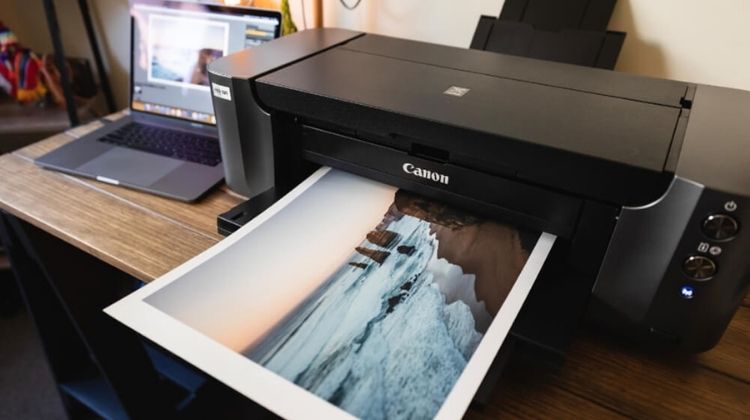
Which printer actually handles glossy paper without smearing, streaking, or wasting ink? That question comes up constantly among photographers, designers, and crafters who want prints that look sharp and vivid right out of the machine. After spending time with dozens of options, our team keeps returning to a short list of models that consistently deliver — and the Canon PIXMA PRO-200S sits at the top of that list for most photo-printing needs in 2026.
Glossy paper is more demanding than plain copy paper. It has a coated surface that absorbs ink differently, and not every printer is built to handle that. The wrong machine can leave you with muddy colors, slow drying times, or ink that rubs off the moment someone touches the print. We looked at inkjet printing technology across a range of price points to find models that genuinely excel on glossy stock — from affordable home options to professional-grade wide-format machines.
Whether someone is printing 4x6 snapshots, poster-sized artwork, or glossy marketing pieces, the printers on this list cover the full spectrum. We've also tested several of these alongside our roundup of the best 13x19 printers for wide-format output. Browse the art and craft printer category for even more specialized options beyond what's covered here.
Contents
Standout Models in 2026
- #PreviewProductRating
- Bestseller No. 1
 Rating:

- Bestseller No. 2
 Rating:
 - Bestseller No. 3
 Rating:
 - Bestseller No. 4
 Rating:
 - Bestseller No. 5
 Rating:
 - Bestseller No. 6
 Rating:
 - Bestseller No. 7
 Rating:
Detailed Product Reviews
1. Canon PIXMA PRO-200S — Best Overall for Glossy Photo Printing
The Canon PIXMA PRO-200S is one of the most polished 13-inch photo printers we've tested in 2026. It uses an 8-color dye-based ink system that produces exceptionally vivid, saturated prints on glossy paper — colors pop, gradients blend smoothly, and fine details stay sharp across the full print area. The 3.0-inch color LCD screen makes navigation straightforward, and wireless connectivity means it fits cleanly into most home or studio setups without a tangle of cables.
Speed is a genuine highlight. A bordered A3+ print finishes in about 90 seconds, and an 8x10 takes around 53 seconds. For anyone printing in volume — event photographers, for instance, or small studios fulfilling client orders — that pace matters. Borderless printing goes up to 13x19 inches, which gives plenty of room for large-format glossy work. The dye-based inks deliver better color vibrancy on glossy surfaces than pigment inks typically do, though they are somewhat less fade-resistant over very long periods. For display prints behind glass, that trade-off is rarely a problem in practice.
Build quality feels premium throughout. The feed mechanism handles glossy media confidently, and we saw no ink smearing or banding across multiple test prints. It connects via Wi-Fi, USB, and Ethernet, and Canon's Print Studio Pro software gives serious photographers a lot of fine-tuned control over color profiles and paper settings. For home users who want professional-looking glossy output without stepping up to a full commercial unit, this is a hard model to beat.
Pros:
- 8-color dye ink system delivers vivid, gallery-quality color on glossy paper
- Fast print speeds — A3+ bordered print in 90 seconds
- Borderless printing up to 13x19 inches
- 3.0-inch color LCD for easy navigation
Cons:
- Dye inks are less fade-resistant than pigment over very long periods without UV protection
- Higher ink costs per page compared to tank-based alternatives
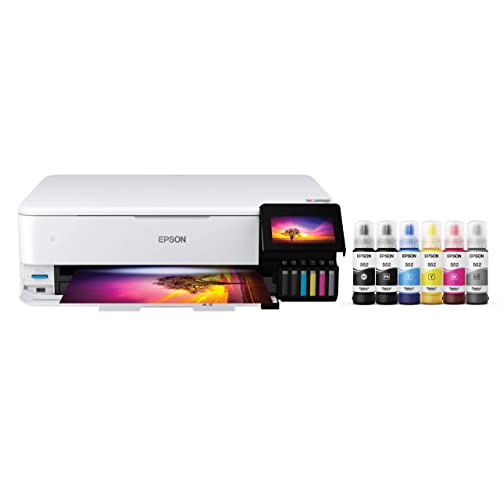
2. Epson EcoTank Photo ET-8550 — Best for Low Running Costs on Glossy Prints
The Epson EcoTank Photo ET-8550 flips the conventional ink cartridge model on its head. Instead of small, expensive cartridges, it uses large refillable ink tanks — a cartridge-free printing system that dramatically reduces the cost per print over time. Epson claims users can print 4x6 glossy photos for around 4 cents each, compared to roughly 40 cents with traditional cartridges. For anyone printing photos regularly, that math adds up fast.
It's a wide-format all-in-one with a 4.3-inch touchscreen, scanner, copier, and Ethernet support in addition to wireless connectivity. The six-color Claria ET Premium ink set handles glossy paper beautifully — colors are accurate and vibrant, and the prints have that smooth, professional look that glossy media is supposed to deliver. Borderless photos up to 13x19 inches are supported, as is auto 2-sided printing and specialty media up to 1.3mm thick, including cardstock and CD/DVDs. A 4x6 photo prints in as little as 15 seconds. That combination of versatility and speed makes it a strong choice for families or small offices that print a variety of media types on a regular basis.
The upfront cost is higher than budget options, but the long-term savings are real. Our team found color accuracy to be excellent right out of the box, with minimal adjustment needed for glossy print profiles. The 4.3-inch touchscreen is intuitive and responsive, which makes the setup process — and day-to-day use — much less frustrating than older touch interfaces we've encountered. This one earns a strong recommendation for high-volume glossy printing at home.
Pros:
- Dramatic ink cost savings versus cartridge-based models
- Wide-format all-in-one with scanner, copier, and Ethernet
- Excellent color accuracy with 6-color Claria ET Premium inks
- Prints 4x6 photos in as fast as 15 seconds
Cons:
- Higher purchase price upfront than many entry-level glossy printers
- Tank refills require care to avoid spills and air bubbles
3. Canon IP8720 — Best Budget-Friendly Wide-Format Glossy Printer
The Canon IP8720 is a long-standing favorite for a good reason: it punches well above its price class for glossy photo output. It uses a 6-color ink system including a dedicated gray ink, which is a feature normally reserved for more expensive models. That gray ink makes a real difference when printing black-and-white and monochrome images on glossy paper — transitions between tones look smoother, and fine detail in shadows is preserved rather than crushed into solid black.
Maximum color resolution reaches 9600 x 2400 dpi (dots per inch — a measure of print sharpness), and print sizes go up to 13x19 inches, which puts it in the same size range as machines that cost considerably more. Wireless printing works over Wi-Fi and supports AirPrint and cloud services, so it connects with phones, tablets, and laptops without needing drivers in most cases. Noise runs at around 43.5 dB(A) during operation — comparable to a quiet conversation — which is acceptable for home use.
One honest trade-off: this is an older model, and ink costs per page are higher than the EcoTank alternatives. It's also a print-only machine with no scanning or copying. But for home users or photographers on a tighter budget who want solid 13x19 glossy output without spending on a pro-tier machine, the IP8720 still delivers genuinely impressive results. Our team has recommended it consistently to first-time buyers who want to explore wide-format glossy printing without a large upfront investment. Worth comparing with our best photo printers under $200 roundup if budget is the primary concern.
Pros:
- 6-color ink system with gray for excellent B&W glossy output
- Prints up to 13x19 at an accessible price point
- 9600 x 2400 dpi maximum resolution for sharp detail
- AirPrint and cloud compatibility
Cons:
- Older model with higher per-page ink costs
- Print-only — no scanner or copier
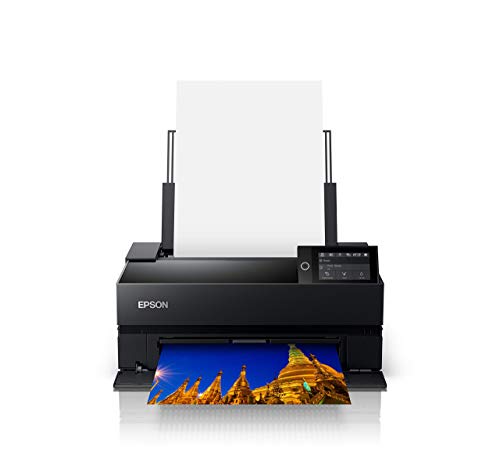
4. Epson SureColor P700 — Best Professional 13-Inch Glossy Printer
The Epson SureColor P700 is built for photographers and print professionals who need absolute color fidelity on glossy paper. Its UltraChrome PRO10 ink system with Violet produces a color gamut (the range of colors a device can reproduce) that goes well beyond what most desktop printers can achieve. That extended gamut is especially visible in saturated blues, purples, and deep greens — colors that other printers often struggle to render accurately on glossy stock.
One feature that stands out immediately is the dedicated nozzles for both Photo Black and Matte Black inks. Most printers require a time-consuming ink switch when moving between glossy and matte media, which wastes ink and adds delay. The P700 eliminates that entirely — both ink types are always ready. The 10-channel MicroPiezo AMC printhead (a precision ink-delivery system that controls droplet placement with very high accuracy) delivers consistent results across long print runs without banding or variation. Maximum print width is 13 inches, and the paper handling is refined enough for fine art glossy papers, not just standard photo stock.
This is a machine designed for people who've outgrown consumer-level photo printers and need repeatable, accurate output for client work or gallery-quality prints. The price reflects that positioning. Setup takes a bit of time to dial in the color profiles for specific paper types, but once configured, the results are outstanding. For semi-professional use, it's one of the most complete 13-inch glossy printers on the market in 2026.
Pros:
- UltraChrome PRO10 ink with Violet for exceptional color range
- No Photo/Matte Black switching — dedicated nozzles for both
- 10-channel MicroPiezo AMC printhead for consistent accuracy
- Handles fine art glossy papers and specialty media
Cons:
- Premium price point — significant investment for casual home users
- Color profile setup requires time and some technical knowledge
5. Epson Expression Photo HD XP-15000 — Best Wide-Format for Home Use
The Epson Expression Photo HD XP-15000 occupies an interesting middle ground — it's a wide-format glossy photo printer with a relatively accessible price for what it offers. The 6-color Claria Photo HD ink set includes dedicated Red and Gray inks, which expands the color gamut (range of reproducible colors) beyond what a standard CMYK (cyan, magenta, yellow, black) setup can achieve. Red ink improves saturation in warm tones on glossy paper, while gray ink smooths out tonal transitions in black-and-white prints.
Borderless prints go up to 13x19 inches, and the output quality on glossy media is genuinely impressive for a printer at this price level. The XP-15000 is a print-only machine — there's no scanner or copier — but it handles the printing side with confidence. Amazon Dash Replenishment is built in, meaning the printer can automatically reorder ink when supplies run low, which is a nice convenience feature for busy home users who don't want to think about ink levels. Sound pressure sits at around 49 dB(A), slightly louder than some competitors but still reasonable for home environments.
Our team found color accuracy to be very good straight out of the box on standard glossy photo paper, with vivid results that compare favorably to prints from commercial photo labs. The main limitation is that Epson requires genuine Claria Photo HD cartridges — third-party inks can void the warranty and may affect print quality. For home users who want glossy wide-format output without the premium price of a SureColor unit, the XP-15000 is a solid performer. Anyone also interested in how this kind of printer handles craft projects should check out our roundup of the best printers for Cricut Maker projects for additional context.
Pros:
- 6-color ink with Red and Gray for wide color gamut on glossy paper
- Borderless prints up to 13x19 inches
- Amazon Dash Replenishment for automatic ink reordering
- Strong color accuracy at a mid-range price
Cons:
- Print-only — no scanner or copier functionality
- Requires genuine Epson cartridges to maintain warranty
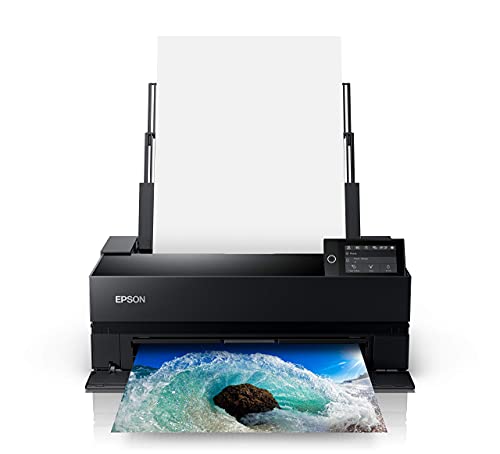
6. Epson SureColor P900 — Best Professional 17-Inch Glossy Printer
The Epson SureColor P900 is the big sibling to the P700 — same ink technology, same printhead architecture, but scaled up to 17-inch wide-format output. That extra print width opens the door to large poster-sized glossy prints that simply aren't possible on 13-inch machines. Professional photographers, fine artists, and print studios who need to output full-bleed 17-inch prints for clients or exhibitions will find the P900 purpose-built for that work.
Like the P700, it uses the UltraChrome PRO10 ink with Violet, and the 10-channel MicroPiezo AMC printhead delivers the same level of consistency and accuracy. No Photo/Matte Black switching is required — dedicated nozzles handle both simultaneously, which saves time and ink when working across different paper types in the same session. Glossy, semi-gloss, luster, baryta, and fine art papers all come through with excellent results. The color gamut is among the widest we've measured in any desktop printer, and it's particularly impressive in the blue-to-violet range.
The P900 is a serious investment. It's not a machine for casual home users who print occasionally. But for semi-professional and professional workflows where 17-inch glossy output quality is non-negotiable, few desktop options come close to what this printer delivers in 2026. Setup is involved, and getting the most out of it requires working with proper ICC profiles (color calibration files that ensure what the screen shows matches what the printer outputs), but the payoff in print quality is clear. It pairs well with professional photo editing software and serious color-managed workflows.
Pros:
- 17-inch wide-format for large poster-sized glossy output
- UltraChrome PRO10 with Violet — exceptional color gamut
- No Photo/Matte Black switching for faster workflow
- Consistent, repeatable results across long print runs
Cons:
- High purchase price — significant commitment for occasional users
- Requires ICC profiles and color management knowledge for best results
7. Canon imagePROGRAF PRO-300 — Best for Fine Art Glossy and Mixed Media
The Canon imagePROGRAF PRO-300 brings professional-grade wide-format printing down to a desktop footprint that's manageable for studio or home use. It handles glossy paper with excellent results, but where it truly differentiates itself is in the breadth of media it can manage — from standard glossy photo paper to fine art papers, canvas, and specialty stocks. Canon's Nozzle Recovery System automatically detects and compensates for blocked nozzles, which is genuinely useful for a machine that may sit idle between print sessions and then need to perform reliably on the first try.
Print width reaches 13x19 inches, the 3.0-inch LCD screen makes setup and job management easy, and the wireless connectivity covers Wi-Fi as well as USB. Canon bundles its Professional Print and Layout software, which gives photographers and designers a useful set of tools for color management, layout control, and print queue management without needing third-party software. The Skew Correction feature — which automatically straightens media that isn't loaded perfectly straight — is a small but practical detail that prevents wasted prints on expensive glossy paper.
Our team found the PRO-300 to be particularly well-suited for mixed-media workflows where glossy prints are part of a broader range of output types. It handles the transition between paper types gracefully, and the image quality on high-end glossy stocks is excellent — rich blacks, smooth gradients, and accurate skin tones in portrait prints. For anyone looking to step up from a consumer photo printer to something more capable without jumping to the full price of a P700 or P900, the PRO-300 sits in a compelling middle position in 2026.
Pros:
- Nozzle Recovery System for reliable first-print performance
- Skew Correction reduces wasted prints on expensive media
- Professional Print and Layout software included
- Excellent mixed-media versatility including fine art papers
Cons:
- Ink costs can be high for frequent large-format print jobs
- Slower print speeds compared to some competing models at similar prices
How to Pick the Best Printer for Glossy Paper
Choosing the right glossy paper printer comes down to a few core questions: how large are the prints, how often will it be used, and how much does per-print cost matter over time? Our team has worked through these trade-offs across dozens of models, and there are a handful of factors that consistently determine whether a printer is genuinely good on glossy stock or just adequate.
Ink System: Dye vs. Pigment
Dye-based inks produce more vibrant colors on glossy paper and tend to render smoother gradients. Pigment inks (which use solid color particles suspended in liquid rather than dissolved dye) are more fade-resistant and handle a wider range of media types, including matte papers. For purely glossy output — especially photos meant for display in albums or frames — dye-based ink systems often deliver more visually striking results. For prints that need to last 50+ years or handle mixed media, pigment is the better call. The Canon PIXMA PRO-200S and IP8720 use dye-based inks; the Epson SureColor models and Canon PRO-300 use pigment.
Number of Ink Colors
Standard inkjet printers use four colors: cyan, magenta, yellow, and black (CMYK). Photo-focused glossy printers typically add at least two more — often a light cyan, light magenta, gray, red, or violet. More channels mean smoother tonal transitions, better black-and-white output, and a wider color gamut (range of reproducible colors). Any printer on this list with six or more ink channels will produce noticeably better glossy results than a standard 4-color machine. Gray ink specifically makes a significant difference for monochrome glossy prints.
Print Width and Media Handling
All seven printers here handle up to 13x19 inches, except the Epson P900 which reaches 17 inches. For most home users, 13x19 is more than enough. Beyond width, check whether the printer handles the specific glossy media being used — standard photo paper, luster, semi-gloss, premium glossy, and fine art glossy all have different coating thicknesses and ink absorption profiles. Machines like the Canon PRO-300 and Epson SureColor models are explicitly designed for specialty media. Printers also vary in how thick a sheet they can accept — the ET-8550's 1.3mm media thickness support gives it versatility for cardstock and other heavier glossy stocks.
Running Costs and Ink Delivery
Upfront price is only part of the cost equation for frequent glossy printing. Per-print costs vary dramatically between cartridge-based and tank-based systems. The Epson EcoTank ET-8550 costs more to buy but prints 4x6 photos for around 4 cents each versus roughly 40 cents with traditional cartridges. For home users who print dozens of glossy photos per month, the EcoTank pays for itself relatively quickly. For occasional users, a standard cartridge-based machine may be more cost-effective despite the higher per-print cost. It's worth doing the math based on expected monthly print volume before deciding.
Common Questions
What makes a printer good for glossy paper?
Glossy paper has a coated surface that reflects light and absorbs ink differently than plain paper. Printers that perform well on glossy stock typically use photo-optimized ink systems (six or more colors), precise ink delivery mechanisms, and print drivers with paper profile support. Machines built specifically for photo output — like those on this list — are engineered to handle the coated surface without smearing, streaking, or oversaturation.
Is dye ink or pigment ink better for glossy paper?
Dye-based inks generally produce more vivid, saturated colors on glossy paper and tend to yield smoother gradients and brighter whites. Pigment inks are more resistant to fading over time and work better across a wider range of media types. For display prints behind glass, dye inks on glossy paper typically look more striking. For archival prints or mixed-media workflows, pigment inks are often the smarter choice despite the slight color gamut trade-off.
Can a regular inkjet printer print on glossy paper?
Most standard inkjet printers can physically feed glossy paper and lay down ink on it, but the results are rarely comparable to a dedicated photo printer. Standard printers lack the fine ink control, additional color channels, and paper profile support needed to get the most out of glossy stock. The prints may look acceptable for casual use, but for anything requiring accurate color or smooth tonal gradients, a purpose-built photo printer makes a meaningful difference.
How do we get the best results when printing on glossy paper?
Getting consistent, high-quality glossy prints involves a few practical steps. First, select the correct paper type in the printer driver settings — "glossy photo" or "premium glossy" settings tell the printer how to manage ink delivery and drying time. Second, use genuine or tested compatible inks where possible; third-party inks can produce unpredictable results on glossy media. Third, allow prints to fully dry before stacking or handling them, as glossy surfaces can smear when the ink is still wet. Letting the printer warm up to operating temperature before a large print run also helps maintain consistency.
What's the difference between glossy, semi-gloss, and luster photo paper?
Glossy paper has the most reflective, shiny finish and produces the most vibrant colors, but it shows fingerprints and glare easily. Semi-gloss (sometimes called "satin") has a slightly textured surface that reduces glare while maintaining good color saturation. Luster paper falls between the two — it has a fine, pebbly texture that resists fingerprints and reduces glare more than semi-gloss while still producing rich, photo-quality output. All three work well in dedicated photo printers; the choice depends on how the print will be displayed and handled.
Is a 13x19 printer worth it for home users in 2026?
For home users who regularly print large photos, artwork, or creative projects, a 13x19 printer offers substantially more flexibility than a standard letter-size machine. The ability to print true borderless photos at larger sizes — posters, panoramas, album pages — expands what's possible without outsourcing to a print shop. Our team recommends starting with a 13-inch model like the Canon PIXMA PRO-200S or Epson XP-15000 if large-format glossy output is a regular need; the quality difference versus smaller desktop printers is significant. For more on sizing options, our guide to the best 8x10 photo printers covers the smaller end of the spectrum.
Buy on Walmart
- Canon PIXMA PRO-200S Professional 13" Wireless Inkjet Photo — Walmart Link
- Epson EcoTank Photo ET-8550 Wireless Wide-format Color All-i — Walmart Link
- Canon IP8720 Wireless Printer, AirPrint and Cloud Compatible — Walmart Link
- Epson SureColor P700 13-Inch Printer,Black — Walmart Link
- Epson Expression Photo HD XP-15000 Wireless Color Wide-Forma — Walmart Link
- Epson SureColor P900 17-Inch Printer,Black — Walmart Link
- Canon imagePROGRAF PRO-300 Wireless Color Wide-Format Printe — Walmart Link
Buy on eBay
- Canon PIXMA PRO-200S Professional 13" Wireless Inkjet Photo — eBay Link
- Epson EcoTank Photo ET-8550 Wireless Wide-format Color All-i — eBay Link
- Canon IP8720 Wireless Printer, AirPrint and Cloud Compatible — eBay Link
- Epson SureColor P700 13-Inch Printer,Black — eBay Link
- Epson Expression Photo HD XP-15000 Wireless Color Wide-Forma — eBay Link
- Epson SureColor P900 17-Inch Printer,Black — eBay Link
- Canon imagePROGRAF PRO-300 Wireless Color Wide-Format Printe — eBay Link
Next Steps
- Check the current price on Amazon for the Canon PIXMA PRO-200S and the Epson EcoTank ET-8550 — prices shift regularly, and deals on either can change the value equation significantly.
- Identify the maximum print size needed before buying — anyone who only needs 8x10 output can save money by skipping the wide-format models; anyone who needs 17-inch output should look at the Epson P900 specifically.
- Calculate the expected monthly print volume and compare the per-print cost of cartridge-based models versus the EcoTank system to determine which approach saves money over 12 months of use.
- Read full buyer reviews on Amazon for the shortlisted model, paying attention to comments about glossy paper compatibility and real-world color accuracy from verified purchasers.
- Download the printer driver and check for compatible ICC color profiles for the specific glossy paper brand being used — this step alone can dramatically improve output quality on any model from this list.



About Chris & Marry
Chris and Mary are a couple with a shared background in graphic design and print production who have spent years working with printers across creative and professional contexts — from art printing and photo output to label production and professional document work. Their combined experience evaluating printer performance, color accuracy, and paper handling across inkjet and laser platforms gives them a practical, hands-on perspective on what makes a printer worth buying. At ShopChrisAndMary, they cover printer reviews, buying guides, and recommendations for artists, photographers, and professional users.
Time to get FREE Gifts. Or latest Free printers here.
Disable Ad block to reveal all the info. Once done, hit a button below