Best Printer for 110lb Cardstock 2026 – Reviews with Buyer’s Guide
by Chris & Marry
The Epson WorkForce WF-7720 is our top pick for printing on 110lb cardstock in 2026 because it handles wide-format media up to 13×19 inches with the kind of paper-handling muscle that thick stock demands. If you've ever tried feeding a stack of 110lb cardstock into a printer not built for the job, you already know the frustration — jammed trays, smeared ink, and wasted sheets that cost you money and patience. Choosing the right printer from the start eliminates all of that.
110lb cardstock (also called 300 gsm, or grams per square meter) is one of the heaviest paper weights (a measure of how thick and stiff a sheet of paper is) that consumer-grade inkjet printers can realistically handle. It's the go-to material for wedding invitations, business cards, greeting cards, scrapbooking pages, and professional art prints. You can browse our full roundup of craft-friendly options on our art and craft printer page, but this guide zeroes in specifically on the printers that handle that heavy stock without complaint. If you're also shopping for invitations, our Best Printer For Wedding Invitations guide covers the overlap in detail.
We tested and researched seven printers that each bring something different to the table for thick-paper printing. Some are budget-friendly wireless workhorses, some are wide-format beasts, and one is a dedicated professional photo printer that produces gallery-quality results on heavy cardstock. According to Wikipedia's paper size reference, printing on non-standard or oversized stock requires printers with rear manual feed slots or bypass trays — a critical feature you'll want to check for before buying. Read on for our full reviews, a buying guide, and answers to the most common questions we hear about printing on heavy cardstock.
Contents
- Best Choices for 2026
- Product Reviews
- Canon Pixma iX6820 — Best Budget Wireless Option
- Epson WorkForce WF-7720 — Best Wide-Format Cardstock Printer
- Brother INKvestment MFC-J4355DW — Best for Home Office
- Epson EcoTank Pro ET-16650 — Best for High-Volume Printing
- Epson SureColor P700 — Best Professional Photo/Art Printer
- Canon PIXMA TS9521Ca — Best All-in-One for Crafters
- Canon PIXMA TR8620a — Best Compact All-in-One
- Key Features to Consider When Choosing
- Questions Answered
- Key Takeaways
Best Choices for 2026
- #PreviewProductRating
- Bestseller No. 1
 Rating:

- Bestseller No. 2
 Rating:
 - Bestseller No. 3
 Rating:
 - Bestseller No. 4
 Rating:
 - Bestseller No. 5
 Rating:
 - Bestseller No. 6
 Rating:
 - Bestseller No. 7
 Rating:
Product Reviews
1. Canon Pixma iX6820 Wireless Business Printer — Best Budget Wireless Option
The Canon Pixma iX6820 is a no-frills wireless inkjet that punches above its price class when it comes to feeding thick media. At 23 inches wide and just 6.3 inches tall, it has a physical footprint that fits on a desk without dominating it, and its straight-through rear paper path means 110lb cardstock travels through the machine at a far gentler angle than it would in a printer that routes paper through a curved path under the chassis. That straight path is the single most important physical feature for heavy stock printing, and Canon built it in here as a standard feature rather than an afterthought.
Print quality on Canon's Fine print head technology (full photolithography inkjet nozzle engineering, which simply means the nozzles are manufactured with extreme precision at a microscopic level) delivers sharp text and smooth color gradients on cardstock surfaces. The iX6820 supports Windows 7 through Windows 8.1, Mac OS X 10.6.8 through 10.9, AirPrint, and Google Cloud Print, so connecting it to your home or office network takes a few minutes at most. It does not have a scanner or copier, which keeps the price down but also means it's a dedicated print-only machine — something to keep in mind if you need an all-in-one setup.
For crafters, small business owners, and anyone printing greeting cards or photo prints on heavy stock at home, the iX6820 delivers reliable results at a price that's easy to justify. The rear feed slot accepts cardstock up to 13×19 inches, which gives you room to print large-format invitations or display prints without needing a wide-format printer. It's not the fastest machine on this list, but for occasional to moderate cardstock printing, the output quality and affordability make it a strong entry point.
Pros:
- Straight-through rear paper path handles thick cardstock with minimal jam risk
- Fine print head technology produces sharp, detailed output on heavy stock
- AirPrint and Google Cloud Print support for easy wireless printing from any device
- Supports wide-format sheets up to 13×19 inches
Cons:
- Print-only — no scanner, copier, or fax functionality
- OS support is dated and may require driver workarounds on newer systems
2. Epson WorkForce WF-7720 Wireless Wide-Format Color Inkjet Printer — Best Wide-Format Cardstock Printer
The Epson WorkForce WF-7720 is our top overall recommendation for printing on 110lb cardstock in 2026, and it earns that spot because it was purpose-built for exactly the kind of heavy, wide-format media work that most home printers struggle with. The WF-7720 prints borderless sheets up to 13×19 inches, which means you can print full-bleed greeting cards, large invitations, art prints, and scrapbooking pages without white borders cutting into your design. It's powered by Epson's PrecisionCore technology (a high-density printhead system that delivers laser-like sharpness on ink), and the difference in text clarity on heavy cardstock compared to a standard inkjet is immediately noticeable.
Beyond raw print quality, the WF-7720 is a fully capable all-in-one machine — it copies, scans, and faxes in addition to printing, and it connects via Wi-Fi, Wi-Fi Direct (which lets you print directly from a phone or tablet without a router), Ethernet, and USB. Amazon Dash Replenishment automatically reorders ink when levels run low, which removes one more thing you have to track when you're in the middle of a big project. The rear manual feed accepts thick cardstock sheets one at a time, and its paper handling system is robust enough to manage 110lb stock reliably without the repeated jams that plague lighter-duty machines. OS support covers Windows Vista through Windows 10 (both 32-bit and 64-bit) and Mac OS X 10.6.8 through macOS 10.12, so compatibility is broad.
One honest caveat: Epson strongly recommends using genuine Epson inks in this printer, and non-Epson inks can void the warranty and potentially damage the printhead over time. If you're doing high-volume cardstock runs, factor the cost of name-brand ink cartridges into your budget. For most users who print at home or in a small business setting, the WF-7720 delivers print-shop quality results on heavy cardstock without requiring a commercial-grade machine. If you're also interested in printing even larger format work, our review of the best 13x19 printers covers the WF-7720 alongside other wide-format options in greater depth.
Pros:
- Borderless printing up to 13×19 inches on heavy cardstock
- PrecisionCore printhead delivers laser-sharp text and vivid color
- Full all-in-one: print, copy, scan, fax with Wi-Fi, Ethernet, and Wi-Fi Direct
- Amazon Dash Replenishment for automatic ink reordering
Cons:
- Requires genuine Epson inks to maintain warranty coverage
- Larger footprint than standard home printers
3. Brother INKvestment MFC-J4355DW Wireless Color Inkjet All-in-One — Best for Home Office
The Brother INKvestment MFC-J4355DW is a compact, versatile all-in-one that earns its place on this list by combining cardstock-friendly paper handling with the kind of practical feature set that home office users rely on every day. The manual feed slot at the front of the machine is your entry point for 110lb cardstock — it feeds single sheets with minimal resistance, and Brother's ink system delivers consistent color output across the full surface of heavy stock. The 1.8-inch color display makes navigating settings straightforward, even when you're adjusting paper type settings to get the best results from thick media.
What sets the MFC-J4355DW apart for home office users is its INKvestment tank system, which ships with a high-yield black cartridge rated for 1,800 pages and color cartridges rated for 750 pages each. That ink yield means fewer interruptions mid-project, which matters when you're running a batch of cardstock invitations or business cards and can't afford to stop for a cartridge swap. The printer connects via Wi-Fi, Wi-Fi Direct, and USB, and it also supports cloud printing to Google Drive, Dropbox, Box, and OneDrive directly from the 1.8-inch panel — a genuinely useful feature when your design files live in cloud storage. It includes a Refresh Subscription trial that lets you explore Brother's ink delivery service without commitment.
The MFC-J4355DW handles print, copy, scan, and fax in a chassis that takes up less desk space than most of its competitors. If your cardstock printing needs are moderate and you want a machine that also handles everyday document printing without switching devices, this Brother model is a well-rounded choice that won't leave you frustrated. The build quality is solid, and Brother's customer support reputation is better than average for consumer inkjets in this price range.
Pros:
- Manual feed slot designed for single-sheet thick media including 110lb cardstock
- High-yield ink cartridges reduce mid-project interruptions
- Cloud printing to Google Drive, Dropbox, OneDrive, and Box from the device display
- Compact footprint ideal for home office desks
Cons:
- 1.8-inch display is functional but small for navigating complex settings
- Not designed for wide-format printing beyond standard letter/legal sizes
4. Epson EcoTank Pro ET-16650 Wireless Wide-Format Color All-in-One — Best for High-Volume Printing
The Epson EcoTank Pro ET-16650 changes the economics of high-volume cardstock printing in a fundamental way. Instead of cartridges you replace every few hundred pages, the ET-16650 uses refillable ink tanks that hold enough ink to print thousands of pages before you need to top them off. Epson estimates the cost per color ISO page at around 2 cents compared to roughly 14 cents with standard cartridges — and when you're printing dozens or hundreds of cardstock sheets for an event, a product launch, or an ongoing craft business, that cost difference adds up to real money over time. The pigment-based ink system (where ink particles sit on top of the paper rather than soaking in) produces sharp, water-resistant output on heavy cardstock that holds up better than dye-based inks when handled frequently.
As a wide-format all-in-one, the ET-16650 prints, copies, scans, and faxes up to 13×19 inches, so your large cardstock projects aren't limited to standard letter size. It connects via Wi-Fi, Ethernet, and USB, and the auto document feeder (ADF) handles multi-page scanning without requiring you to feed sheets one at a time. The rear feed tray is your path for 110lb cardstock, and Epson's paper handling on this machine is reliable enough for production-level runs rather than occasional single sheets. One important note: this printer is designed strictly for pigment inks, and using dye-based inks will damage the machine and void your warranty — so stick with Epson's genuine 542 ink bottles.
The ET-16650 is a significant investment upfront, but if you're running a home-based business that relies on frequent cardstock printing — think Etsy sellers, event planners, or print-on-demand crafters — the per-page savings pay back the premium price faster than you might expect. For anyone curious about cost comparisons between printing at home and using a copy shop, our piece on whether it's cheaper to buy a printer or go to the copy shop lays out the math in detail.
Pros:
- Refillable ink tanks deliver dramatically lower cost per page vs. cartridge printers
- Wide-format printing up to 13×19 inches with full all-in-one functionality
- Pigment-based inks produce water-resistant, smear-resistant output on cardstock
- Auto document feeder for efficient multi-page scanning
Cons:
- Higher upfront purchase price than cartridge-based alternatives
- Strictly pigment-ink only — dye inks will damage the machine
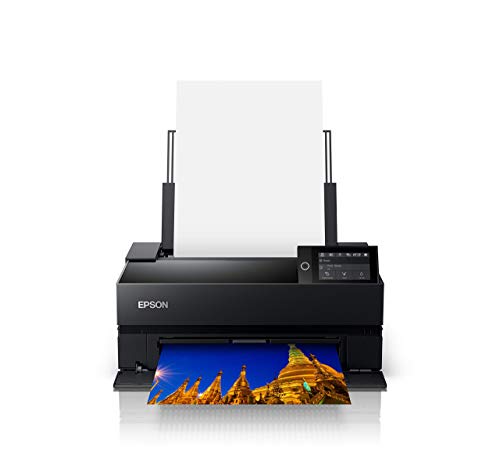
5. Epson SureColor P700 13-Inch Printer — Best Professional Photo/Art Printer
The Epson SureColor P700 occupies a different category than every other printer on this list — it's a professional-grade photo and fine-art printer that happens to handle 110lb cardstock with exceptional precision. If you're printing fine-art reproductions, photography prints, or high-end greeting cards where color accuracy and tonal range (the spectrum of light to dark values a printer can reproduce) matter at a professional level, the P700 delivers output that consumer inkjets simply cannot match. Its all-new UltraChrome PRO10 ink set includes a dedicated Violet ink channel that expands the color gamut (the range of colors a printer can reproduce) far beyond what 4-color or even 6-color systems can achieve, producing blues, purples, and greens with a richness and depth that's immediately visible on quality cardstock.
The 10-channel MicroPiezo AMC printhead (a precision piezoelectric system that controls each ink droplet with microscopic accuracy) means every print comes out with consistent dot placement across the full 13-inch width of the sheet — no banding, no uneven saturation, no weak spots in shadow areas. Dedicated nozzles for both Photo Black and Matte Black inks eliminate the ink-switching delay (a frustrating wait that occurs on printers that share a single nozzle between the two black ink types) that slows down other photo printers when you switch between glossy and matte cardstock. For professional photographers, gallery artists, and premium card designers, this is the printer that makes 110lb cardstock look as good as anything produced by a print lab. If you're comparing options at this tier, our roundup of the best photo printers under $200 covers the more budget-conscious end of the photo printing spectrum.
The P700 is not the right choice if you need an all-in-one or if you're primarily printing documents and occasional cardstock projects. It's a dedicated print-only machine with a premium price tag to match its output quality. But if the cardstock work you're producing needs to look professional — if people are paying you for it, displaying it, or making decisions based on how it looks — the P700 is the printer that justifies its cost every time you pull a finished sheet from the tray.
Pros:
- 10-channel UltraChrome PRO10 ink with Violet for an exceptionally wide color gamut
- Dedicated Photo Black and Matte Black nozzles — no switching delay between paper types
- MicroPiezo AMC printhead delivers consistent, banding-free output across 13-inch sheets
- Professional-grade color accuracy for fine-art and photography cardstock prints
Cons:
- Print-only — no scanner, copier, or fax
- Premium price point designed for professional use cases
6. Canon PIXMA TS9521Ca Wireless Home All-in-One Inkjet Printer — Best All-in-One for Crafters
The Canon PIXMA TS9521Ca is designed with crafters and home users in mind, and it shows in every detail of how it handles specialty media. The TS9521Ca's five individual ink system (which uses separate cartridges for each color including a dedicated photo black) means you only replace the color that runs out rather than discarding a partially full tri-color cartridge — a small thing that saves real money over time, especially when you're running cardstock printing projects in multiple colors. It prints at approximately 15 images per minute in black and 10 per minute in color, which is fast enough for home production batches of greeting cards or scrapbooking pages without the long waits associated with photo-quality inkjets.
Setup is genuinely fast — Canon's streamlined installation process gets you printing in minutes rather than the 30-to-45-minute ordeal some all-in-ones require, and the wireless connection is stable enough for regular home use without needing to reconnect frequently. The rear tray accepts 110lb cardstock via a straight paper path that minimizes bending stress on stiff sheets, and Canon's print quality on heavy media is clean and accurate with good color fidelity across the gamut. It copies and scans as well, making it a true all-in-one for the crafter who needs to digitize hand-drawn designs or reproduce existing artwork onto cardstock.
The TS9521Ca comes with a one-year limited warranty, which is standard for this category, and Canon's support resources are thorough and accessible. For crafters who print at moderate volume and want a machine that handles everything from everyday documents to specialty cardstock projects without requiring a dedicated workspace, the TS9521Ca strikes a balance between print quality, speed, and convenience that's hard to beat at its price point in 2026.
Pros:
- Five individual ink tanks reduce waste and lower per-project ink cost
- Fast print speeds (15 ppm black / 10 ppm color) for home production batches
- Streamlined setup gets you printing in minutes out of the box
- Full all-in-one: print, copy, and scan in one compact unit
Cons:
- Maximum paper size is limited compared to wide-format competitors
- No fax functionality for users who still need that capability
7. Canon PIXMA TR8620a All-in-One Printer — Best Compact All-in-One
The Canon PIXMA TR8620a rounds out our list as the most compact full-featured option for users who need to print on 110lb cardstock but don't have space for a larger machine. The TR8620a is a wireless 4-in-1 covering print, copy, scan, and fax, and it adds Alexa integration that no other printer on this list includes — you can receive spoken ink-level alerts and even have Alexa place an automatic smart reorder from Amazon when your ink runs low, without needing a subscription. That kind of hands-free ink management is genuinely useful when you're in the middle of a cardstock project and notice the magenta is getting light after you've already started.
The TR8620a feeds 110lb cardstock through its rear straight-path tray, which handles the stiffness of thick stock without the buckling that curved paper paths cause. Canon's print quality here is consistent with what you get from the rest of the PIXMA lineup — accurate color reproduction, sharp text, and clean photo output on glossy or matte cardstock surfaces. The auto document feeder handles multi-page scan and copy jobs without manual feeding, and the touchscreen panel makes settings adjustments fast and intuitive. Alexa compatibility via smart reorders requires enrollment but no ongoing subscription, which keeps the ongoing cost predictable.
The TR8620a is the right choice for users who want a capable, space-efficient all-in-one that handles cardstock printing as part of a broader home or home office workflow rather than as the primary use case. If your cardstock runs are occasional — birthday cards, event invitations, thank-you notes — and you want a machine that also handles everything else you print, copy, scan, and fax without occupying a large corner of your desk, the TR8620a delivers solid all-around performance in a compact package.
Pros:
- Alexa integration for hands-free ink monitoring and automatic smart reorders
- Compact footprint fits on small desks and home office setups easily
- Auto document feeder for efficient multi-page copy and scan jobs
- Full 4-in-1 functionality: print, copy, scan, and fax
Cons:
- Not designed for wide-format cardstock beyond standard sizes
- Alexa smart reorder requires Amazon account enrollment to use
Key Features to Consider When Choosing a Printer for 110lb Cardstock
Paper Path Design
The single most important feature to evaluate when you're buying a printer specifically for 110lb cardstock is the paper path — the physical route the sheet takes from the input tray to the output tray. Printers that route paper in a tight curve through the machine (common in compact laser printers and many consumer inkjets) place significant bending stress on stiff, thick cardstock, which leads to paper jams, misfeeds, and damaged sheets. A straight-through rear paper path is what you need for reliable 110lb cardstock feeding — the sheet enters the back of the printer and travels in nearly a straight line to the output at the front or top, experiencing minimal flex. Every printer on this list offers some form of straight-path rear feeding, but the width and capacity of that rear slot varies, so check the manufacturer's specifications for maximum supported media weight before you buy.
Maximum Paper Size
If your cardstock projects are limited to standard sizes — 5×7 cards, letter-size sheets, A4 — almost any inkjet printer with a rear manual feed will work. But if you're printing large invitations, art prints, scrapbooking pages, or anything approaching 13×19 inches (also called Super B or tabloid-plus size), you need a wide-format printer. The Epson WF-7720 and the Epson EcoTank ET-16650 are the clear choices on this list for wide-format cardstock work, and the Canon iX6820 and Epson SureColor P700 also support up to 13-inch width. Standard all-in-ones like the Brother MFC-J4355DW and the Canon TR8620a top out at letter or legal size — fine for most projects, but not for oversized work.
Ink Type: Pigment vs. Dye
Inkjet printers use one of two fundamental ink chemistry types, and the difference matters for cardstock output. Dye-based inks (the more common type in consumer inkjets) produce vivid, saturated colors but can bleed slightly on porous cardstock surfaces and are more vulnerable to water and handling. Pigment-based inks sit on top of the paper surface rather than soaking in, which produces sharper edges, better water resistance, and output that holds up better when you're handling finished cards frequently. The Epson EcoTank ET-16650 and the SureColor P700 use pigment inks — a meaningful advantage if your cardstock prints will be touched, mailed, or displayed. If you're using glossy cardstock with a smooth coating, dye inks often look more vivid, so the best choice depends on your specific stock and project type.
Cost Per Page and Ink Economy
Cardstock printing costs more per sheet than plain paper printing because thick media consumes more ink to achieve full surface coverage, and the sheets themselves cost more than copy paper. When you're evaluating printers for regular cardstock work, look beyond the upfront machine price and calculate the ongoing ink cost. Cartridge-based printers (Canon PIXMA models, the Epson WF-7720, Brother INKvestment) cost more per page than tank-based systems but have lower entry prices. The Epson EcoTank ET-16650's refillable tank system dramatically lowers per-page cost — around 2 cents per color page versus 14 cents for cartridge systems — which makes it the economical choice for high-volume users even though it costs more to buy. If you print fewer than 50 cardstock sheets per month, a cartridge printer is likely the better financial decision; above that volume, the EcoTank math starts to favor the tank system.
Questions Answered
Can any inkjet printer print on 110lb cardstock?
Not all inkjet printers can handle 110lb cardstock reliably. The key requirements are a rear manual feed slot with a straight paper path, support for media weights up to at least 300 gsm (grams per square meter, the metric equivalent of 110lb cover stock), and a printhead assembly that doesn't require the paper to bend around tight rollers. Printers that only have a front-loading cassette tray typically cannot feed 110lb stock without jamming. Always check the manufacturer's media specification sheet for the maximum supported paper weight before attempting to print on heavy cardstock.
What is the difference between 110lb cover stock and 110lb text weight paper?
This is a common source of confusion because the pound weight system for paper uses different basis sizes for text and cover stock, making the numbers incomparable directly. 110lb cover stock is significantly heavier and stiffer than 110lb text weight paper — it's approximately equivalent to 298 gsm, while 110lb text is only around 163 gsm. When people refer to 110lb cardstock for printing, they almost always mean 110lb cover weight, which is the thick, stiff material used for greeting cards, business cards, and invitations. Confirm which weight category your paper falls into before selecting printer settings, since the wrong media setting can cause ink adhesion problems on the surface.
Do laser printers work better than inkjets for 110lb cardstock?
Laser printers use heat and pressure to fuse toner onto paper, and that heat can cause 110lb cardstock to warp, curl, or crack along the fold lines — especially on glossy or coated stock. Inkjet printers apply liquid ink without heat, which makes them generally safer and more reliable for thick cardstock printing, particularly on coated and glossy surfaces. There are some heavy-duty laser printers designed for thick media, but at the consumer and prosumer price levels covered in this guide, inkjet technology is the more practical choice for 110lb cardstock work. For comparison, our guide to the best laser printers for PCB covers cases where laser printing on specialty substrates makes more sense.
What printer settings should I use for 110lb cardstock?
Select the heaviest paper type available in your printer's media settings — typically labeled "Cardstock," "Heavy Paper," or "Thick Paper." This setting adjusts the ink volume, drying time, and paper feed speed to match the demands of heavy stock. If your printer offers a straight-path or rear-feed mode as a separate setting, enable it. Set print quality to "High" or "Best" to ensure full ink coverage across the surface of the cardstock, and allow printed sheets to dry for at least 60 seconds before stacking them to prevent ink transfer between sheets. For double-sided printing on 110lb stock, print one side first, allow it to dry completely, then manually flip and feed for the second side.
Can I print borderless on 110lb cardstock?
Borderless printing on 110lb cardstock is possible on printers that support it, but it requires specific conditions. Your printer must explicitly support borderless printing on heavy media — not all printers that offer borderless printing on photo paper extend that capability to thick cardstock. The Epson WorkForce WF-7720 and the Epson EcoTank ET-16650 both support borderless printing up to 13×19 inches, including on heavy media when you use the appropriate paper settings. Feed sheets one at a time through the rear manual tray for borderless cardstock work rather than loading a stack, since misfeeds are more likely to happen during borderless jobs where the margins are tight.
How do I prevent paper jams when printing on 110lb cardstock?
The most reliable way to prevent jams is to feed cardstock one sheet at a time through the rear manual feed slot rather than loading a stack in the main tray. Fan the sheets before loading to separate any that are stuck together, and make sure the paper guides in the rear tray are snug against the edges of the sheet without squeezing it. Set the paper type in your printer software to the heaviest available option so the machine adjusts its feed speed and roller pressure accordingly. If your printer has a paper weight adjustment lever (some rear trays include one), set it to the heavy or cardstock position. Clean the feed rollers with a slightly damp lint-free cloth periodically if you experience repeated misfeeds, since dust and paper coating residue accumulate on rollers over time.
Buy on Walmart
- Canon Pixma iX6820 Wireless Business Printer with AirPrint a — Walmart Link
- Epson WorkForce WF-7720 Wireless Wide-format Color Inkjet Pr — Walmart Link
- Brother INKvestment 4355 Wireless Color Inkjet All-in-One Pr — Walmart Link
- Epson EcoTank Pro ET-16650 Wireless Wide-Format Color All-in — Walmart Link
- Epson SureColor P700 13-Inch Printer,Black — Walmart Link
- Canon PIXMA TS9521Ca – Wireless Home All-in-One Inkjet Print — Walmart Link
- Canon PIXMA TR8620a - All-in-One Printer Home Office|Copier| — Walmart Link
Buy on eBay
- Canon Pixma iX6820 Wireless Business Printer with AirPrint a — eBay Link
- Epson WorkForce WF-7720 Wireless Wide-format Color Inkjet Pr — eBay Link
- Brother INKvestment 4355 Wireless Color Inkjet All-in-One Pr — eBay Link
- Epson EcoTank Pro ET-16650 Wireless Wide-Format Color All-in — eBay Link
- Epson SureColor P700 13-Inch Printer,Black — eBay Link
- Canon PIXMA TS9521Ca – Wireless Home All-in-One Inkjet Print — eBay Link
- Canon PIXMA TR8620a - All-in-One Printer Home Office|Copier| — eBay Link
Key Takeaways
- The Epson WorkForce WF-7720 is the best overall choice for printing on 110lb cardstock in 2026, delivering wide-format borderless output up to 13×19 inches with laser-sharp PrecisionCore quality.
- For professional photographers and fine-art printers, the Epson SureColor P700 offers 10-channel pigment ink with a dedicated Violet channel that produces color accuracy no consumer inkjet can match on heavy cardstock.
- High-volume cardstock printers — Etsy sellers, event planners, and home crafters who print regularly — save the most money over time with the Epson EcoTank ET-16650, whose refillable tank system cuts per-page cost to around 2 cents versus 14 cents for cartridge printers.
- A straight-through rear paper path is the single most important hardware feature to look for in any printer you plan to use regularly with 110lb cardstock, regardless of brand or price point.



About Chris & Marry
Chris and Mary are a couple with a shared background in graphic design and print production who have spent years working with printers across creative and professional contexts — from art printing and photo output to label production and professional document work. Their combined experience evaluating printer performance, color accuracy, and paper handling across inkjet and laser platforms gives them a practical, hands-on perspective on what makes a printer worth buying. At ShopChrisAndMary, they cover printer reviews, buying guides, and recommendations for artists, photographers, and professional users.
Time to get FREE Gifts. Or latest Free printers here.
Disable Ad block to reveal all the info. Once done, hit a button below