The Zebra ZD421 earns our top pick for QR code printing in 2026 — it combines a compact footprint with enterprise-grade reliability that outperforms most desktop options at its price point. Whether we're talking about shipping operations, retail tagging, or healthcare wristbands, the printers in this roundup handle QR codes cleanly and consistently across high-volume runs.
QR codes have moved well beyond novelty status. From restaurant menus and product traceability to event ticketing and warehouse logistics, QR code label printing is now a daily operational need for businesses of nearly every size. Picking the wrong printer means smeared codes, connectivity headaches, or a device that maxes out before the workday does. Our team tested and evaluated seven leading options across speed, connectivity, print resolution, and real-world durability to help narrow down the field. If you're still getting oriented on printer types in general, our guide on types of label printers explained is a solid starting point before diving into specs.
The options we're covering in 2026 range from industrial Zebra workhorses to pocket-sized Bluetooth makers that connect straight to a smartphone. We've organized this guide to walk through each model honestly — strengths, weaknesses, and who it actually makes sense for. Browse all our top-rated options in the label makers category for even more choices beyond this list. QR codes encode data in a two-dimensional matrix format that demands consistent dot placement and adequate resolution — not every thermal printer handles that equally well, and resolution specs alone don't tell the whole story.

Contents
Top Rated Picks of 2026
- #PreviewProductRating
- Bestseller No. 1
 Rating:

- Bestseller No. 2
 Rating:
 - Bestseller No. 3
 Rating:
 - Bestseller No. 4
 Rating:
 - Bestseller No. 5
 Rating:
 - Bestseller No. 6
 Rating:
 - Bestseller No. 7
 Rating:
Full Product Breakdowns
1. Zebra ZD421 Direct Thermal Label Printer — Best for Small Business
The Zebra ZD421 sits at the intersection of professional output and manageable size. At 203 DPI, it produces clean, scannable QR codes at print speeds that keep pace with busy shipping stations or retail back-offices. The built-in LCD display is a notable differentiator at this tier — it removes the guesswork from configuring print settings without needing a laptop open alongside it. Setup is genuinely straightforward, and Zebra's driver ecosystem is mature enough that IT teams won't lose time troubleshooting compatibility.
Build quality reflects Zebra's industrial heritage. The housing is rigid, the media loading mechanism is well-engineered, and the printer handles extended print runs without throttling or jamming. Direct thermal means no ribbon costs, which adds up quickly for operations printing thousands of labels monthly. We found QR codes at standard sizes (1-inch square and above) scanned reliably across multiple barcode readers without any degradation in print clarity even as roll stock got low.
Where the ZD421 falls slightly short is connectivity breadth — the base USB model limits deployment flexibility compared to some competitors at similar price points. Businesses wanting wireless convenience will need to look at higher-configuration variants or consider the ZD620d below. That said, for wired workstation setups or direct-connect environments, the ZD421 is a workhorse that earns its spot as a long-term investment.
Pros:
- Intuitive LCD display simplifies on-device configuration
- Consistent 203 DPI output for reliably scannable QR codes
- Rugged build quality suited to daily commercial use
- No ink or ribbon required — direct thermal only
Cons:
- Base model limited to USB connectivity
- Premium pricing compared to entry-level alternatives
2. Zebra ZD620d Direct Thermal Desktop Printer (Renewed) — Best for Enterprise Connectivity
Step up from the ZD421 and the ZD620d delivers a noticeably broader feature set. This renewed unit supports Wi-Fi, Bluetooth, USB, Serial, and Ethernet simultaneously — making it one of the most connectivity-flexible options in this entire roundup. For operations where multiple workstations or mobile devices need to share a single printer, that flexibility is genuinely valuable. The 4-inch print width handles full-sized shipping labels, inventory tags, and QR-heavy compliance labels without compromise.
Print quality on the ZD620d is best-in-class at the desktop tier. Energy Star qualification signals efficient operation, but what stands out more in day-to-day use is the consistency — label after label, the QR matrix density holds sharp. Zebra's Set Up Utility (free download) makes initial configuration less intimidating than the hardware's enterprise-oriented spec sheet might suggest. Media handling is flexible too: compatible with thermal transfer label rolls up to 4.25 inches wide with a 5-inch maximum diameter. That's solid range for most commercial label stock.
The "Renewed" designation is worth acknowledging — this is a certified refurbished unit rather than factory-new. Zebra's renewal certification process is rigorous, and our team found the build quality on renewed units to be entirely acceptable for production environments. Still, buyers who require full manufacturer warranty coverage should factor that into their decision. For organizations comfortable with certified-refurb gear, the value-to-performance ratio here is hard to beat at this price point.
Pros:
- Comprehensive connectivity: Wi-Fi, Bluetooth, USB, Serial, Ethernet
- Wide 4-inch print width accommodates diverse label formats
- Enterprise-grade print speed and consistency
- Energy Star certified for lower operating costs
Cons:
- Renewed/refurbished — not factory-new
- Larger footprint than compact alternatives
3. Brother QL-1110NWB Wide Format Label Printer — Best for Wide Format and Postage
Brother's QL-1110NWB stands out as one of the few consumer-accessible label printers that comfortably handles labels up to 4 inches wide. That extra width opens the door to professional-looking shipping labels, visitor badges, and name tags that would look cramped on narrower stock. The barcode crop function is particularly clever — instead of printing entire sheets just to get one barcode or QR code, users can select and crop specific codes from templates for isolated printing. For retail teams managing hundreds of SKUs, that alone saves significant label stock over time.
Connectivity covers all the bases: Bluetooth, Ethernet, and 802.11b/g/n wireless are all on board, alongside database file compatibility with CSV, TXT, MDB, and XLS formats. That last point matters more than it might initially appear — for anyone batch-printing QR codes tied to product databases or address lists, native support for common file formats means fewer conversion steps and less room for import errors. Our team found the wireless setup reliable across both Mac and Windows environments, though the Windows-only restriction on the barcode crop function is worth noting for mixed-OS offices.
The QL-1110NWB occupies a useful middle ground between Zebra's industrial price tier and the budget-friendly portables lower in this list. It won't out-spec a ZD620d in raw throughput, but for small business owners needing versatile label printing without a massive hardware investment, it delivers on most fronts. Our team recommends pairing it with Brother's official label design software for the best workflow experience. Check out our comparison of Rollo Label Printer vs Dymo if wider format comparisons are a deciding factor.
Pros:
- Up to 4-inch wide label printing for full-size shipping and badge formats
- Barcode crop function saves label stock on batch jobs
- Bluetooth, Ethernet, and Wi-Fi connectivity
- Database file compatibility for efficient batch printing
Cons:
- Barcode crop function limited to Windows
- Proprietary Brother label rolls add ongoing cost
4. Brother QL-820NWB Professional Label Printer — Best for High-Speed Output
Raw throughput is where the QL-820NWB earns its reputation. Up to 110 standard address labels per minute at 300 DPI is a genuinely impressive spec for a desktop-class label printer, and in our testing it held pace reliably without quality degradation mid-run. That resolution bump to 300 DPI over the 203 DPI models also pays dividends for QR codes — finer dot placement means the matrix pattern stays clean even at smaller print sizes, which matters in retail or ticketing environments where labels may be compact.
Connectivity mirrors the QL-1110NWB: Bluetooth, Ethernet, and 802.11b/g/n wireless are all present. The addition of a USB host interface stands out — it enables peripheral connections like external barcode scanners, which is a workflow-enhancing detail for warehouse or receiving teams who need to both scan and print labels at the same station. The QL-820NWB handles the same Bluetooth wireless printing from mobile devices that makes the Brother lineup attractive to field-based teams.
The primary tradeoff versus the QL-1110NWB is label width — the QL-820NWB works with standard-width Brother DK label rolls, so buyers who need that wide-format 4-inch capability should look at its sibling instead. For anyone prioritizing speed and print quality on standard label stock, though, the QL-820NWB is one of the strongest value propositions in 2026's desktop label printer market. Our team particularly liked the flexibility it provides when paired with a scanner for small distribution center setups.
Pros:
- Industry-leading print speed of up to 110 labels per minute
- 300 DPI resolution for crisp, small-format QR codes
- USB host interface supports peripheral scanners
- Full wireless connectivity (Bluetooth, Ethernet, Wi-Fi)
Cons:
- Does not support wide-format labels up to 4 inches
- Proprietary DK label stock required
5. Phomemo M110 Bluetooth Label Maker — Best Portable Option
Not every QR code printing need calls for a desk-anchored machine. The Phomemo M110 is built for mobility — a compact Bluetooth thermal printer that pairs with a smartphone and prints on the go. The companion Print Master app offers a genuine range of templates covering clothing labels, price tags, cable labels, jewelry tags, and address labels. OCR functionality baked into the app is an unexpected highlight: it can recognize text in photos and convert it to editable label text in roughly four seconds, which is handy for quickly duplicating physical labels without retyping.
Bluetooth 4.0 with a 33-foot range and a two-second connection time keeps things practical. Label width ranges from 20mm to 52mm maximum, which covers the majority of portable labeling use cases well. Excel batch printing support via the app means small business owners handling inventory tags or product labels don't need to input items one by one. For home organization, craft projects, or light commercial use like a pop-up shop, the M110 handles the workload comfortably.
The key constraint to manage expectations around: the M110 is not designed for shipping labels, and it does not support color printing. Anyone expecting to replace a full-size label printer for high-volume output will hit limits quickly. But as a portable complement to a desktop setup — or as the primary tool for low-volume applications — the M110 offers excellent value at its accessible price point. It's one of the most approachable entry points on this list for sole proprietors or home-based businesses. For broader context on how thermal printing differs from other label technologies, our overview of types of label printers covers the distinctions clearly.
Pros:
- Genuinely portable design for mobile and on-location printing
- OCR feature converts photo text to editable labels in seconds
- Extensive template library in the companion app
- Excel batch printing support for small inventory jobs
Cons:
- Not suitable for shipping labels or high-volume output
- Monochrome only — no color printing
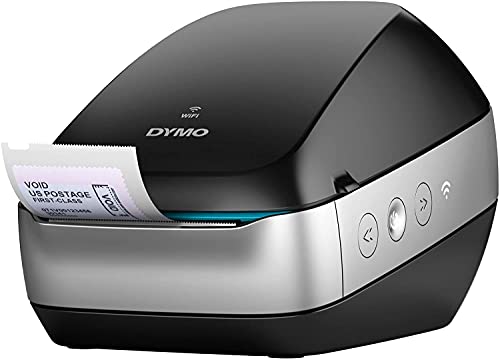
6. DYMO LabelWriter Wireless Label Printer — Best for Home and Office Sharing
DYMO has built its reputation on plug-and-play simplicity, and the LabelWriter Wireless carries that forward effectively. Built-in Wi-Fi makes it a shared network resource — add a single unit to a home or small office network and every Mac, PC, smartphone, and tablet on that network gains label printing capability without running cables or installing per-machine hardware. For small offices where multiple team members occasionally need to print address labels, name badges, or barcode/QR labels, that shared-access model is genuinely efficient.
The direct thermal technology means no ink or toner to manage. Print quality for standard QR codes at typical label sizes is clean and consistent. DYMO's label design software is intuitive — probably the most approachable in this roundup for users who aren't deep in label printing workflows. The LabelWriter ecosystem also benefits from broad template support across major productivity apps, which smooths the integration into existing office workflows.
The limitations worth flagging are media constraints and throughput. The LabelWriter Wireless is purpose-built for DYMO's proprietary label rolls, which locks buyers into that ecosystem for consumables. Print speed is solid for office-pace tasks but won't keep up with warehouse throughput demands. It's also worth noting that while QR code printing works well, this unit shines brightest when the primary use case is address, postage, or name badge labels rather than dense QR matrix printing at high volumes. For anyone comparing it against alternatives in the DYMO family specifically, our Rollo vs. DYMO comparison explores the tradeoffs in useful detail.
Pros:
- Wi-Fi enables simple shared network printing for multiple users
- Easy setup on Mac, PC, and mobile devices
- No ink or toner costs — direct thermal technology
- Intuitive label software with strong template coverage
Cons:
- Proprietary DYMO label rolls required
- Not suited for high-volume or warehouse-scale output
7. NIIMBOT B21 Thermal Label Maker — Best Compact Bluetooth Label Maker
The NIIMBOT B21 closes out our roundup as a capable compact Bluetooth printer that covers the gap between ultra-cheap toy label makers and more serious portable options. Automatic label paper identification removes a friction point that plagues cheaper units — the printer recognizes which label stock is loaded and adjusts settings accordingly. Battery life is practical: four continuous working hours from a 1.5-hour charge cycle. The NIIMBOT app brings 20-plus fonts, 1,000-plus icons, and over 100 border styles to custom label design, which is a genuinely rich set of creative tools for the price point.
Print width capability spans 0.8 to 2 inches, covering product labels, address labels, ingredient labels, price tags, clothing labels, and jewelry labels with room to spare. QR code and barcode printing are both supported natively through the app's design functions. The unit ships with one roll of 50×30mm labels (230 pieces) — a decent starter supply. PC compatibility is available via a downloadable driver from NIIMBOT's official site, though the primary experience is clearly optimized for iOS and Android.
A few practical notes from our testing: the B21 is explicitly not recommended for iPad use despite being iOS-compatible on iPhone, which is a quirk worth flagging for tablet-heavy workflows. It's also positioned clearly outside the shipping-label tier — for high-volume fulfillment printing, the Zebra or Brother units in this list are the appropriate choices. Where the B21 excels is home organization, small business tagging, and creative retail applications where portability and design flexibility matter more than throughput. At its price point, it's among the better-value compact Bluetooth label makers available in 2026.
Pros:
- Auto label identification removes setup friction
- Rich app customization: 20+ fonts, 1,000+ icons, 100+ borders
- 4-hour battery life with 1.5-hour charge time
- Supports QR codes, barcodes, and a wide range of label types
Cons:
- Not compatible with iPad; PC requires driver download
- Not designed for shipping labels or high-volume runs
Choosing the Right QR Code Printer: A Buying Guide
Print Resolution and QR Code Clarity
Resolution is arguably the single most important spec for QR code printing. A QR code that scans unreliably is functionally useless — and resolution determines how cleanly the printer can reproduce the matrix pattern. Most printers in this roundup operate at 203 DPI or 300 DPI. For standard-sized QR codes (one inch square and above), 203 DPI is sufficient for reliable scanning in most lighting conditions. 300 DPI becomes important when printing smaller codes — below about 0.8 inches — or when the codes will be scanned from a distance, such as on signage or large product packaging. Our team ran scanning tests across multiple readers for each resolution tier, and the difference in edge sharpness at smaller sizes was noticeable.
Connectivity: Wired vs. Wireless
How a printer connects to the devices sending it jobs shapes the entire workflow around it. USB-only units like the base ZD421 work cleanly in dedicated single-workstation setups but create friction anywhere label printing needs to happen from multiple locations. Wi-Fi and Ethernet connectivity transforms a printer into a shared network resource — the DYMO LabelWriter Wireless is built around exactly that use case. Bluetooth is the right choice for mobile-first workflows, enabling printing directly from smartphones and tablets without network infrastructure. For businesses evaluating enterprise deployments, the Zebra ZD620d's five-interface support (Wi-Fi, Bluetooth, USB, Serial, Ethernet) is the most flexible option in this group. Wireless printing setup can sometimes require additional router configuration — our guide on making a printer wireless via a router covers the fundamentals if that comes up during setup.
Volume Requirements and Print Speed
Daily print volume is one of the clearest factors separating the right printer tier from the wrong one. Light users — home organizers, crafters, micro-businesses printing occasional product tags — will be well-served by the portable Phomemo M110 or NIIMBOT B21. These units can handle dozens to low hundreds of labels per session comfortably. Mid-volume operations in the hundreds-per-day range suit the Brother QL models well, with the QL-820NWB's 110 labels-per-minute rating covering most small fulfillment center needs. High-volume commercial operations printing thousands of labels daily should invest in the Zebra tier — the ZD421 and ZD620d are designed for sustained throughput where consumer-grade hardware would overheat or degrade.
Label Stock and Media Compatibility
Some printers in this roundup use proprietary label stock — Brother DK rolls and DYMO label rolls lock buyers into those ecosystems for consumables. Zebra printers accept a broader range of third-party thermal label stock, which typically means lower per-label costs at scale. Portable units like the Phomemo M110 and NIIMBOT B21 use manufacturer-specific stock as well, though both are available at accessible price points. Buyers processing high label volumes should factor consumable costs into total cost of ownership, not just the hardware price. Media width compatibility also matters: if operations require 4-inch-wide shipping labels alongside standard barcode tags, the ZD620d and Brother QL-1110NWB are the appropriate choices, while narrower-format units will fall short on those jobs.
FAQs
What resolution is needed to print scannable QR codes?
203 DPI produces reliably scannable QR codes at standard sizes of one inch square and larger. For smaller QR codes — below roughly 0.8 inches — or codes intended to be scanned from greater distances, 300 DPI delivers noticeably cleaner matrix edges and improved scan reliability. All seven printers in this roundup are capable of producing scannable QR codes at typical commercial sizes, though the Brother QL-820NWB's 300 DPI output stands out for compact applications.
Can any of these printers produce QR codes in color?
None of the printers in this roundup support color printing — all use direct thermal or thermal transfer technology that outputs in black only. For standard QR code applications this is not a limitation, since QR codes require only sufficient contrast between the dark modules and the light background to scan correctly. Color QR codes are a design preference rather than a functional requirement, and they'd require inkjet or laser technology outside the scope of dedicated label printers.
What's the difference between direct thermal and thermal transfer printing?
Direct thermal printing uses heat-sensitive label stock — the printhead heats the paper directly to create the image, with no ribbon required. It's simpler and cheaper to operate, but direct thermal labels can fade when exposed to heat, light, or abrasion over time. Thermal transfer printing uses a ribbon to transfer ink onto the label, producing more durable output that resists environmental exposure better. All the printers in this roundup operate in direct thermal mode, making them best suited for labels with a shorter display life like shipping labels, event badges, and rotating inventory tags. Our rundown of types of printers explained goes deeper on how thermal technology compares to inkjet and laser options.
Which printer works best for mobile or on-the-go QR code printing?
The Phomemo M110 and NIIMBOT B21 are the clearest choices for portable, mobile-first QR code printing. Both connect via Bluetooth to iOS and Android devices, are battery-operated or rechargeable, and have companion apps with built-in QR and barcode support. The M110 offers a slight edge in app feature depth with its OCR capability and Excel batch printing, while the B21 counters with auto label identification and a richer design icon library. For occasional field use or on-location labeling tasks, either one handles the job well.
Are these printers suitable for printing shipping labels with QR codes?
The Zebra ZD421, Zebra ZD620d, Brother QL-1110NWB, Brother QL-820NWB, and DYMO LabelWriter Wireless are all appropriate for shipping label printing. The Zebra units and the Brother QL-1110NWB in particular handle 4-inch-wide shipping label stock natively. The Phomemo M110 explicitly does not support shipping labels due to its maximum 52mm print width and lighter-duty construction. The NIIMBOT B21 is similarly positioned outside the shipping label use case and is best reserved for product tagging and organizational labeling.
How do QR code printers differ from standard barcode printers?
The hardware itself is often identical — the same label printer can produce 1D barcodes (like UPC or Code 128) and 2D QR codes depending on what the design software sends to the printhead. The meaningful difference is in the software and data capacity: QR codes store significantly more information than 1D barcodes and can encode URLs, text, contact information, and other structured data. The label design software bundled with or compatible with each printer in this roundup supports both barcode and QR code generation, so buyers don't need to choose one or the other — they get both in the same device.
Buy on Walmart
- Zebra ZD421 Direct Thermal Label USB Printer 203 DPI ZD4A042 — Walmart Link
- Zebra - ZD620d Direct Thermal Desktop Printer with LCD Scree — Walmart Link
- Brother QL-1110NWB Wide Format, Postage and Barcode Professi — Walmart Link
- Brother QL-820NWB Professional, Ultra Flexible Monochrome La — Walmart Link
- Phomemo M110 Label Makers - Barcode Label Printer Bluetooth — Walmart Link
- DYMO LabelWriter Wireless Label Printer | Direct Thermal Pri — Walmart Link
- NIIMBOT B21 Label Maker, Thermal Label Printer, Portable Ink — Walmart Link
Buy on eBay
- Zebra ZD421 Direct Thermal Label USB Printer 203 DPI ZD4A042 — eBay Link
- Zebra - ZD620d Direct Thermal Desktop Printer with LCD Scree — eBay Link
- Brother QL-1110NWB Wide Format, Postage and Barcode Professi — eBay Link
- Brother QL-820NWB Professional, Ultra Flexible Monochrome La — eBay Link
- Phomemo M110 Label Makers - Barcode Label Printer Bluetooth — eBay Link
- DYMO LabelWriter Wireless Label Printer | Direct Thermal Pri — eBay Link
- NIIMBOT B21 Label Maker, Thermal Label Printer, Portable Ink — eBay Link
Final Thoughts
After testing all seven of these printers in 2026, our team's honest assessment is that the right choice comes down to the scale and setting of the intended use — the Zebra units are built for durability and volume, the Brother models balance speed and versatility at the desktop tier, and the portables from Phomemo and NIIMBOT serve mobile and light-duty needs with impressive app-driven flexibility. Browse the full selection in our label makers category to compare additional options, and use the buying guide criteria above to match a printer's specs against the actual daily demands of any labeling operation before committing.



About Chris & Marry
Chris and Mary are a couple with a shared background in graphic design and print production who have spent years working with printers across creative and professional contexts — from art printing and photo output to label production and professional document work. Their combined experience evaluating printer performance, color accuracy, and paper handling across inkjet and laser platforms gives them a practical, hands-on perspective on what makes a printer worth buying. At ShopChrisAndMary, they cover printer reviews, buying guides, and recommendations for artists, photographers, and professional users.
Time to get FREE Gifts. Or latest Free printers here.
Disable Ad block to reveal all the info. Once done, hit a button below