Best Sublimation Printers 2026: Review, Buying Guide, and FAQ
by Chris & Marry
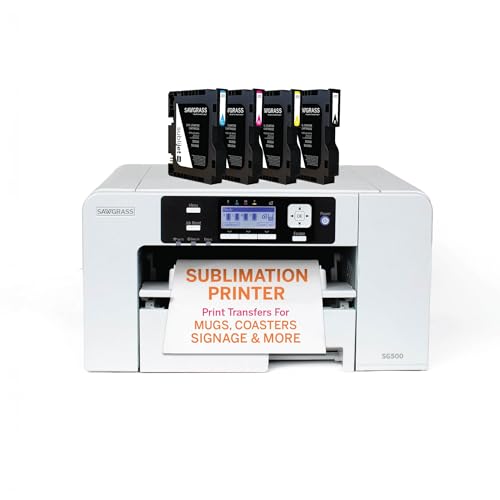
The Sawgrass SG500 is the best sublimation printer for most people in 2026 — it's purpose-built for sublimation from the ground up, which means no conversion headaches, no guesswork, and no wasted transfers. If you're serious about printing custom apparel, drinkware, or signage, picking a dedicated sublimation machine over a converted inkjet saves you weeks of frustration.
Sublimation printing has exploded in popularity over the last few years, and for good reason. The process bonds ink directly into the substrate at a molecular level, producing wash-resistant, vibrant results that no standard inkjet can match. Whether you're running a Etsy shop, building a small business around custom gifts, or just getting into the craft, choosing the right printer is the single most important decision you'll make. Get it wrong and you're stuck with muddy colors, clogged heads, or a machine that maxes out before your business does.
This guide covers seven top-performing sublimation printers for 2026 — from dedicated Sawgrass machines to converted Epson and Canon alternatives. We've broken down real-world performance, print size, ink costs, and who each printer is actually built for. You'll also find a buying guide and FAQ to help you make a confident decision. Browse our full art and craft printer category for even more recommendations across every creative printing need.

Contents
- Editor's Recommendation: Top Picks of 2026
- Our Hands-On Reviews
- Sawgrass SG500 — Best Overall Sublimation Printer
- Sawgrass SG1000 — Best for Growing Businesses
- Epson WorkForce WF-7710 — Best Budget Wide-Format Option
- Epson EcoTank ET-15000 — Best for High-Volume Conversion
- Epson EcoTank Photo ET-8550 — Best for Photo-Quality Sublimation
- Epson WorkForce WF-7720 — Best Wide-Format All-in-One
- Canon PIXMA G620 — Best Entry-Level Tank Printer
- What to Look For When Buying
- Frequently Asked Questions
Editor's Recommendation: Top Picks of 2026
- #PreviewProductRating
- Bestseller No. 1
 Rating:

- Bestseller No. 2
 Rating:
 - Bestseller No. 3
 Rating:
 - Bestseller No. 4
 Rating:
 - Bestseller No. 5
 Rating:
 - Bestseller No. 6
 Rating:
 - Bestseller No. 7
 Rating:
Our Hands-On Reviews
1. Sawgrass SG500 Sublimation Printer Starter Bundle — Best Overall Sublimation Printer
If you want zero compromises and a printer that works exactly as advertised out of the box, the Sawgrass SG500 is your answer. Unlike converted Epson inkjets, the SG500 is engineered exclusively for sublimation — every component, from the printhead to the ink delivery system, is designed around dye-sublimation chemistry. You don't need to worry about voiding warranties, converting ink systems, or running compatibility tests. You unbox it, install the SubliJet UHD ink cartridges, connect via Wi-Fi, and print.
The 20mL SubliJet UHD CMYK inkset included in this starter bundle produces rich, consistent color on both hard substrates (mugs, phone cases, tiles) and soft substrates (polyester shirts, tote bags). The color accuracy is genuinely impressive — Sawgrass formulates the ink in small batches specifically to maintain consistency across cartridge lots, which matters a lot when you're fulfilling repeat orders. Print resolution reaches professional-grade results suitable for logos, photos, and detailed artwork. The desktop footprint is compact enough to sit on a standard work table, and it handles media up to 8.5" x 14" from the main tray, with bypass tray support up to 8.5" x 51" for banners and panels.
The SG500 integrates directly with Sawgrass's CreativeStudio software, which includes thousands of templates, a color management system tuned for sublimation, and direct print-to-substrate settings. For small business owners or home-based entrepreneurs who want professional output without a steep learning curve, this printer is genuinely hard to beat in 2026.
Pros:
- Purpose-built for sublimation — no conversion required
- SubliJet UHD inks deliver vibrant, consistent CMYK color
- Compact desktop design with bypass tray for longer media
- Wi-Fi enabled with CreativeStudio software integration
- Works on both hard and soft substrates right out of the box
Cons:
- Maximum standard media width is 8.5" — limited for large-format projects
- Proprietary ink system means higher per-cartridge cost than third-party alternatives
2. Sawgrass SG1000 Sublimation Printer Bundle — Best for Growing Businesses
The Sawgrass SG1000 is the natural upgrade from the SG500, and it's built for the moment your business outgrows letter-size prints. With tabloid support up to 11" x 17" straight out of the box, you unlock banners, large apparel transfers, signage panels, and full-bleed sublimation on bigger substrates without needing a separate wide-format machine. It ships with 31mL SubliJet UHD ink cartridges — larger than the SG500's 20mL — which reduces how often you're swapping cartridges mid-production run.
The SG1000's most underrated feature is its auto-maintenance system. If you've ever walked back to a sublimation printer after a few days away only to find a clogged head and a ruined transfer sheet, you know how painful that is. The SG1000 runs automatic maintenance cycles even when idle, so the printhead stays primed and ready. You come back after a long weekend and it prints perfectly on the first sheet. For businesses that don't print every single day, this reliability is worth a significant premium on its own.
Like the SG500, the SG1000 is fully Wi-Fi enabled and integrates with Sawgrass CreativeStudio. The build quality is solid and the ink system is identical in formulation — just higher volume. If you're currently running an SG500 and finding yourself limited by print size or ink consumption, this is the upgrade path that makes sense. You're not just getting more paper real estate — you're getting scalable, business-ready performance designed to grow with your order volume.
Pros:
- Prints up to 11" x 17" (tabloid) — significantly expands product range
- Auto-maintenance prevents clogged heads even after extended idle periods
- 31mL ink cartridges reduce swap frequency during production runs
- Wi-Fi enabled, integrates with CreativeStudio software
- Dedicated sublimation design means no conversion, no compatibility issues
Cons:
- Higher price point than converted inkjet alternatives
- Proprietary ink locks you into Sawgrass pricing
3. Epson WorkForce WF-7710 — Best Budget Wide-Format Option
The Epson WorkForce WF-7710 is one of the most popular converted sublimation printers on the market in 2026, and it earns that reputation through a combination of wide-format printing capability, a low entry price, and strong Epson build quality. When loaded with third-party sublimation ink and used with sublimation transfer paper, it produces solid results on both apparel and hard substrates. The big selling point is the print size: borderless output up to 13" x 19" (Super B) gives you access to large t-shirt transfers, big mug wraps, and wide decorative panels.
The WF-7710 runs on Epson's PrecisionCore printhead technology, which means high-speed output without sacrificing resolution. You also get a full all-in-one package — print, scan, copy, and fax — plus Wi-Fi Direct and Ethernet in addition to standard wireless. For a business that also needs document functionality alongside sublimation, this is a practical dual-purpose machine. Keep in mind that converting a standard inkjet to sublimation requires flushing the original ink and loading sublimation cartridges, which voids the Epson warranty and adds setup complexity.
The WF-7710 is a capable workhorse for crafters and small businesses who want wide-format capability without dedicating a full budget to a Sawgrass machine. If you're also printing sticker paper or other craft media alongside your sublimation projects, the WF-7710's wide media support makes it a flexible studio printer. Just buy it new and convert it before running any Epson ink through the heads for cleanest results.
Pros:
- Prints borderless up to 13" x 19" — excellent for large transfers
- PrecisionCore printhead delivers fast, high-resolution output
- All-in-one: print, scan, copy, fax
- Wi-Fi, Wi-Fi Direct, and Ethernet connectivity
- Strong value for wide-format capability at this price point
Cons:
- Requires conversion to sublimation — voids warranty and adds setup steps
- Not purpose-built for sublimation; results depend on ink quality and paper
4. Epson EcoTank ET-15000 — Best for High-Volume Conversion Printing
The Epson EcoTank ET-15000 takes a different approach to ink economics. Instead of cartridges, it uses refillable ink tanks — and when you convert those tanks to hold sublimation ink, you dramatically cut the cost per print compared to cartridge-based systems. For high-volume sublimation shops that are printing hundreds of transfers per week, the ET-15000's supertank system is a genuine game-changer for running costs. You buy bulk sublimation ink by the bottle, fill the tanks, and run.
This is an all-in-one that prints, scans, copies, and faxes, with wireless (802.11b/g/n), Ethernet, and USB connectivity. Print sizes go up to 13" x 19", which covers the full range of standard sublimation projects from mugs to large apparel. The ET-15000 is a workhorse — designed for high throughput — and it handles that duty reliably when properly maintained. Setup for sublimation conversion is more involved than a standard cartridge printer, but the payoff in reduced ink cost per transfer is real.
One thing to understand: the ET-15000 is a converted printer, not a dedicated sublimation machine. You'll get excellent results with quality sublimation ink and the right transfer paper, but you're operating outside Epson's intended use case. If you want to understand the difference between dye-based sublimation ink and pigment inks before you commit to a conversion, our guide on dye ink vs pigment ink explains exactly what matters for sublimation output. For high-volume operators focused on minimizing cost per print, the ET-15000 is the strongest converted option in this price bracket.
Pros:
- Refillable supertank system dramatically reduces per-print ink cost
- Prints up to 13" x 19" for wide-format sublimation transfers
- All-in-one with wireless, Ethernet, and USB
- High page yield makes it ideal for volume production
- Solid build quality from Epson's business-grade lineup
Cons:
- Requires conversion — not a dedicated sublimation machine
- Tank refilling can be messier than cartridge swapping
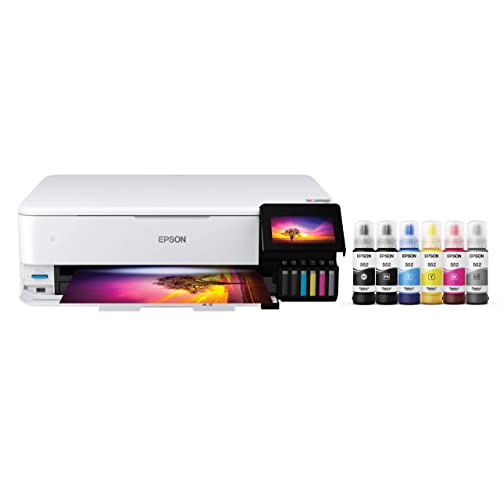
5. Epson EcoTank Photo ET-8550 — Best for Photo-Quality Sublimation
The Epson EcoTank Photo ET-8550 is the premium choice for sublimation printing that demands photographic color accuracy. Where most sublimation printers run a standard four-color CMYK setup, the ET-8550 uses a six-color Claria ET Premium inkset — adding Photo Black, Red, and additional color channels that produce smoother tonal gradations, deeper shadows, and more accurate skin tones. When converted to sublimation ink, those extra channels translate into richer, more nuanced transfers on photo-heavy products like personalized portrait mugs, face masks, and fine art panels.
The ET-8550 handles borderless media up to 13" x 19" and supports specialty substrates including cardstock and CD/DVDs up to 1.3mm thick. Print speed is impressive for the quality — a 4" x 6" photo in about 15 seconds. The refillable tank system keeps ink costs low over time, and the 4.3" color touchscreen makes navigating settings genuinely easy. For crafters creating 12x12 scrapbook pages or high-end custom photo gifts, the ET-8550's color output is in a different class from standard four-color printers.
The trade-off is that six-color sublimation ink systems require sourcing compatible ink across all six channels, which narrows your supplier options compared to a standard CMYK setup. You also pay a premium over the ET-15000 for the photo-grade hardware. But if your product line revolves around portraits, wedding gifts, or anything where color fidelity is your competitive edge, the ET-8550's output quality is worth every dollar.
Pros:
- Six-color Claria ET Premium inkset produces lab-quality photo output
- Borderless printing up to 13" x 19" with wide media support
- Refillable tanks keep long-term ink costs low
- 4.3" color touchscreen for intuitive control
- Prints a 4x6" photo in approximately 15 seconds
Cons:
- Six-color sublimation ink is harder to source than standard CMYK
- Higher upfront cost than the four-color ET-15000
6. Epson WorkForce WF-7720 — Best Wide-Format All-in-One
The Epson WorkForce WF-7720 is the upgraded sibling of the WF-7710, and the differences matter for serious sublimation work. The WF-7720 is powered by PrecisionCore and delivers print-shop-quality borderless output up to 13" x 19", matching the WF-7710's maximum print size while adding improved paper handling and higher maximum paper capacity in the dual paper trays. If you're running high-volume sublimation and switching between standard and sublimation paper frequently, the dual-tray design saves significant time.
Like the WF-7710, the WF-7720 is a full all-in-one supporting print, copy, scan, and fax, with Wi-Fi Direct, Ethernet, and wireless connectivity. Epson strongly recommends using genuine Epson inks with this machine — but the sublimation conversion community has documented reliable results with quality third-party sublimation cartridges. As always with converted printers, buy a brand-new unit, install sublimation ink before ever running Epson ink, and you avoid mixing issues entirely. The WF-7720 runs on Windows and Mac platforms with broad OS compatibility.
For home crafters and small businesses who want wide-format sublimation capability plus everyday document printing in a single machine, the WF-7720 represents excellent value. It competes directly with the WF-7710 — the right choice between them comes down to whether you need higher paper capacity and the slight build quality bump the 7720 offers. If noise levels are a concern in your workspace, it's worth reading our picks for quiet printers to compare before deciding.
Pros:
- Borderless printing up to 13" x 19" — ideal for large sublimation transfers
- PrecisionCore printhead for fast, high-resolution output
- Dual paper trays improve workflow when alternating paper types
- Full all-in-one: print, copy, scan, fax
- Wide OS compatibility including Windows and Mac
Cons:
- Requires conversion — warranty voided with third-party sublimation ink
- Slightly larger footprint than the WF-7710
7. Canon PIXMA G620 MegaTank — Best Entry-Level Tank Printer
The Canon PIXMA G620 is the budget-friendly entry point into refillable tank printing, and it earns its place on this list for creators who are just starting to explore sublimation. The MegaTank system delivers a massive page yield — up to 3,800 4" x 6" color photos on a full set of ink — which means your per-print cost stays low over time even on sublimation paper. It connects wirelessly and works with Alexa for smart ink monitoring, so you're never caught mid-project without ink.
The G620 handles photo printing on standard and specialty media, supports copy and scan functionality, and connects via Wi-Fi. It's compact, quiet, and designed for home use — not production volumes. As a sublimation conversion printer, it works best for small hobby projects: personalized mugs, coasters, small fabric patches. You're not going to run a full product line through a G620, but as a low-risk starting point to test sublimation before investing in a dedicated machine, it does the job.
The limitation is clear: this is a photo-focused desktop printer with no wide-format capability. Maximum print size stays within standard photo dimensions, which rules out t-shirt transfers and large signage. If you're running your first sublimation experiments at home and want the lowest possible cost of entry, the G620 is a smart way to learn the process before scaling up. Once your volume justifies it, the step up to a Sawgrass or Epson WorkForce becomes obvious.
Pros:
- MegaTank system yields up to 3,800 4x6" photos per fill — very low per-print cost
- Alexa integration with smart ink reorder capability
- Compact and quiet — fits any home workspace
- Wireless connectivity with solid Canon reliability
- Low entry price for getting started with sublimation experiments
Cons:
- No wide-format support — limits you to small sublimation projects
- Not designed for production volume; speed and capacity are modest
What to Look For When Buying a Sublimation Printer
Sublimation printing is not like standard document printing. According to Wikipedia's overview of dye-sublimation printers, the process works by converting solid dye directly to gas under heat and pressure, bonding it into the substrate at a molecular level. That means the printer you buy needs to handle sublimation-compatible ink chemistry — and that's just the starting point. Here's what actually matters when you're choosing your machine in 2026.
Dedicated vs. Converted: Know What You're Buying
This is the most important decision you'll make. Dedicated sublimation printers like the Sawgrass SG500 and SG1000 are purpose-built for the process — the ink system, printhead, and software are all engineered around sublimation from the ground up. You get reliable results, proper color profiles, and manufacturer support. Converted printers (Epson EcoTank, WorkForce, Canon PIXMA) use standard inkjet hardware loaded with third-party sublimation ink. You get lower upfront cost and more ink flexibility, but you're working outside the manufacturer's warranty and results depend heavily on ink quality and transfer paper. If you're building a business, a dedicated machine pays for itself quickly in reliability and time saved troubleshooting.
Print Size and Media Capacity
Think about your biggest product before you buy. A 8.5" x 11" printer works for mugs, coasters, and small apparel patches. But if you want to do full front t-shirt transfers, you need at least 11" x 17" — and for youth tees or larger apparel, borderless 13" x 19" opens up everything. Don't buy to your current needs — buy to your 12-month growth plan. Upgrading printers is expensive and time-consuming, and the wider-format options on this list aren't dramatically more expensive than the smaller ones. Also consider bypass tray support for banner-length media if you do signage work.
Ink System: Cartridge vs. Tank
Cartridge printers (Sawgrass, WF-7710, WF-7720) are easy to manage but cost more per milliliter of ink. Tank printers (Epson EcoTank lineup, Canon PIXMA G620) cost more upfront but deliver dramatically lower per-print costs over time. At moderate production volumes — say 200+ transfers per week — the tank system usually breaks even within a few months and saves money long-term. If you're at lower volume or prefer the simplicity of cartridge swapping, the cartridge systems are perfectly viable. For dedicated sublimation machines like Sawgrass, proprietary ink is required and the cost is baked into the business model.
Connectivity and Software Integration
Every printer on this list offers wireless connectivity, which is the baseline in 2026. The differentiator is software. Sawgrass machines connect directly to CreativeStudio, which provides color management profiles, templates, and substrate-specific print settings that take guesswork out of production. Converted Epson and Canon printers work through standard driver software, which gives you flexibility but requires you to manually dial in color profiles for sublimation output. If you're selling custom products at scale, the right software integration saves you hours per week in color correction and print setup. For smaller operations or hobby use, standard drivers with a quality ICC profile get you where you need to go.
Frequently Asked Questions
What is sublimation printing and how does it work?
Sublimation printing is a process where heat converts solid dye ink directly into gas, which then bonds into the surface of a polyester or polymer-coated substrate. The result is a permanent, wash-resistant image that becomes part of the material rather than sitting on top of it. You print a mirrored image onto sublimation transfer paper using sublimation ink, then use a heat press to transfer the image onto your substrate at around 375–400°F. The process only works on materials with a high polyester content (at least 65% for fabric) or polymer-coated hard substrates like mugs, phone cases, and ceramic tiles.
Can any inkjet printer be converted to a sublimation printer?
Not every inkjet printer can be converted. Sublimation conversion works best on Epson printers that use PiezoElectric printheads, because those heads can handle the viscosity of sublimation ink without damage. Canon and HP printers generally use thermal printheads that can be damaged or degraded by sublimation ink. The Epson WorkForce and EcoTank models on this list are among the most popular and well-documented conversion choices. The key rule: always load sublimation ink before running any standard Epson ink through the system — once you mix, you compromise both inks and risk permanent clogging.
What materials can I sublimate on?
Sublimation works on polyester fabric (minimum 65% poly for apparel), polymer-coated hard substrates (mugs, tumblers, tiles, phone cases, mousepads), and specially coated items like metal sheets and coated wood. It does not work on 100% cotton, dark fabrics, or uncoated surfaces. The final color on dark fabrics will be washed out because sublimation ink is transparent — it needs a white or light base to show true colors. For dark garments, direct-to-film (DTF) printing is a better option. Stick to white or light polyester garments and properly coated hard substrates for consistent, vibrant results.
Do I need a heat press to use a sublimation printer?
Yes. A heat press is required to complete the sublimation transfer — the printer alone only produces the transfer paper, not the finished product. You need consistent heat (typically 375–400°F), firm pressure, and precise timing (usually 45–90 seconds depending on the substrate). A flat heat press handles apparel and flat items; a mug press handles cylindrical drinkware; a cap press handles curved surfaces. Without the correct heat press for your substrate, you'll get incomplete transfers, ghosting, or washed-out colors. Budget for both the printer and an appropriate heat press when planning your setup.
How long does sublimation ink last in a printer before it dries out or clogs?
Sublimation ink can clog printheads if the printer sits unused for extended periods, typically more than one to two weeks. Regular printing — even just a short nozzle check print every few days — keeps the heads primed and the ink flowing. The Sawgrass SG1000 addresses this problem directly with its auto-maintenance system, which runs cleaning cycles automatically even when idle. For converted Epson printers, you'll need to run manual cleaning cycles if you haven't printed recently. Keeping the printer covered when not in use and storing sublimation paper in a sealed bag also helps prevent humidity-related issues.
Is sublimation printing profitable for small businesses in 2026?
Yes — sublimation has strong margins for personalized and custom products. Custom mugs, tumblers, t-shirts, phone cases, and home décor items typically sell for $15–$60 each, while the per-unit cost of materials (blank, ink, transfer paper, heat press time) often falls between $2–$8 depending on volume. The biggest costs are equipment (printer + heat press), blanks inventory, and your time. Businesses that focus on personalization — names, photos, custom designs — command premium pricing that straight product sales can't achieve. Many sellers on Etsy and Shopify generate consistent revenue with a single mid-range sublimation printer and a heat press. For business card printing alongside your sublimation work, check our guide to the best printers for business cards to round out your studio setup.
Buy on Walmart
- Sawgrass SG500 Sublimation Printer Starter Bundle | Anti-Clo — Walmart Link
- Sawgrass SG1000 Sublimation Printer Bundle | Professional Dy — Walmart Link
- WorkForce WF-7710 Wireless Wide-format Color Inkjet Printer — Walmart Link
- Epson EcoTank ET-15000 Wireless Color All-in-One Supertank P — Walmart Link
- Epson EcoTank Photo ET-8550 Wireless Wide-format Color All-i — Walmart Link
- Epson WorkForce WF-7720 Wireless Wide-format Color Inkjet Pr — Walmart Link
- Canon PIXMA G620 Wireless MegaTank Photo All-in-One Printer — Walmart Link
Buy on eBay
- Sawgrass SG500 Sublimation Printer Starter Bundle | Anti-Clo — eBay Link
- Sawgrass SG1000 Sublimation Printer Bundle | Professional Dy — eBay Link
- WorkForce WF-7710 Wireless Wide-format Color Inkjet Printer — eBay Link
- Epson EcoTank ET-15000 Wireless Color All-in-One Supertank P — eBay Link
- Epson EcoTank Photo ET-8550 Wireless Wide-format Color All-i — eBay Link
- Epson WorkForce WF-7720 Wireless Wide-format Color Inkjet Pr — eBay Link
- Canon PIXMA G620 Wireless MegaTank Photo All-in-One Printer — eBay Link
Buy the printer that fits where your business is going, not just where it is today — the right machine now saves you from a painful upgrade six months from now.



About Chris & Marry
Chris and Mary are a couple with a shared background in graphic design and print production who have spent years working with printers across creative and professional contexts — from art printing and photo output to label production and professional document work. Their combined experience evaluating printer performance, color accuracy, and paper handling across inkjet and laser platforms gives them a practical, hands-on perspective on what makes a printer worth buying. At ShopChrisAndMary, they cover printer reviews, buying guides, and recommendations for artists, photographers, and professional users.
Time to get FREE Gifts. Or latest Free printers here.
Disable Ad block to reveal all the info. Once done, hit a button below