Business & Professional Printers ›
How To Print Copies Of Text Messages Sent To And From A Cell Phone
by Chris & Marry
Last spring, a colleague found herself in the middle of a contractor dispute — and the only evidence she had was buried in a text thread on her phone. She needed clean, timestamped printouts fast. Knowing how to print text messages in a format courts and insurance adjusters will actually accept can make or break a case. Whether you're dealing with a legal matter, an insurance claim, or simply want a paper archive of important conversations, this guide walks you through every reliable method — from quick workarounds to purpose-built software — so you can produce credible printed records on demand.
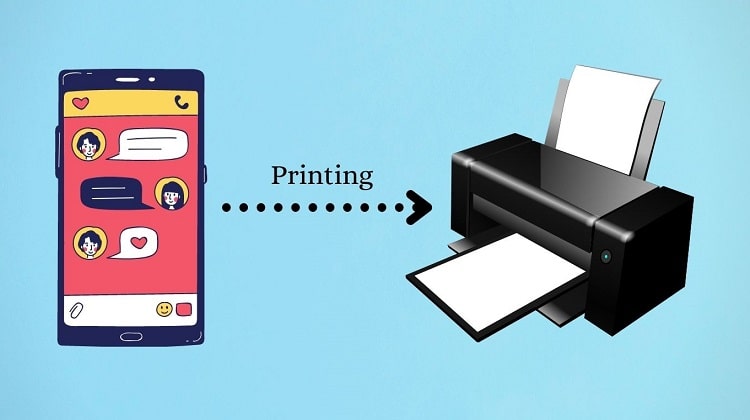
Text messages live inside closed app ecosystems — iOS Messages, Google Messages, WhatsApp — and pulling them into a print-ready format takes more than pressing Ctrl+P. Unlike a standard web page you'd print from a browser, message threads require you to either mirror your screen, export through a dedicated app, or request certified records from your carrier. Each approach has different trade-offs in speed, legibility, and legal standing.
Understanding your options before you need them prevents the all-too-common mistake of producing a blurry screenshot that gets rejected or missing the metadata that makes a record credible. For professionals who print frequently — contracts, records, business documentation — hardware matters just as much as method. Our roundup of the best printers for professionals can help you identify a machine built for demanding, high-stakes output.
Contents
- Step-by-Step: How to Print Text Messages from Any Device
- When Printed Text Messages Become Essential
- Faster Methods Worth Knowing
- Organizing and Storing Your Printed Records
- Getting the Best Print Quality from Text Conversations
- Scenarios Where a Printed Text Changed Everything
- Frequently Asked Questions
Step-by-Step: How to Print Text Messages from Any Device
Your approach depends on your phone's operating system and how much detail the final printout needs to show. Here are the three most reliable paths, in order of reliability and output quality.
Printing from iPhone
Apple doesn't include a native message-export feature in iOS, but you have solid options:
- AirPrint via screenshots: Open the Messages app, scroll to the start of the conversation, and take a series of overlapping screenshots that cover the full thread. Go to Photos → select all screenshots → tap the Share icon → choose Print → select an AirPrint-compatible printer.
- iMazing (Mac/PC): Connect your iPhone via USB. iMazing lets you browse message threads, filter by date range, and export as PDF, Excel, or plain text — with sender names and timestamps fully preserved.
- Decipher TextMessage: A dedicated desktop app for Mac and Windows. It reads your iTunes or Finder backup and produces formatted, attorney-ready PDFs. Often the best choice for legal use.
- TouchCopy: Similar to iMazing, with a focus on clean printout formatting. Outputs Word documents or PDFs that look polished on paper.
Key detail: Always verify that full phone numbers — not just first names — appear in the printout. Many courts require the full number for identification purposes.
Pro tip: Before printing for legal purposes, confirm that every page shows the contact's complete phone number or Apple ID. A first name alone rarely satisfies court authentication requirements.
Printing from Android
Android provides somewhat more flexibility for exporting messages than iOS:
- Install SMS Backup & Restore (free on Google Play) on your Android device.
- Open the app and select the conversation or full inbox to back up.
- Choose HTML as the export format — this preserves message bubbles, timestamps, and sender names in a readable layout.
- Transfer the HTML file to your computer via USB cable, Google Drive, or email.
- Open the file in Chrome or any desktop browser.
- Use the browser's Print function (Ctrl+P or Cmd+P) to send it to your printer or save as PDF.
Samsung devices running One UI also offer a built-in export option inside the Messages app (three-dot menu → Export), which outputs a plain text file you can format and print from any word processor. It's quick but produces less polished output than SMS Backup & Restore's HTML format.
Using a Web Client or Computer Method
If your messaging platform has a desktop interface — WhatsApp Web, Facebook Messenger, Google Voice, or Telegram — you can access conversations through your browser and print them exactly as you would any other web document. Navigate to the thread, scroll to load the full history, then use Ctrl+P to open the print dialog. This method is clean, fast, and free.
For standard SMS without a web client, screen mirroring tools like Vysor (Android) or QuickTime Player (iPhone via USB) let you display your phone's screen on your desktop, where you can take full-resolution screenshots and print them at a larger, more legible size than phone-native captures.
When Printed Text Messages Become Essential
Knowing how to print text messages matters most when you understand the stakes. Here are the most frequent scenarios where a physical record proves decisive.
Legal and Court Proceedings
Text messages are increasingly accepted as evidence in civil and criminal courts. According to Wikipedia's overview of electronic discovery, digital communications — including SMS — are subject to the same preservation and disclosure obligations as email and physical documents.
- Divorce and custody disputes often center on message threads showing communication patterns or agreement violations.
- Contract disagreements where terms were negotiated informally over text.
- Harassment or defamation cases where the messages are the primary evidence.
- Small claims court filings over unpaid services or goods disputes.
- Personal injury cases where liability was discussed between parties.
For court submissions, your printout typically needs to show: the sender's full phone number or account identifier, the recipient's information, complete message content, and precise date and time stamps for every message.
Insurance and Financial Claims
Insurance companies and financial institutions regularly request printed communication records as supporting documentation:
- Auto accident claims where fault or scene details were discussed over text immediately after the incident.
- Home contractor disputes covered under homeowner policies, particularly when the contractor acknowledged defective work in writing.
- Fraud investigations requiring a communication timeline between parties.
- Warranty disputes where a vendor's promises were made via SMS.
Business and Personal Documentation
Even outside legal contexts, printed message records serve practical, everyday purposes:
- Preserving client instructions given informally over SMS before a project begins.
- Maintaining a paper trail for freelance agreements that were never formalized in a signed contract.
- Archiving family conversations — messages from a parent or grandparent that you want to keep beyond the lifespan of a phone.
- Documenting workplace harassment or hostile communications for HR purposes.
Faster Methods Worth Knowing
Not every situation calls for a full export with metadata. Sometimes speed is the priority.
The Screenshot-and-Print Method
This is the fastest approach when you need just a few messages:
- Open the conversation on your phone and scroll to the beginning of the relevant section.
- Take overlapping screenshots — each should start slightly above where the previous one ended so the thread reads continuously without gaps.
- Transfer screenshots to your computer via USB, iCloud sync, or Google Photos.
- Open them in any image viewer, paste them into a Word document, or import into a PDF editor.
- Print with standard settings, or save as a multi-page PDF first for a cleaner final result.
Limitation: Screenshot files can be altered in any photo editing application. For anything that may face scrutiny, this method's credibility is inherently lower than a tool-generated export.
Warning: For anything that may end up in front of a judge or insurance adjuster, skip the screenshot method entirely. Use a dedicated export tool or request certified records directly from your carrier — the difference in credibility is significant.
Third-Party Export Apps Compared
Several apps are purpose-built for exporting and printing text message records. Here's how the most widely used options compare:
| App / Tool | Platform | Output Format | Best For | Cost |
|---|---|---|---|---|
| Decipher TextMessage | iPhone (via Mac/PC) | PDF, CSV | Legal-grade documentation | Paid (~$39) |
| iMazing | iPhone (via Mac/PC) | PDF, Excel, Text | Full backups + selective export | Paid (~$44) |
| SMS Backup & Restore | Android | XML, HTML | Full thread exports, free | Free |
| TouchCopy | iPhone (via Mac/PC) | PDF, Word | Formatted, readable printouts | Paid (~$30) |
| WhatsApp Web / Google Voice | Any browser | Browser print | Quick informal printing | Free |
For high-stakes situations, paid dedicated tools like Decipher TextMessage or iMazing are worth the one-time cost. They produce cleaner, more consistent output and are designed from the ground up with legal and archival use in mind.
Organizing and Storing Your Printed Records
Printing is only half the job. A disorganized stack of pages is nearly as useless as no record at all when you need to find a specific message under pressure.
Filing Systems That Hold Up
Once you have your printed text message copies, organize them immediately — before the context fades:
- Create a cover sheet: Include the contact's name, their phone number, and the date range of the conversation. Staple it to the front of every printed thread.
- Use labeled manila folders or three-ring binders: Keep separate folders per case, claim, or contact. Label each folder on the spine and the front.
- File chronologically within each folder: Earliest message first, so the thread reads naturally when you page through it.
- Store sensitive records in a fireproof box or locked filing cabinet. Standard file boxes are fine for general archives, but anything with legal or financial stakes deserves better protection.
- Number your pages if the thread spans multiple printed pages — "Page 3 of 11" prevents pages from being separated and later disputed.
Digital Backup Alongside Physical Copies
Never rely on a single format or storage location. Physical paper can be damaged, lost, or destroyed. Always maintain a parallel digital backup:
- Save the original export files — PDF, HTML, XML — to a clearly named, password-protected folder on your computer.
- Back up to an encrypted cloud service (Google Drive, iCloud, Dropbox) with two-factor authentication enabled.
- For legal matters, consider giving your attorney a copy at the same time you file your physical records. Their office copy creates an independent chain of custody.
- If you're managing ongoing documentation for a business matter, maintain a dated log of when each set of records was printed, by whom, and for what purpose.
Keeping your printer in top condition is equally important when output quality matters. Our guide on how to clean printer rollers covers a straightforward maintenance routine that prevents smearing and feed problems on documents you can't afford to reprint.
Getting the Best Print Quality from Text Conversations
Text message threads present unique print challenges — small fonts, colored chat bubbles, and pale backgrounds can all combine to produce output that's hard to read. A few targeted adjustments fix most of these problems.
Printer Settings to Optimize
- Use grayscale mode for most text message printouts. It produces sharper, more legible text than color mode and avoids wasting color ink on chat bubble backgrounds.
- Set print resolution to at least 600 DPI. Lower resolutions make small-font timestamps look muddy.
- Select "Fit to Page" or "Shrink to Fit" in the print dialog to prevent message bubbles from getting clipped at the right margin.
- If the export generates colored backgrounds, convert to PDF first and use your PDF viewer's option to suppress background graphics before printing. Most PDF readers include this option under Advanced Print Settings.
- Print a test page from a non-critical message thread before committing your important records. Catching layout or legibility issues on a throwaway thread saves paper and frustration.
Paper and Format Choices
- Standard 20 lb copy paper is adequate for personal archives and casual reference.
- For legal submissions or anything that will be scanned or photocopied repeatedly, use 24 lb bright white paper. It handles high-contrast text better and produces cleaner copies.
- If you're binding multiple printed pages into a single document, set a left margin of at least 1.25 inches in your print settings to prevent text from disappearing into the binding.
- Landscape orientation sometimes works better for wide conversation exports generated by desktop apps — check the preview before printing to determine which orientation is more readable.
- Avoid glossy paper for text message printouts. It looks polished but smears more easily and can be harder to write annotations on if you need to mark specific messages for reference.
Scenarios Where a Printed Text Changed Everything
The abstract value of printed records becomes concrete when you see the kinds of situations where they've proven decisive:
- Landlord-tenant dispute: A tenant printed a thread showing the landlord had acknowledged a broken heater repair request in writing. The printout became the key exhibit in a small claims case over a withheld security deposit — and the tenant won.
- Freelance scope creep: A graphic designer printed SMS messages confirming a client's verbal scope changes. When the client disputed the invoice, the designer had documented proof of every out-of-scope request. Without it, it would have been her word against the client's.
- Custody modification filing: A parent printed message exchanges showing repeated schedule violations by the other party and submitted them as supporting documentation in a court petition. The timestamps made the pattern undeniable.
- Insurance fraud investigation: A homeowner printed texts from a contractor explicitly admitting to using substandard materials. The insurance company used the printed thread to validate the claim and pursue the contractor for damages.
- Elder care documentation: Adult children printed messages between an aging parent and a financial advisor after suspecting undue influence over account transfers. The printed record helped an attorney establish a timeline and sequence of events that would have been nearly impossible to reconstruct from memory alone.
- Workplace harassment documentation: An employee maintained a printed log of hostile messages from a supervisor over several months. When HR initially dismissed a verbal complaint, the printed records gave the investigation team a documented pattern rather than a single incident.
In every case, the person with a clean, timestamped, printed record was the one who could make their argument stick. The person relying on a phone screen or memory alone was at a structural disadvantage before they even walked into the room.
Frequently Asked Questions
Can I print text messages directly from my phone without a computer?
Yes. If you have an AirPrint-compatible wireless printer, you can print screenshots directly from your iPhone's Photos app without touching a computer. Android users with a compatible wireless printer can do the same. However, for complete thread exports with full metadata intact, connecting to a computer and using a dedicated export app produces significantly more reliable and legible output.
Are printed text messages admissible in court?
Printed text messages can be admissible as evidence, but courts routinely scrutinize them for authenticity. A carrier-certified record or an export from a forensically sound tool carries substantially more weight than a phone screenshot. Authentication standards vary by jurisdiction, so consult your attorney about the specific requirements before submitting printed messages as formal evidence.
How do I request text message records directly from my carrier?
Contact your carrier's customer service or legal/subpoena department directly. Most major carriers — AT&T, Verizon, T-Mobile — can provide message logs showing phone numbers, dates, and times upon written request. Full message content is generally not available to account holders without a court order or law enforcement subpoena. Retention periods vary by carrier, typically between 90 days and one year for content data.
What is the best free method to print text messages from an Android device?
SMS Backup & Restore is the most reliable free option for Android. It exports message threads as HTML files, which you can open in any desktop browser and print using your standard printer settings. The HTML output preserves timestamps, sender names, and full message content in a clean, readable layout — and it handles large conversation histories without truncating.
A printed text message is only as useful as the metadata it carries — always confirm that timestamps, full phone numbers, and sender names are visible on every page before you consider the job done.



About Chris & Marry
Chris and Mary are a couple with a shared background in graphic design and print production who have spent years working with printers across creative and professional contexts — from art printing and photo output to label production and professional document work. Their combined experience evaluating printer performance, color accuracy, and paper handling across inkjet and laser platforms gives them a practical, hands-on perspective on what makes a printer worth buying. At ShopChrisAndMary, they cover printer reviews, buying guides, and recommendations for artists, photographers, and professional users.
Time to get FREE Gifts. Or latest Free printers here.
Disable Ad block to reveal all the info. Once done, hit a button below