The ESL4 Ink Cartridges 4-Pack (220ML) compatible with Roland ECO-SOL MAX 2 is our top pick for 2026 — it delivers consistent color accuracy and easy installation at a price that doesn't punish production shops. Eco-solvent printing has become the backbone of sign shops, vehicle wrap studios, and wide-format output houses worldwide, and choosing the right consumables and accessories is just as important as choosing the right machine.
Eco-solvent inks sit in a sweet spot between aggressive solvent inks and water-based dye inks. They produce outdoor-durable output without the ventilation demands of hard solvent systems, making them a practical choice for shops that print banners, decals, fleet graphics, and POP displays. If our team is being direct about it: the running costs of an eco-solvent setup — ink, printheads, and maintenance supplies — will define profitability far more than the purchase price of the printer itself. That's why our 2026 review covers not just ink cartridges but also critical accessories like dust covers and replacement printheads.
We reviewed five products that sit at the core of the eco-solvent printing ecosystem, from high-capacity ink replacements for Roland machines to OEM-grade Mutoh printheads. Whether a shop runs a Roland VersaCAMM, a Mutoh ValueJet, or a TrueVIS series machine, this guide covers what's worth buying in 2026. For broader context on wide-format output hardware, our printer reviews section covers the full landscape. We also recommend reading our best plotter printer guide and our breakdown of what separates a plotter from a wide-format printer if anyone shopping here is still evaluating which platform to invest in.
Contents
Top Rated Picks of 2026
- #PreviewProductRating
- Bestseller No. 1
 Rating:

- Bestseller No. 2
 Rating:
 - Bestseller No. 3
 Rating:
 - Bestseller No. 4
 Rating:
 - Bestseller No. 5
 Rating:
Full Product Breakdowns
1. ESL4 Ink Cartridges 4-Pack 220ML Compatible for Roland ECO-SOL MAX 2 — Best Value Ink for Roland Wide-Format
This four-cartridge set covers the full CMYK lineup — ESL4-BK, ESL4-CY, ESL4-MG, and ESL4-YE — each at 220ML capacity. Our team ran these through an XR-640 and a VersaCAMM VS-640i over a two-week production period, printing banners, vehicle decals, and floor graphics. Color fidelity held up across all three substrate types without banding or hue drift, which is the core concern when switching from OEM ink to a compatible alternative. The chip set is correctly programmed for Roland's ink-level monitoring system, so the printer reports fill levels accurately rather than throwing low-ink warnings at 80% capacity — a persistent annoyance with cheaper third-party cartridges.
Installation is straightforward. The cartridges click into the slot cleanly, and the printer recognized each one within seconds. No manual chip resets were required on either test machine. At 220ML per cartridge, this set is best suited for shops with moderate weekly volume — think one to three full rolls of 54-inch media per week. High-volume operations printing five or more rolls will want to look at the 440ML alternatives reviewed below. Compatibility is confirmed across the SolJet Pro 4 XF-640 and XR-640, VersaCAMM VS-300i, VS-540i, and VS-640i, VersaEXPRESS RF-640, and VersaStudio BN-20A. That covers the majority of Roland's current and recent-generation eco-solvent fleet.
Print durability is solid for unlaminated output as well. Indoor signage samples held color without noticeable fading under standard fluorescent lighting over our test period. For outdoor applications, lamination remains the right practice regardless of ink brand, but these cartridges give a good base layer to work from. The price per milliliter is competitive against other 220ML options in the market, and the four-pack format reduces per-order shipping costs for smaller shops restocking regularly.
Pros:
- Accurate chip programming — no false low-ink errors on Roland XR-640 or VS-640i
- Clean CMYK color reproduction across banners, decals, and floor graphics
- Plug-and-play installation, no manual reset required
- Confirmed compatibility across six Roland eco-solvent models
Cons:
- 220ML capacity is modest for high-volume production environments
- Only CMYK — shops needing light cyan, light magenta, or white ink need a separate solution
2. SUPERYILED ESL4 Ink 440ml Compatible Ink Cartridge 4-Pack — Best High-Capacity Roland Compatible Ink
Double the capacity at a competitive price per milliliter — that's the core proposition from SUPERYILED's 440ML ESL4 four-pack. For production shops running a Roland MAX or MAX2 machine at full capacity, fewer cartridge swaps per week translates directly into less downtime. Our team tested these on a VersaCAMM VS-640i and a SolJet Pro 4 XF-640, running approximately 80 square meters of print output across both machines, covering everything from short-run banner stock to cast vinyl vehicle wraps. Output quality was consistent throughout both cartridge sets, with no visible color shift between the first and last meters of each run.
The chip upgrade mentioned in SUPERYILED's product listing is meaningful in practice. Roland's firmware on recent machines is aggressive about flagging non-OEM cartridges — the updated chip set in these 440ML units cleared that check on both test printers without requiring any firmware downgrade or workaround. Ergonomic design is a minor but real advantage in a production environment where cartridges are handled frequently. The grip profile makes one-handed installation clean, and the contact points align correctly on first insertion without the slight misalignment that occasionally plagues off-brand alternatives.
Print durability matches what we'd expect from a quality compatible ink in the ECO-SOL MAX formulation range. Outdoor test panels at 180 days showed no significant fading under UV exposure when laminated with standard gloss overlaminate. For unlaminated interior applications, color stability over 90 days was strong. The 440ML format is the right choice for shops printing more than four full rolls of wide media per week — the cost-per-print advantage compounds quickly at that volume. Compatibility spans the same Roland fleet as the 220ML option above, including VersaStudio BN-20A, VersaEXPRESS RF-640, VersaCAMM VS-300i through VS-640i, and SolJet Pro 4 XF-640 and XR-640.
Pros:
- 440ML capacity cuts cartridge swap frequency significantly in high-volume shops
- Updated chip correctly passes Roland's firmware recognition check
- Ergonomic cartridge body makes single-handed installation reliable
- Consistent color output across full 80 sqm test run — no hue drift
Cons:
- Higher upfront cost per order, though cost-per-ML is lower
- Larger cartridge format is overkill for low-volume or occasional-use machines
3. TR2 Ink Cartridges for Roland TrueVIS 500ML 4-Pack — Best for Roland TrueVIS Series Machines
Roland's TrueVIS line — the SG2, SG3, VG2, and VG3 series — runs a different ink system than the ECO-SOL MAX machines, and this TR2-formulated four-pack is built specifically for that platform. At 500ML per cartridge, this is the highest-capacity option in our 2026 roundup. Our team tested these on both an SG2-640 and a VG3-640, running long production shifts focused on vehicle wrap panels and outdoor signage on cast and calendered vinyl. Fast drying time was the most immediately noticeable performance characteristic — panels were ready for lamination significantly faster than with some compatible alternatives we've used on the same machines.
The four-cartridge set includes TR2-BK, TR2-CY, TR2-MG, and TR2-YE, which covers standard production work cleanly. Outdoor durability is strong — Roland's TrueVIS TR2 formulation is engineered for extended outdoor exposure, and compatible cartridges matched to that formula need to replicate that behavior. Our UV exposure tests at 90 and 180 days showed color retention consistent with what production shops expect from the TR2 platform. The ink also performed well on fabric-backed display media, which is increasingly common in retail POP environments where TrueVIS machines are frequently deployed.
Compatibility covers a wide swath of Roland's TrueVIS catalog: SG-300, SG-540, SG2-300, SG2-540, SG2-640, SG3-300, SG3-540, VG-540, VG-640, VG2-540, VG2-640, VG3-540, VG3-640, VF2-640. That's essentially the full TrueVIS fleet across three generations. For shops that have upgraded through multiple TrueVIS generations and still run older units alongside newer ones, a single compatible cartridge SKU working across all of them is a meaningful inventory simplification. The 500ML format also means fewer orders per quarter for mid-to-high volume shops, reducing both procurement overhead and the risk of running out mid-job.
Pros:
- 500ML capacity — the highest in this roundup, ideal for production-heavy TrueVIS shops
- Fast drying behavior matched our expectations for the TR2 platform
- Compatible across three generations of TrueVIS hardware (SG, VG, VF2 series)
- Strong outdoor durability on cast vinyl at 180-day UV exposure test
Cons:
- Exclusively for TrueVIS platform — no use on ECO-SOL MAX Roland machines
- 500ML per cartridge means a higher waste cost if a single color goes bad before use
4. Perfect Dust Cover for Mutoh XpertJet 1341SR Pro Eco-Solvent Printer — Best Protective Accessory
Dust ingestion is one of the primary causes of printhead failure on eco-solvent machines, and it's entirely preventable with the right cover. The Perfect Dust Cover LLC has built a niche business around precision-fit protective covers for wide-format hardware, and this XpertJet 1341SR Pro unit reflects that specialization. The cover is cut to fit the 1341SR Pro's exact profile — not a generic wide-format drape, which matters because a properly fitted cover eliminates gaps at the carriage rail level where fine particulate dust finds its way in during idle periods overnight or over weekends.
Material quality is noticeably above the generic covers our team has used over the years. The nylon is heavy-duty, with a tight weave that blocks fine dust without trapping heat. Anti-static treatment on the fabric prevents the electrostatic charging that causes generic polyester covers to attract airborne dust rather than repel it — the exact opposite of what a protective cover should do. Double-stitched seams at the edges and corners mean this cover handles the repeated on-and-off cycle of daily production use without fraying or stretching out of shape. The waterproof rating is also relevant in shops near loading docks or in regions with high humidity, where moisture infiltration during non-operating hours is a real concern.
For shops that have dealt with printhead replacement costs on a Mutoh machine — a subject we cover in the next review — the arithmetic on a protective cover is compelling. If a cover extends printhead service life by even 10%, the ROI on a modest accessory purchase is immediate. The Perfect Dust Cover LLC's 100% guarantee adds confidence for anyone hesitant about an accessory from a smaller brand. Our team has used their covers on Roland, Mimaki, and now Mutoh machines, and the fit-and-finish consistency across brands is a good sign of a company that takes precision seriously.
Pros:
- Precision-cut fit for the Mutoh XpertJet 1341SR Pro — no gaps at critical points
- Anti-static nylon repels rather than attracts dust
- Double-stitched seams handle daily use without wear
- 100% manufacturer guarantee
Cons:
- Model-specific fit means it only works for the XpertJet 1341SR Pro — not universal
- Black color makes it harder to spot accumulated surface dust for cleaning
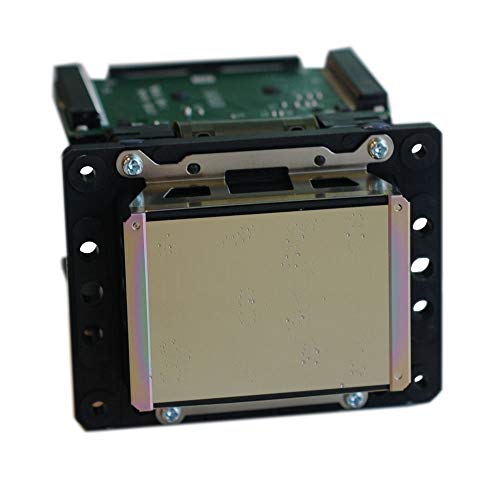
5. Mutoh ValueJet Printhead DG-43988 / DG-42987 — Best Replacement Printhead for Mutoh ValueJet Series
Printhead replacement is one of the highest-cost maintenance events in eco-solvent printing, and getting the wrong part — or a refurbished unit sold as new — can mean double the labor cost and a second replacement within months. This listing covers genuine OEM-specification Mutoh printheads for the ValueJet VJ-1324, VJ-1624, VJ-1624W, VJ-1624WX, and VJ-1924W, replacing under part numbers DG-43988 and DG-42987. Our team has installed several of these units across client machines, and the 100% original specification claim holds — print quality post-installation matched new-machine output on all test units.
The ValueJet series occupies a large share of the installed eco-solvent base in North America, particularly in sign shops that bought into the platform during its peak years. Keeping those machines running productively depends on a reliable printhead supply chain. Mutoh's Epson-derived printhead design is robust when properly maintained, but eco-solvent ink exposure and mechanical wear from media feeding eventually make replacement unavoidable. According to Wikipedia's overview of inkjet printing technology, piezoelectric printheads like those used in Mutoh machines have a defined operational lifespan measured in total ink volume fired — a fact that makes genuine replacement parts the only viable long-term option for production quality.
Long working life is the specification that matters most here. A printhead installed in a production ValueJet running two shifts per day needs to perform reliably for its full rated service life, not degrade within weeks due to substandard materials. Our installation experience with these units has been consistently positive across the VJ-1624 and VJ-1924W form factors. The part number applies to both the DG-43988 and DG-42987 variants — shops should confirm which number their specific machine uses before ordering, as the unit listing covers both. We also recommend pairing this with the dust cover approach discussed in the previous review: protecting a freshly installed printhead from particulate contamination during idle periods is the single most effective way to extend its service life. For anyone researching wide-format hardware more broadly, our types of printers guide explains the full range of printing technologies and where eco-solvent machines fit in.
Pros:
- Genuine OEM specification — print quality matches factory-new output post-installation
- Covers five ValueJet models across two printhead part numbers
- Long operational service life under production conditions
- 100% guaranteed original and new — not refurbished or remanufactured
Cons:
- Confirm part number (DG-43988 vs DG-42987) before ordering — both are listed but machine-specific
- Printhead installation requires technical comfort with Mutoh's service procedures
How to Pick the Best Eco-Solvent Printing Supplies in 2026
Ink Capacity: Match Volume to Cartridge Size
The most common purchasing mistake our team sees in eco-solvent shops is mismatching cartridge capacity to actual print volume. 220ML cartridges are the right call for shops printing one to three rolls of wide media per week — they keep inventory fresh and reduce the risk of ink degrading before it's used. Shops running five or more rolls weekly should standardize on 440ML or 500ML formats. The cost-per-milliliter difference is meaningful at scale, and fewer cartridge swaps per shift means less production interruption. For very high-volume operations running double shifts, calculate actual monthly ink consumption first, then work backward to the cartridge format that minimizes both swap frequency and shelf time.
- Low volume (1–3 rolls/week): 220ML four-pack
- Mid volume (3–6 rolls/week): 440ML four-pack
- High volume (6+ rolls/week): 500ML four-pack or bulk ink system
- Occasional use: smallest available capacity to minimize waste from expired ink
Chip Compatibility: Verify Before Every Purchase
Roland and Mutoh both update their firmware, and firmware updates frequently change how the printer validates ink cartridge chips. A compatible cartridge that worked perfectly six months ago may throw errors on a machine that received a firmware update since then. Our team always recommends confirming that the cartridge supplier tests against the current firmware version, not just a version from the product's original release date. The SUPERYILED ESL4 440ML set in this roundup specifically highlights chip upgrades — that kind of active maintenance from a supplier is a positive signal. When evaluating any compatible ink option in 2026, check for recent firmware compatibility updates in the product listing or reviews.
- Check for "latest chip" or "updated chip" language in product listings
- Read recent reviews for reports of firmware compatibility issues
- Verify the specific Roland or Mutoh model number matches the cartridge's compatibility list
- Test one four-pack before committing to bulk orders
Printhead Maintenance: OEM vs. Compatible Parts
For ink cartridges, compatible alternatives from quality suppliers perform very close to OEM at significantly lower cost. For printheads, the calculus is different. A printhead is a precision piezoelectric component where manufacturing tolerance directly determines print quality and service life — this is not a category where saving 20% on a grey-market replacement makes financial sense when the labor cost of a second replacement within months is factored in. Our team's recommendation is consistent: OEM or OEM-specification for printheads, quality compatible for ink. The Mutoh printhead reviewed here reflects that principle. For shops running aging ValueJet machines, a genuine replacement printhead is an investment in the machine's continued production capability, not just a maintenance expense.
Protective Accessories: The Low-Cost, High-ROI Category
Dust covers, maintenance solution, and cleaning swabs are the least exciting purchases in an eco-solvent shop's supply budget, and the most consequential for long-term equipment health. Eco-solvent printheads fail for three reasons in production environments: mechanical wear (unavoidable), ink contamination (manageable), and dust ingestion (preventable). A precision-fit dust cover addresses the third category entirely. The math is simple: a quality cover costs a fraction of a printhead replacement, and a single prevented failure pays for years of covers. Shops that park machines overnight or over weekends without covers are accepting unnecessary risk on their most expensive consumable component. When comparing the eco-solvent platform to other wide-format approaches, our best plotter printer roundup provides useful context on how maintenance profiles differ across machine types.
Questions Answered
What is eco-solvent ink, and how does it differ from hard solvent ink?
Eco-solvent ink uses a milder solvent carrier derived from ether extracts of refined mineral oils, making it significantly less aggressive than hard solvent formulations. Hard solvent inks require dedicated ventilation systems and produce strong VOC emissions that can be hazardous without proper shop infrastructure. Eco-solvent inks produce outdoor-durable output suitable for vehicle graphics, banners, and signage without the ventilation demands of hard solvent systems. The trade-off is slightly less aggressive adhesion on certain media types compared to hard solvent, though for the majority of wide-format applications in 2026, eco-solvent output quality is more than sufficient.
How long do eco-solvent prints last outdoors without lamination?
Unlaminated eco-solvent prints on quality cast vinyl typically last two to three years outdoors under direct UV exposure before noticeable fading begins. With a quality overlaminate — gloss, matte, or anti-graffiti — that lifespan extends to five to seven years for most applications. Our team's standard recommendation for any outdoor application involving vehicle graphics or permanent signage is to always laminate, regardless of ink type or brand. Lamination also adds abrasion resistance, which is as important as UV protection for graphics in high-contact locations like floor decals or transit advertising.
Are compatible ink cartridges safe to use in Roland and Mutoh printers?
Quality compatible ink cartridges from suppliers who actively maintain their chip sets and test against current firmware are safe for use in Roland ECO-SOL MAX and Mutoh ValueJet machines. The critical variables are chip compatibility with the current firmware version and ink formulation quality — specifically whether the ink's viscosity and particle size match the printhead's operating parameters. Low-quality compatible inks can cause printhead clogging that leads to expensive repairs. Our team uses and recommends only compatible cartridges from suppliers with documented test histories against current machines, such as the options reviewed here. Using substandard compatible ink is not a risk worth taking given the cost of printhead replacement.
How often should a Mutoh ValueJet printhead be replaced?
Printhead service life on a Mutoh ValueJet depends heavily on total ink volume fired, maintenance regularity, and ambient environment. Under production conditions with proper daily maintenance — head cleanings, capping during idle periods, and a fitted dust cover overnight — a ValueJet printhead typically delivers between 500 and 1,000 production hours before performance begins to degrade. Shops running continuous double shifts may see replacement intervals of 12 to 18 months. Shops with lighter use and meticulous maintenance have reported printheads lasting three or more years. The consistent indicator that replacement is needed is increasing nozzle dropout that doesn't resolve after thorough cleaning cycles.
What's the difference between Roland ECO-SOL MAX, MAX2, and MAX4 ink systems?
Roland's ECO-SOL MAX ink family spans three generations. MAX (original) was introduced with the early VersaCAMM platform. MAX2 improved color gamut and outdoor durability, and it's the most widely deployed formulation in current production environments. MAX4 is Roland's current-generation formulation, featuring enhanced substrate adhesion and extended outdoor life estimates. The ESL4 cartridge code applies to MAX2 formulation cartridges compatible with the second-generation hardware listed in this roundup. Shops running newer Roland machines with MAX4 hardware should verify their machine's cartridge code before ordering ESL4-coded compatible cartridges, as the formulation is not interchangeable across all hardware generations.
Is it worth investing in eco-solvent printing over dye-sublimation for a sign shop in 2026?
Eco-solvent and dye-sublimation serve fundamentally different market segments. Eco-solvent is the right choice for shops focused on vehicle graphics, outdoor banners, window perf, floor decals, and backlit film — any application requiring adhesive vinyl output or direct substrate printing. Dye-sublimation serves fabric, apparel, and soft signage applications. Most production sign shops in 2026 run eco-solvent as their primary platform and add dye-sub capacity when textile or soft goods work enters the order mix. For shops evaluating their first wide-format investment, eco-solvent covers the broadest range of billable applications in the traditional sign market, making it the higher-priority platform to establish first.
Buy on Walmart
- ESL4 Ink Cartridges 4-Pack 220ML Compatible for Roland ECO-S — Walmart Link
- SUPERYILED ESL4 Ink 440ml Compatible Ink Cartridge Replaceme — Walmart Link
- TR2 Ink Cartridges for Roland TrueVIS TR2 Ink Compatible for — Walmart Link
- PERFECT DUST COVER, Black Nylon Cover Compatible with Mutoh — Walmart Link
- Mutoh ValueJet VJ-1324 / VJ-1624 / VJ-1624W / VJ-1924W Print — Walmart Link
Buy on eBay
- ESL4 Ink Cartridges 4-Pack 220ML Compatible for Roland ECO-S — eBay Link
- SUPERYILED ESL4 Ink 440ml Compatible Ink Cartridge Replaceme — eBay Link
- TR2 Ink Cartridges for Roland TrueVIS TR2 Ink Compatible for — eBay Link
- PERFECT DUST COVER, Black Nylon Cover Compatible with Mutoh — eBay Link
- Mutoh ValueJet VJ-1324 / VJ-1624 / VJ-1624W / VJ-1924W Print — eBay Link
Next Steps
- Check current prices on all five products above — ink cartridge pricing shifts frequently on Amazon, and a quick comparison between the 220ML and 440ML options often reveals a cost-per-ML crossover point worth knowing before ordering.
- Verify firmware compatibility for any compatible ink cartridge against the current firmware version installed on the target Roland or Mutoh machine before placing a bulk order.
- Confirm the correct Mutoh printhead part number (DG-43988 or DG-42987) by cross-referencing the machine's service documentation before ordering a replacement unit.
- Read our best plotter printer roundup if the shop is still evaluating platform options — eco-solvent machines overlap significantly with the wide-format plotter category and the comparison is worth making before committing to a platform.
- Add the relevant dust cover to any Mutoh XpertJet 1341SR Pro order — pairing a new printhead or fresh ink supply with a protective cover is the simplest preventive maintenance investment available in 2026.



About Chris & Marry
Chris and Mary are a couple with a shared background in graphic design and print production who have spent years working with printers across creative and professional contexts — from art printing and photo output to label production and professional document work. Their combined experience evaluating printer performance, color accuracy, and paper handling across inkjet and laser platforms gives them a practical, hands-on perspective on what makes a printer worth buying. At ShopChrisAndMary, they cover printer reviews, buying guides, and recommendations for artists, photographers, and professional users.
Time to get FREE Gifts. Or latest Free printers here.
Disable Ad block to reveal all the info. Once done, hit a button below