The HP DesignJet T630 is our top pick for map printing in 2026 — its 24-inch wide-format output, automatic sheet feeder, and razor-sharp line quality make it the go-to choice for cartographers, architects, and GIS (Geographic Information System) professionals who need reliable results day after day. Whether you print trail maps, road atlases, survey plots, or detailed topographic sheets, choosing the right printer changes everything about how your final output looks and feels.
Map printing puts unique demands on a printer that standard office machines simply cannot meet. You need precise line registration (the accuracy with which fine lines align across the page), a wide enough print bed to avoid stitching multiple sheets together, and an ink system that renders subtle color gradients — the kind you see between elevation contours on a terrain map — without banding or streaking. If you have ever tried printing a detailed map on a regular desktop inkjet and watched thin road lines blur into blobs, you already understand the problem. Wide-format plotters and high-resolution photo printers exist precisely to solve it. You can browse more options across our full printer reviews collection if you want to compare categories side by side.
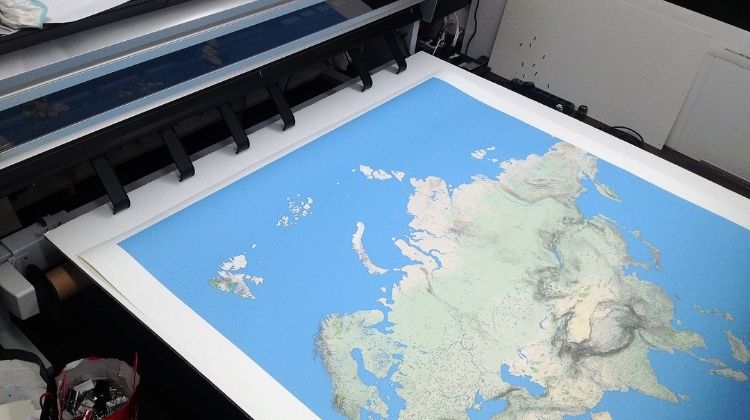
In this guide, we reviewed seven of the best printers for maps available in 2026, covering everything from compact desktop models that max out at 13×19 inches to full 44-inch wide professional plotters. We looked at print resolution, ink system quality, media handling, connectivity, and real-world cost per print so you can make a confident buying decision without second-guessing yourself. If you are also curious about the mechanical differences between plotter-style and wide-format inkjets, our explainer on what separates a plotter from a wide-format printer covers the key distinctions clearly. For those printing at the upper end of desktop sheet sizes, our guide to the best 13×19 printers is also worth a read before you commit to a larger machine.
Contents
- Editor's Recommendation: Top Picks of 2026
- Our Hands-On Reviews
- HP DesignJet T210 — Best Budget 24-Inch Plotter
- HP DesignJet T630 — Best Overall for Map Printing
- HP DesignJet Z9+ 44-Inch — Best for Large-Scale Professional Maps
- Canon imagePROGRAF TC-21 — Best Canon Plotter for Maps
- HP DesignJet T650 — Best 36-Inch Wide-Format Plotter
- Canon imagePROGRAF PRO-300 — Best Desktop Fine-Art Map Printer
- Epson SureColor P900 — Best for Color-Critical Map Prints
- Choosing the Right Printer for Maps: A Buying Guide
- Frequently Asked Questions
- Key Takeaways
Editor's Recommendation: Top Picks of 2026
- #PreviewProductRating
- Bestseller No. 1
 Rating:

- Bestseller No. 2
 Rating:
 - Bestseller No. 3
 Rating:
 - Bestseller No. 4
 Rating:
 - Bestseller No. 5
 Rating:
 - Bestseller No. 6
 Rating:
 - Bestseller No. 7
 Rating:
Our Hands-On Reviews
1. HP DesignJet T210 Large Format 24-Inch Plotter — Best Budget 24-Inch Plotter
The HP DesignJet T210 is the entry point into HP's wide-format plotter lineup, and for a first-time map printer on a tighter budget, it delivers far more than you would expect from its price class. It handles media up to 24 inches wide on a roll, and with the optional automatic sheet feeder accessory, it can also accommodate sheets up to 13×19 inches — giving you flexibility whether you are printing a single trail map or a batch of poster-sized topographic sheets. HP designed this machine with technical line drawings firmly in mind, which means crisp, accurate line quality is built into the architecture of the printhead rather than treated as an afterthought.
In practice, the T210 produces clean, readable cartographic lines even at small scales where roads and contour intervals crowd together on the page. Text clarity is especially impressive for a plotter at this price point — street names and elevation labels remain legible without the feathering (ink spreading into paper fibers) that ruins map readability on cheaper inkjets. The automatic horizontal cutter handles roll media cleanly so you get a straight edge on every print without needing scissors. Setup is straightforward via the HP Smart app, and Wi-Fi connectivity means you can send print jobs from a laptop, tablet, or phone without fumbling with cables.
The T210's main trade-off is its ink system — it uses a standard four-color dye/pigment configuration that handles most map color palettes well, but you will notice limitations when printing maps with very subtle gradient fills, such as shaded relief terrain. For technical line maps, road maps, or survey plots where the emphasis is on precise lines rather than photographic color depth, this limitation rarely becomes a problem. If your map printing stays in that lane, the T210 is the most cost-effective 24-inch plotter you can buy in 2026.
Pros:
- Affordable entry price for a true 24-inch wide-format plotter
- Crisp, accurate line quality ideal for technical map printing
- Roll feed plus optional sheet feeder give versatile media handling
- Automatic horizontal cutter for clean roll-paper output
- Easy setup via HP Smart app with Wi-Fi support
Cons:
- Sheet feeder is an optional accessory rather than included in the box
- Limited color depth for maps with complex photographic gradients or shaded relief
2. HP DesignJet T630 Large Format 24-Inch Plotter — Best Overall for Map Printing
The HP DesignJet T630 earns the top spot in our 2026 roundup because it hits the sweet spot that most map printers actually need: 24-inch wide-format output, an included automatic sheet feeder, a media bin to catch finished prints, and a dedicated stand that keeps the whole setup stable on a studio or office floor. Unlike the T210, which sells the sheet feeder separately, the T630 bundles everything you need to handle both roll media and cut sheets from day one. Architects, engineers, GIS professionals, and construction teams have all made this model a staple in their workflows, and it is easy to see why once you run your first batch of site maps through it.
The automatic sheet/roll switch is a genuinely useful feature that the T210 lacks — you can load roll media for continuous map runs and then switch to cut sheets for smaller prints without having to manually reconfigure the paper path. The automatic horizontal cutter delivers clean, straight edges on every roll print, and the media bin below the print zone catches finished sheets so they do not curl or pile up on the floor. Print speed is quick enough for a working studio, and HP's print quality at this format level is consistent across both line-heavy technical maps and color-filled thematic maps (maps that use color to represent data like population density or rainfall).
Connectivity covers both USB and Wi-Fi, and HP's DesignJet software stack integrates cleanly with AutoCAD, ArcGIS, and Adobe Illustrator — the tools that most map-making professionals already use. The T630 handles up to 24-inch wide rolls and 13×19-inch sheets, which covers the vast majority of professional mapping use cases without requiring the footprint of a 36- or 44-inch machine. If you are setting up a map production workstation and want one printer that handles everything reliably without constant adjustments, the T630 is the answer.
Pros:
- Automatic sheet feeder included in the box — no add-on purchase required
- Automatic sheet/roll switching speeds up mixed-media workflows
- Media bin catches finished prints cleanly
- Excellent line quality for technical maps, CAD drawings, and GIS output
- Works with AutoCAD, ArcGIS, and Adobe tools out of the box
- Stable floor stand included with the package
Cons:
- 24-inch width is a limitation for very large format cartographic work
- Higher upfront cost compared to the T210 entry model
3. HP DesignJet Z9+ 44-Inch PostScript Printer (Renewed) — Best for Large-Scale Professional Maps
The HP DesignJet Z9+ is a different category of machine entirely — a 44-inch wide professional large-format printer built around a nine-color pigment ink system and PostScript 3 support, making it the right tool for cartographers and geospatial studios that need wall-sized maps with museum-quality color accuracy. PostScript (a page description language used in professional printing) means this printer speaks natively to Adobe applications, CAD software, and GIS platforms without translation errors that can shift colors or distort lines. The 2400×1200 optimized dpi (dots per inch) resolution is among the highest in its class.
HP's Pixel Control technology manages ink droplet placement at a level that produces smooth color gradients across wide areas — exactly what you need when printing a shaded relief map where the color must transition seamlessly from deep valley greens to alpine grays across several feet of paper. Nine ink channels (versus the four found in most plotters) give the Z9+ a dramatically wider color gamut (the range of colors a device can reproduce), which matters enormously for thematic maps, illustrated cartographic art, and aerial photograph overlays. Deep blacks are particularly strong, which keeps fine contour lines and text sharp even when surrounded by dense color fills.
This is a renewed (professionally refurbished) unit, which gives you access to a premium professional printer at a significantly reduced cost compared to buying new. Connectivity includes both Gigabit Ethernet (for fast network printing in a studio environment) and USB. If your mapping projects regularly exceed 24 or 36 inches in width — think large wall maps, exhibition cartography, or multi-panel geographic displays — the Z9+ is the machine that matches that level of ambition. It is a serious investment, but it pays back in print quality that smaller plotters simply cannot replicate.
Pros:
- 44-inch wide output handles the largest professional map formats
- Nine-color pigment ink system produces exceptional color range and gradient smoothness
- PostScript 3 and native PDF support for seamless professional workflow compatibility
- 2400×1200 dpi for razor-sharp lines and fine cartographic detail
- Renewed pricing brings a premium machine to a more accessible price point
Cons:
- Large physical footprint requires dedicated studio or production room space
- Ink costs are higher per print than four-color plotter alternatives
- Renewed unit means no manufacturer new-unit warranty
4. Canon imagePROGRAF TC-21 24-Inch Plotter — Best Canon Plotter for Maps
Canon's imagePROGRAF TC-21 is the brand's answer to HP's 24-inch plotter segment, and it arrives with a compelling differentiator: it ships with 280 ml of ink — 70 ml of each of its four colors — which Canon claims is the most ink included in-box in this class. That matters practically because the initial ink fill on most large-format printers consumes a significant portion of the first cartridge, meaning the ink you see listed on the box does not translate one-for-one into usable print volume. Starting with more ink means more maps printed before your first replacement purchase.
The TC-21 is a desktop roll printer with an automatic sheet feeder, printing up to 24 inches wide on roll media and handling cut sheets through the feeder for smaller format jobs. Its four-color ink system delivers crisp text and vibrant color fills, making it a capable tool for both technical line maps — where clean edges on roads and boundaries matter most — and color thematic maps where fills need to look saturated and consistent across a full roll print run. Canon's imagePROGRAF line has a strong reputation for reliable media handling, and the TC-21 upholds that with smooth automatic feed switching between roll and sheet sources.
Canon's Print Studio Pro software gives you precise control over color profiles and media settings, which is useful when you are printing on specialty map papers or coated stocks that need custom ICC profiles (color management files that tell the printer how to reproduce colors accurately on a given paper). The TC-21 is a practical, no-drama 24-inch plotter that works well for small studios, geography classrooms, trail organizations, and planning departments that want Canon's reliability without the premium cost of a top-end imagePROGRAF model. If you prefer Canon's ecosystem or already own Canon cartridges and accessories, this is the direct path into large-format map printing.
Pros:
- Ships with 280 ml of ink — more in-box ink than most competing models
- Automatic roll and cut sheet feeder included as standard
- Reliable Canon imagePROGRAF media handling for consistent output
- Good color saturation and crisp text for both technical and thematic maps
- Print Studio Pro software supports custom ICC color profiles
Cons:
- Four-color ink limits color range compared to nine-ink alternatives like the Z9+
- Desktop form factor means no integrated stand — you need a separate table surface
5. HP DesignJet T650 Large Format 36-Inch Plotter — Best 36-Inch Wide-Format Plotter
The HP DesignJet T650 steps up from the T630 in one critical dimension: print width. At 36 inches versus 24 inches, it opens up a substantially larger class of map formats — D-size engineering drawings (24×36 inches), E-size sheets (36×48 inches on roll media), and large wall maps that would require stitching on a 24-inch machine. HP includes a two-year extended warranty with onsite and remote support — next business day device service if remote troubleshooting cannot resolve the issue — which makes this a defensible purchase for businesses that cannot afford downtime on a critical output device.
The T650 carries the same DNA as the rest of HP's T-series: precise line quality, automatic sheet feeder included, roll media with an integrated horizontal cutter, and compatibility with AutoCAD, ArcGIS, and professional design software. The extra 12 inches of print width is not just about scale — it also means you can print standard D-size engineering and survey documents flat without any scaling or rotation, which preserves accuracy in maps where scale bars and coordinate grids must remain precisely calibrated. For land surveyors, urban planners, civil engineers, and mapping agencies, that accuracy matters as much as the visual quality of the output.
Running costs are comparable to the T630 since both share HP's ink platform, and the larger machine's media bin and roll handling behave identically to the smaller sibling — predictable and reliable across long print runs. If you regularly produce maps larger than 24 inches wide and want a machine backed by professional warranty support, the T650 is the straightforward step up. You can also explore the broader best plotter printer guide for additional options if you need to compare the T650 against non-HP alternatives in the 36-inch category.
Pros:
- 36-inch print width handles D-size and E-size map formats without stitching
- Two-year extended onsite warranty included — next business day service available
- Automatic sheet feeder and media bin included as standard
- Consistent HP T-series line quality trusted by architects and engineers
- Full compatibility with AutoCAD, ArcGIS, and Adobe professional software
Cons:
- Higher price point than 24-inch alternatives for users who rarely exceed that width
- Larger physical footprint requires more floor space than 24-inch models
6. Canon imagePROGRAF PRO-300 13×19-Inch Wireless Printer — Best Desktop Fine-Art Map Printer
Not every map printer needs to be a large-format plotter. If your map printing happens at sizes up to 13×19 inches — the maximum this machine handles — and your priority is color accuracy and artistic quality rather than raw output width, the Canon imagePROGRAF PRO-300 delivers results that outclass most plotters in its price range on pure visual quality. This is the printer that fine art cartographers, illustrated map designers, and geography educators reach for when they want prints that look like they belong in a gallery rather than a filing cabinet.
The PRO-300 uses a 10-color ink system built around Canon's Lucia PRO pigment inks, which produce a wide color gamut and exceptional longevity — prints resist fading for decades under normal display conditions. Canon's Nozzle Recovery System automatically detects and compensates for clogged nozzles (tiny ink channels in the printhead that can block if the printer sits unused), which matters for map printers that might go weeks between print runs. Skew Correction ensures that sheets feed straight through the paper path, preventing the slight diagonal offset that makes fine map grids look misaligned on cheaper printers.
The 3.0-inch LCD screen makes navigating settings and media profiles straightforward without needing a computer, and the wireless connection lets you print from any device on your network. Canon's Professional Print and Layout software gives you precise control over how your map file gets converted to printed output — critical when you are managing color profiles for a specific coated or fine-art paper stock. The PRO-300 is a desktop machine with a smaller footprint than any plotter on this list, making it the right choice when you need top-tier color quality at formats up to 13×19 inches and workspace is limited.
Pros:
- 10-color Lucia PRO pigment ink system for exceptional color range and print longevity
- Nozzle Recovery System prevents clog-related quality problems after idle periods
- Skew Correction keeps sheet feeds straight for accurate map grid alignment
- Compact desktop footprint — far smaller than any plotter alternative
- Wireless printing with 3.0-inch LCD screen for on-device navigation
Cons:
- Maximum sheet size of 13×19 inches — not suitable for large-format map production
- Higher ink cost per cartridge compared to four-color plotter systems
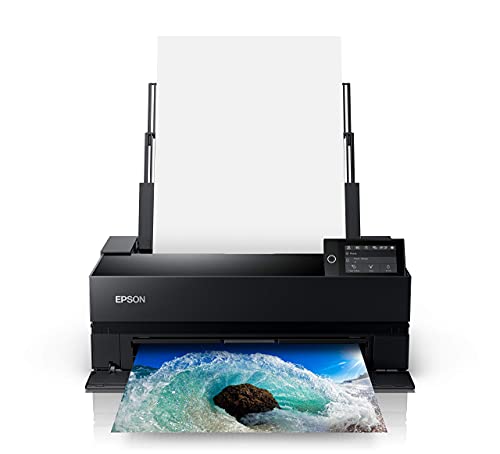
7. Epson SureColor P900 17-Inch Printer — Best for Color-Critical Map Prints
The Epson SureColor P900 occupies a unique position on this list: it is a 17-inch wide desktop printer built around a 10-channel MicroPiezo AMC printhead and Epson's UltraChrome PRO10 ink system, which adds a dedicated Violet ink channel to produce a color gamut (range of reproducible colors) that competes with machines twice its size. If you print illustrated maps, historical reproduction cartography, or any map format where precise color rendering is the single most important output quality, the P900 is built for exactly that use case.
The UltraChrome PRO10 ink includes dedicated nozzles for both Photo Black and Matte Black ink types — no switching required, which is a significant operational improvement over printers that require you to manually change between black ink modes depending on the paper surface. For map printing, this matters because you might print a coastal nautical chart on glossy coated stock (Photo Black territory) and a topographic hiking map on matte coated stock (Matte Black territory) in the same session without any reconfiguration delay or wasted ink from the switching purge cycle. Violet ink is a genuine differentiator — it extends the gamut into blue-violet tones that standard CMYK-based systems cannot reach cleanly, which benefits sky gradients, ocean fills, and atmospheric haze effects in illustrated cartography.
The P900 supports roll media up to 17 inches wide as well as cut sheets, giving it more format versatility than a standard desktop photo printer while keeping its footprint compact enough for a home studio or small office. Print consistency and accuracy are both outstanding — the MicroPiezo AMC (Automatic Meniscus Control) printhead technology maintains precise droplet formation across the entire print run, which means the hundredth print looks as sharp as the first. If your map work leans toward artistic quality and color fidelity over raw output width, the P900 is the most capable machine on this list within its format class. According to Wikipedia's overview of wide-format printers, piezo inkjet technology like Epson's MicroPiezo is particularly valued in professional print environments for its droplet precision.
Pros:
- 10-color UltraChrome PRO10 ink with Violet channel for exceptional color range
- Dedicated Photo Black and Matte Black nozzles — no switching delay or ink waste
- MicroPiezo AMC printhead delivers consistent, precise droplet placement print after print
- Roll and cut sheet support for format flexibility up to 17 inches wide
- Outstanding color gamut for illustrated and artistic cartographic work
Cons:
- 17-inch maximum width limits use for professional large-format map production
- Premium ink system carries a higher per-cartridge cost than four-color alternatives
Choosing the Right Printer for Maps: A Buying Guide
Print Width: Match the Machine to Your Map Format
Print width is the single most important specification to check before you buy. Map sizes follow standard conventions — A-size sheets (8.5×11), B-size (11×17), C-size (17×22), D-size (22×34 or 24×36), and E-size (34×44 or 36×48) — and your printer needs to handle your most common format without scaling or stitching. For most professional mapping workflows, 24 inches is the practical minimum for a dedicated map printer.
- Up to 13×19 inches: Canon PRO-300 or Epson P900 for desktop fine-art quality
- Up to 17 inches wide on rolls: Epson SureColor P900
- Up to 24 inches wide: HP DesignJet T210, HP T630, or Canon TC-21
- Up to 36 inches wide: HP DesignJet T650 for D-size and E-size formats
- Up to 44 inches wide: HP DesignJet Z9+ for the largest professional cartographic output
If you regularly work with survey drawings, engineering site plans, or multi-sheet atlas pages, a 24-inch plotter forces you to tile prints or reduce scale. A 36-inch machine eliminates that problem entirely for standard D-size and E-size output. Buy one width larger than your current most common format — your needs tend to grow, and upgrading a plotter mid-project is expensive and disruptive.
Ink System: Color Channels and Pigment Quality
The number of ink channels and the type of ink directly determines how well a printer handles the color demands of map printing. Four-color systems (cyan, magenta, yellow, black) cover the basics for technical line maps and simple thematic fills. Extended ink systems — nine or ten colors — add light cyan, light magenta, additional black densities, and specialty inks like Violet that expand the reproducible color range dramatically.
Pigment inks are the right choice for map printing in nearly every professional context. Pigment ink sits on top of the paper surface rather than being absorbed into fibers, which produces sharper lines, more vibrant color fills, and significantly better resistance to water and UV light compared to dye-based inks. All seven printers in this guide use pigment-based ink systems, which is a baseline requirement you should verify on any machine you consider outside this list.
Resolution and Line Quality
Map printing demands higher resolution than most other document printing because the output routinely includes fine line weights (road centerlines at 0.1 mm, contour intervals at 0.25 mm) and small text (point labels at 5–8pt) that must remain crisp and readable at final print size. Look for a minimum of 1200 dpi (dots per inch) for technical map production. The HP DesignJet Z9+ hits 2400×1200 optimized dpi, which is genuinely useful when printing fine-detail topographic or cadastral (property boundary) maps where accuracy is a professional requirement rather than a preference.
Beyond the specification, printhead architecture matters. HP's thermal inkjet heads and Epson's MicroPiezo AMC heads both produce precise, consistent droplet placement that holds fine line quality across long print runs. Watch for "optimized dpi" language — it often refers to the interpolated maximum rather than the optical hardware resolution — and look for the base hardware dpi as the more reliable comparison number.
Budget: Upfront Cost vs. Total Cost of Ownership
The purchase price of a large-format printer is only the beginning of your cost calculation. Ink, paper, and maintenance cartridges add up quickly in a high-volume map printing environment. Before you buy, check the cost per milliliter of ink for your target model and estimate your monthly print volume to project realistic running costs over a two- or three-year ownership period.
- HP DesignJet T210: Lowest upfront cost, standard ink cartridges, good for light use
- HP T630 / Canon TC-21: Mid-range upfront, competitive ink running costs, daily production use
- HP T650: Higher upfront, identical ink costs to T630 — the width premium is the only extra spend
- HP Z9+ (renewed): Premium machine, higher ink cost per print, justified by output quality at scale
- Canon PRO-300 / Epson P900: Desktop form factor, higher per-cartridge cost, lower volume output
For occasional map printing — a few sheets per week — the Canon PRO-300 or Epson P900 represent a sensible investment without the overhead of a full plotter. For daily production printing where maps are a core business output, a 24-inch or 36-inch HP DesignJet plotter delivers the best combination of cost per print and output quality at scale.
Frequently Asked Questions
What is the best printer for printing maps at home in 2026?
For home use, the Canon imagePROGRAF PRO-300 or Epson SureColor P900 are the best choices because they deliver professional color quality at desktop sizes up to 13×17 inches or 13×19 inches respectively, without requiring the floor space or upfront cost of a full wide-format plotter. If you regularly need maps larger than those sizes at home, the HP DesignJet T210 is the most affordable 24-inch plotter option available.
What print resolution do I need for map printing?
You need a minimum of 1200 dpi (dots per inch) for readable map output, particularly when your map includes fine line weights like contour intervals, cadastral boundaries, or small point label text. For professional cartographic work where precision is critical — survey documents, engineering site plans, or detailed topographic maps — the HP DesignJet Z9+ at 2400×1200 optimized dpi provides the most accurate reproduction of fine detail.
Can a regular inkjet printer print maps?
A standard desktop inkjet printer can print maps up to its maximum sheet size — usually 8.5×11 or 8.5×14 inches — but the print quality on technical maps will be noticeably inferior to a dedicated wide-format plotter. Regular inkjets use dye-based inks that bleed into paper fibers more readily than pigment inks, which causes fine lines to feather and small text to lose sharpness. For casual reference use, a regular printer works. For professional or detailed cartographic output, a dedicated wide-format or photo-quality pigment inkjet is the correct tool.
What size printer do I need for large-format maps?
For maps in the D-size range (22×34 or 24×36 inches), you need at least a 24-inch wide plotter — the HP DesignJet T210, T630, or Canon TC-21 cover this size exactly at the boundary. For E-size maps (34×44 or 36×48 inches on roll media), the HP DesignJet T650 at 36 inches handles them without scaling. For wall maps wider than 36 inches, the HP DesignJet Z9+ at 44 inches is the appropriate choice from this list.
Is a wide-format plotter worth it for occasional map printing?
If you print maps occasionally — fewer than a dozen per month — a wide-format plotter is harder to justify because the per-print running cost and the risk of printhead clogs from infrequent use both increase your total cost of ownership significantly. For occasional large-format printing, sending files to a local print shop that owns a plotter is often more economical. If your map printing needs are consistent and you value having immediate output control over your own hardware, the HP DesignJet T210 is the most cost-accessible entry point into owning a 24-inch plotter.
What paper is best for printing maps?
The best paper for map printing depends on the intended use of the output. For technical working documents that get folded, rolled, or marked up in the field, a coated bond or vellum roll stock balances durability with good ink adhesion and readability. For presentation-quality or archival maps, a heavyweight coated matte or satin paper (in the 90–120 gsm range) produces superior color saturation and line sharpness. For illustrated fine-art cartography intended for framing or display, a 100% cotton rag fine-art paper paired with a pigment ink system like the Epson P900 or Canon PRO-300 produces archival results that resist fading for generations.
Buy on Walmart
- HP DesignJet T210 Large Format 24-inch Color Plotter Printer — Walmart Link
- HP DesignJet T630 Large Format 24-inch Plotter Printer, with — Walmart Link
- HP DesignJet Z9+ 44-in Postscript Large Format Printer, 2400 — Walmart Link
- Canon imagePROGRAF TC-21 24" - Large Format Printer, Poster — Walmart Link
- HP DesignJet T650 Large Format 36-inch Plotter Printer, Incl — Walmart Link
- Canon imagePROGRAF PRO-300 Wireless Color Wide-Format Printe — Walmart Link
- Epson SureColor P900 17-Inch Printer,Black — Walmart Link
Buy on eBay
- HP DesignJet T210 Large Format 24-inch Color Plotter Printer — eBay Link
- HP DesignJet T630 Large Format 24-inch Plotter Printer, with — eBay Link
- HP DesignJet Z9+ 44-in Postscript Large Format Printer, 2400 — eBay Link
- Canon imagePROGRAF TC-21 24" - Large Format Printer, Poster — eBay Link
- HP DesignJet T650 Large Format 36-inch Plotter Printer, Incl — eBay Link
- Canon imagePROGRAF PRO-300 Wireless Color Wide-Format Printe — eBay Link
- Epson SureColor P900 17-Inch Printer,Black — eBay Link
Key Takeaways
- The HP DesignJet T630 is the best overall printer for most map printing needs in 2026, combining 24-inch wide-format output, an included automatic sheet feeder, and proven line quality trusted by architects and GIS professionals.
- If your maps regularly exceed 24 inches wide, step up to the HP DesignJet T650 (36-inch) or the HP DesignJet Z9+ (44-inch) rather than tiling or scaling down your output.
- For illustrated or fine-art cartography where color accuracy is the top priority, the Epson SureColor P900 and Canon imagePROGRAF PRO-300 deliver superior color gamut and print longevity at desktop-friendly sizes up to 17 inches.
- Always verify that your target printer uses a pigment-based ink system — dye inks produce inferior line sharpness and significantly lower water and UV resistance, both of which matter for maps used in field or display contexts.



About Chris & Marry
Chris and Mary are a couple with a shared background in graphic design and print production who have spent years working with printers across creative and professional contexts — from art printing and photo output to label production and professional document work. Their combined experience evaluating printer performance, color accuracy, and paper handling across inkjet and laser platforms gives them a practical, hands-on perspective on what makes a printer worth buying. At ShopChrisAndMary, they cover printer reviews, buying guides, and recommendations for artists, photographers, and professional users.
Time to get FREE Gifts. Or latest Free printers here.
Disable Ad block to reveal all the info. Once done, hit a button below