Business & Professional Printers ›
Best Printers for Laptops: Wireless and Multi-OS Compatible
by Chris & Marry
Nearly 60% of home office workers still print documents at least once a week in 2026, yet finding a printer that pairs seamlessly with a laptop — any laptop, on any OS — remains surprisingly tricky. macOS users wrestle with driver conflicts, Linux users hit dead ends, and Windows users deal with setup screens that feel like they were designed in 2004. The good news: modern wireless printers have gotten dramatically better at cross-platform compatibility, and the seven models we've tested and reviewed below prove it.
Whether you're printing one-page boarding passes or fifty-page client reports, the right printer for your laptop should connect in under three minutes, stay connected, and not charge you a fortune for ink. We've broken down each option by use case so you can match the machine to your actual workflow — not just a spec sheet. If you're printing a lot of professional-grade documents and need even more firepower, check out our roundup of printers for professionals for a deeper dive into high-volume options.
This list covers inkjet, laser, and supertank models across a wide price range. We've prioritized wireless reliability, multi-OS support, and total cost of ownership — including ink — because a cheap printer with expensive cartridges is rarely a bargain. Let's get into it.
Contents
- Standout Models in 2026
- In-Depth Reviews
- HP DeskJet 2755e — Best Budget Wireless Inkjet
- Epson EcoTank ET-2800 — Best for Low Ink Costs
- Brother HL-L2460DW — Best Monochrome Laser
- HP OfficeJet Pro 9125e — Best All-in-One for Offices
- Canon PIXMA TR8620a — Best for Home Office Versatility
- Canon imageCLASS MF743Cdw — Best Color Laser
- HP LaserJet Pro M15w — Best Compact Laser
- What to Look For When Buying
- Frequently Asked Questions
Standout Models in 2026
- #PreviewProductRating
- Bestseller No. 1
 Rating:

- Bestseller No. 2
 Rating:
 - Bestseller No. 3
 Rating:
 - Bestseller No. 4
 Rating:
 - Bestseller No. 5
 Rating:
 - Bestseller No. 6
 Rating:
 - Bestseller No. 7
 Rating:
In-Depth Reviews
1. HP DeskJet 2755e Wireless Color Inkjet Printer — Best Budget Wireless Inkjet
If your laptop printing needs are light — think travel documents, recipes, the occasional form — the HP DeskJet 2755e hits a sweet spot that's hard to argue with. At its price point, you get a full-color all-in-one (print, scan, copy) with dual-band Wi-Fi that self-resets when the connection drops. That self-healing wireless feature alone saves you the frustrating dance of unplugging and re-pairing that plagues cheaper printers. Setup is genuinely fast: HP's Smart app walks you through it on iOS, Android, Windows, and macOS, and the printer registers within a couple of minutes on most networks.
Print quality at 1200 DPI is solid for everyday documents and passable for color graphics — you won't be printing gallery-quality photos, but color forms and illustrated presentations come out clean and readable. The 60-sheet input tray is modest; if you're printing more than a small batch at a time, you'll be refilling paper frequently. Ink costs are the main trade-off here: HP's cartridge-based system adds up fast if you print heavily, though the included six-month Instant Ink trial is a genuine offset for lighter users. The 64MB RAM keeps operations smooth for basic jobs without lag.
This is a straightforward choice for a student or remote worker who needs wireless printing without a complex setup and doesn't print more than a few dozen pages a week. It's not built for volume, but it's not trying to be. According to Wikipedia's overview of inkjet printing technology, modern thermal inkjet heads like HP's have reached a level of reliability that makes budget models genuinely viable for everyday use. Just go in understanding the ink cost model.
Pros:
- Very easy wireless setup via HP Smart app on all major OSes
- Dual-band Wi-Fi with self-reset for consistent connectivity
- Compact footprint — won't crowd a small desk
- Six-month Instant Ink trial lowers the entry cost
- 1200 DPI output is clean for everyday documents
Cons:
- 60-sheet paper tray means frequent refills for bigger jobs
- Cartridge ink costs escalate quickly for moderate-to-heavy users
- No automatic duplex printing
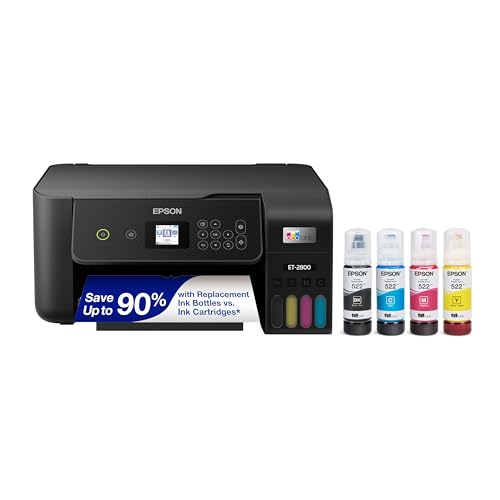
2. Epson EcoTank ET-2800 Wireless Color All-in-One — Best for Low Ink Costs
The Epson EcoTank ET-2800 flips the traditional printer economics on its head. Instead of cheap hardware and expensive cartridges, you pay more upfront for a tank-based system that dramatically slashes ongoing ink costs — up to 90% less per page compared to cartridge competitors, according to Epson's own figures. Each ink bottle set is roughly equivalent to 80 individual cartridges. For anyone who prints consistently, the math tends to work out decisively in the ET-2800's favor within the first year. The included ink is enough to print up to 4,500 pages in black and 7,500 in color before you need to buy a refill.
Epson's Micro Piezo Heat-Free technology is worth understanding: unlike thermal inkjet systems that heat ink to create bubbles, piezo heads use electrical charges to physically eject ink. This puts less stress on the printhead, which translates to better longevity and consistent output quality over time. Print speeds reach 10 pages per minute, which is respectable for a home-grade inkjet. The wireless setup is straightforward and compatible with iOS, Android, Windows, macOS, and Chromebook via Epson's iPrint app and Wi-Fi Direct. You won't have driver headaches on a modern laptop regardless of OS.
Where the ET-2800 shows its price-tier limits: there's no automatic document feeder, no fax capability, and no auto-duplex. For someone who needs to scan multipage contracts or print on both sides automatically, this isn't the right fit. But if your use case is basic color printing and light scanning from a home laptop, the ET-2800's cost-per-page advantage is one of the most compelling in its class. If you're specifically looking for strong photo output, our best photo printer under $200 guide covers options with better color accuracy for image-heavy work.
Pros:
- Dramatically lower ink costs vs. cartridge printers — up to 90% savings
- Huge page yield: 4,500 black / 7,500 color before refill needed
- Heat-Free Micro Piezo technology extends printhead lifespan
- Cross-platform wireless support including Chromebook
- Simple, mess-free ink tank refilling
Cons:
- Higher upfront cost compared to entry-level cartridge inkjets
- No auto-duplex printing
- No ADF — manual single-page scanning only
3. Brother HL-L2460DW Wireless Compact Monochrome Laser Printer — Best Monochrome Laser
If you only print text documents and need them fast, crisp, and cheap per page, a monochrome laser printer is the right call — and the Brother HL-L2460DW is one of the stronger options in the compact category for 2026. It prints up to 36 pages per minute, handles automatic duplex printing, and connects via dual-band wireless (2.4GHz and 5GHz), Ethernet, or direct USB. That dual-band flexibility matters: on a congested 2.4GHz home network, being able to drop to 5GHz for cleaner throughput is a real practical advantage.
The Brother Mobile Connect app lets you manage print jobs remotely, reorder toner, and track supply levels from your phone — which sounds minor until you realize you can queue a 30-page document from your laptop on the train and have it waiting for you when you walk in the door. Alexa compatibility adds voice-triggered printing for those set up in smart home environments. Build quality is solid for its size: compact enough for a credenza or small home office shelf but sturdy enough to feel like it was built to last. Toner cartridge yields are reasonable, and third-party toner availability keeps long-term costs manageable.
The obvious limitation is color. This is a black-and-white-only machine. If you ever need color output — even occasionally — you'll need a second printer or a different choice entirely. For a home office or small team that churns through internal documents, reports, and contracts, though, the HL-L2460DW delivers professional output at a cost-per-page that inkjet printers simply can't match. It pairs well with laptops running Windows, macOS, and Linux, with driver support that's unusually broad for a printer in this category.
Pros:
- 36 ppm print speed — genuinely fast for a compact laser
- Automatic duplex printing saves paper and time
- Dual-band Wi-Fi (2.4GHz + 5GHz) plus Ethernet and USB
- Strong multi-OS compatibility including Linux
- Brother Mobile Connect app with Alexa integration
Cons:
- Monochrome only — no color printing capability
- No scanner or copier functions
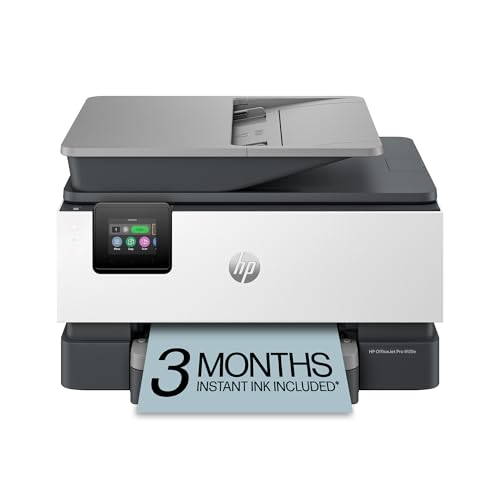
4. HP OfficeJet Pro 9125e Wireless All-in-One Color Inkjet Printer — Best All-in-One for Offices
The HP OfficeJet Pro 9125e is built for the kind of laptop user who needs more than occasional printing — think weekly client presentations, color brochures, scanned contracts, and the occasional fax to a stubborn vendor who hasn't moved on. Color print speeds up to 18 ppm and black up to 22 ppm put it well ahead of most consumer inkjet all-in-ones, and the auto document feeder handles multipage scan jobs without babysitting. The 250-sheet input tray means you're not constantly reloading paper. Auto two-sided printing and scanning comes standard.
What sets the 9125e apart in 2026 is the HP AI print formatting feature. It analyzes web pages and emails before printing, automatically strips ads, navigation bars, and other page junk, and delivers clean, properly formatted output. This might sound like a minor convenience, but anyone who has printed a web article and gotten three pages of header bloat and sidebar garbage will immediately appreciate it. The printer registers as a network device with a full-featured web interface, and the HP Smart app provides mobile access across all major platforms. Setup is fast and the wireless connection has been reliable in extended use.
The ink cost model is worth your attention: this is a cartridge-based printer, and color output costs more per page than a supertank or laser. HP's Instant Ink subscription (three-month trial included) helps offset this if you print predictably. For a home office handling real workloads — varied document types, regular scanning, occasional faxing — the 9125e justifies its step up in price with a corresponding step up in capability. It's also worth comparing notes with our best duplex scanning printer guide if two-sided scanning is a priority for your workflow.
Pros:
- 18 ppm color / 22 ppm black — fast for a color inkjet
- Auto document feeder for hands-free multipage scanning
- HP AI formatting removes clutter from web/email prints
- 250-sheet input tray reduces paper refill frequency
- Full all-in-one: print, scan, copy, fax
Cons:
- Cartridge ink costs add up for heavy color printing
- Larger footprint than basic home models
5. Canon PIXMA TR8620a All-in-One Printer — Best for Home Office Versatility
Canon's PIXMA TR8620a is a well-rounded all-in-one that earns its place in a home office through consistent quality and thoughtful feature integration. It handles printing, copying, scanning, and faxing, with wireless connectivity that plays nicely with iOS, Android, macOS, Windows, and Chromebook via Canon's PRINT app and AirPrint. The five-ink system — including a dedicated photo black cartridge — gives it a noticeable edge in color accuracy over four-ink competitors, particularly for photos and graphics-heavy documents. If your laptop is used for design work or photography on the side, this matters.
The Alexa integration here is genuinely practical: you can receive low-ink notifications through an Alexa-enabled device, and if you enable smart reorders, Alexa can automatically place a replenishment order from Amazon before you run dry. No subscription required — it's built into the hardware. The automatic document feeder supports both single and double-sided scanning, and the rear tray handles specialty media including photo paper and envelopes without requiring a tray swap. Build quality feels premium for its category; the TR8620a doesn't have the hollow plastic feel of budget all-in-ones.
Ink costs run on the higher side compared to the EcoTank, and the cartridge system means you'll be buying replacements more frequently if you print photos regularly. The fax capability is a genuine plus for certain professional contexts — real estate agents, medical offices, and legal support workers still encounter fax requirements regularly in 2026. If photo quality is a major factor in your decision, our best photo printer for Mac comparison digs deeper into color-accurate models worth considering alongside this one.
Pros:
- Five-ink system produces superior color accuracy and photo quality
- Alexa-enabled ink monitoring and auto-reorder
- ADF supports two-sided scanning
- Rear specialty tray for photo paper and envelopes
- Strong multi-OS and mobile compatibility
Cons:
- Ink costs are higher than tank-based alternatives
- Slightly bulkier than purely document-focused models
6. Canon Color imageCLASS MF743Cdw All-in-One Wireless Laser Printer — Best Color Laser
When you need color laser output with the full suite of all-in-one capabilities and a machine that will hold up for years, the Canon imageCLASS MF743Cdw makes a compelling case. It's a step up in investment from the inkjet options on this list, but you're getting laser-grade print quality, a first-page-out time of 10.3 seconds, and a 5-inch color touchscreen that makes the interface feel significantly more polished than typical business printers. The three-year warranty is notable in a category where most competitors offer one year.
NFC (Near Field Communication) connectivity lets you print directly from your phone by tapping it to the printer — no network or app required. For teams or households where multiple laptop users need occasional printing access, this is a genuinely elegant solution. The one-pass duplex document feeder handles two-sided scanning in a single pass, which saves meaningful time on multipage jobs. Canon's Application Library allows custom workflow shortcuts directly on the touchscreen — useful if you have repetitive tasks like scan-to-email or specific print configurations you run regularly. The Wi-Fi Direct feature creates a hotspot from the printer itself, enabling direct laptop connection without a router.
The main sticker shock is toner cost: color laser toner is more expensive per cartridge than inkjet, though cost-per-page tends to be competitive for high-volume users. The physical footprint is larger than the other options here — this is a proper office machine, not a desk corner unit. If your laptop use involves professional presentations, color marketing materials, or departmental document workflows, the MF743Cdw's output quality and durability make it worth the price premium. Take a look at our best color laser printer for Mac roundup for additional alternatives in this tier.
Pros:
- Laser print quality with 10.3-second first-page-out
- Three-year warranty — longest on this list
- NFC tap-to-print for instant mobile access
- 5-inch color touchscreen with Application Library shortcuts
- One-pass duplex ADF for efficient two-sided scanning
Cons:
- Largest and heaviest model on this list
- Higher upfront cost than inkjet alternatives
- Color toner replacements are a meaningful recurring expense
7. HP LaserJet Pro M15w Wireless Monochrome Printer — Best Compact Laser
The HP LaserJet Pro M15w holds a genuine record: it's the world's smallest laser printer in its class, measuring 35% smaller than its predecessor. If desk space is at an absolute premium — a studio apartment, a dorm room, a hotel room setup for a frequent traveler — this machine prints laser-quality black and white documents from a footprint that fits in a backpack. At up to 19 pages per minute with the first page out in 8.1 seconds, it's no slouch despite its size. Wireless setup works via the HP Smart app, and cloud printing through iCloud, Google Drive, and Dropbox is supported natively.
Alexa compatibility lets you voice-trigger print jobs, and the HP Smart app handles scanning from your smartphone (using the phone's camera) when you don't have a dedicated scanner. This is a clever feature that makes the M15w feel more complete than its spec sheet suggests — for someone who only occasionally needs to digitize a document, camera scanning covers most needs without adding a scanner to the budget. Toner management through the app keeps you ahead of supply depletion, and HP Genuine toner is widely available in major retailers.
This printer does not scan or copy natively — it's print-only. There's no automatic duplex either. Those are real limitations, but they're knowingly baked into the design to hit that extraordinary size. If you travel with a laptop and occasionally need to print from hotel rooms, shared offices, or temporary workspaces, the M15w's combination of wireless flexibility, fast laser output, and laptop-bag-friendly dimensions is genuinely difficult to match. For anyone who prints text-heavy documents and values speed over features, it's a quiet workhorse.
Pros:
- Smallest laser printer in its class — fits nearly anywhere
- 19 ppm with 8.1-second first-page-out
- Cloud printing: iCloud, Google Drive, Dropbox supported
- HP Smart app enables phone-based document scanning
- Alexa voice printing support
Cons:
- Print-only — no scan, copy, or fax
- No automatic duplex printing
- Monochrome only
What to Look For When Buying Printers for Laptops
Wireless Connectivity and Multi-OS Compatibility
Not every wireless printer plays nicely with every operating system. Before you buy, verify that the printer supports your laptop's OS — whether that's Windows 11, macOS Sonoma, Chrome OS, or a Linux distribution. Most modern printers handle Windows and macOS without issues, but Linux and Chromebook support is spottier. Look for printers that use AirPrint, Mopria, or IPP Everywhere protocols — these are OS-agnostic standards that allow driverless printing from virtually any device. If a printer relies exclusively on a proprietary driver and that driver isn't available for your OS, you'll have a frustrating experience regardless of how good the hardware is.
Dual-band Wi-Fi (both 2.4GHz and 5GHz support) is worth prioritizing over single-band 2.4GHz models. Congested 2.4GHz networks — common in apartment buildings and shared offices — cause dropped connections and print job failures. The 5GHz band offers faster throughput and less interference, though it has shorter range. Some models also offer Wi-Fi Direct, which creates a hotspot directly from the printer for device-to-device connection without a router. This is useful in environments where network access is restricted or unpredictable.
Print Technology: Inkjet vs. Laser
The inkjet-vs-laser decision still matters in 2026, and the answer depends heavily on what you're printing. Inkjet printers produce better color accuracy and photo output but cost more per page for high-volume printing and can suffer from clogged printheads if left idle for extended periods. Laser printers produce sharper text, cost less per page at volume, and have no "left sitting too long" problem — toner doesn't dry out. They're also generally faster for document printing and more reliable in humid environments.
For a laptop user whose output is mostly text documents, reports, and forms, a monochrome laser is typically the smarter long-term choice. For someone who prints a mix of documents and graphics — or occasional photos — a color inkjet or supertank model offers better flexibility. The EcoTank-style supertank printers close the cost-per-page gap significantly by replacing cartridges with refillable ink reservoirs, making them a hybrid that suits moderate-to-heavy inkjet users much better than standard cartridge models.
Paper Capacity and All-in-One Features
A 60-sheet input tray is fine for occasional printing; a 250-sheet tray is the minimum for anyone running a real home office workflow. If you're constantly babysitting the paper tray, you'll resent the printer within a month. Similarly, consider whether you need scan and copy capabilities — a print-only model is cheaper, but having integrated scanning through the same wireless connection you're already using simplifies the setup considerably.
Automatic document feeders (ADFs) are worth the premium if you regularly scan multipage documents. Manual flatbed scanning — loading one page at a time — becomes genuinely tedious when you're digitizing a ten-page contract. Auto-duplex printing is another feature that's easy to overlook until you're manually flipping a 20-page report and hoping the alignment lines up. For professional use, both features earn their cost.
Total Cost of Ownership: Ink and Toner
The purchase price is never the real cost of a printer. Ink and toner typically represent the largest expense over a printer's lifetime, often exceeding the original hardware cost within the first two years for moderate users. Before committing to a model, calculate the estimated cost per page using the manufacturer's published cartridge yield and price. A printer that costs $50 less upfront but charges twice as much per page is rarely a bargain for anyone who prints regularly.
Subscription ink services (HP Instant Ink, Epson ReadyPrint) can reduce per-page costs for light users with predictable monthly volume — but they can also lock you into rolling charges for months you don't print much. Tank-based systems like the Epson EcoTank eliminate the cartridge economy entirely at the cost of a higher initial purchase price. For laser printers, check both OEM and reputable third-party toner options — toner yields are typically published clearly and third-party alternatives are often substantially cheaper without quality loss. Consider also looking at our guide to best laser printers for specialized tasks if your needs extend beyond standard documents.
Frequently Asked Questions
What makes a printer compatible with multiple operating systems?
Multi-OS compatibility typically comes from support for open printing standards like AirPrint (Apple), Mopria (Android/Chrome OS), and IPP Everywhere — protocols that allow printers to communicate with devices without installing custom drivers. Printers that rely solely on proprietary driver packages often lose support when OS versions update. When shopping for a laptop printer in 2026, look for these standard certifications on the product listing to ensure broad and lasting compatibility across Windows, macOS, Chrome OS, and mobile platforms.
Do wireless printers work without an internet connection?
Most wireless printers connect to your local Wi-Fi network rather than the internet itself — so yes, they work fine as long as your laptop and the printer are on the same network, even without an active internet connection. Some features like cloud printing (Google Drive, iCloud, Dropbox), firmware updates, and subscription ink management do require internet access. Wi-Fi Direct-capable printers can also connect directly between your laptop and the printer without any network at all, which is useful in offline or restricted environments.
Is an inkjet or laser printer better for laptop users?
It depends on what you print. Laser printers are generally better for text-heavy documents — they're faster, cheaper per page at volume, and don't suffer from dried ink if left unused. Inkjet printers, particularly modern supertank models, are more versatile for color documents and photos. For a laptop user primarily printing reports, forms, and text documents, a monochrome laser is usually the practical choice. For mixed-use printing including graphics, photos, or occasional color output, a good color inkjet or tank-based printer offers a better balance.
How do I connect a wireless printer to my laptop without a CD drive?
Modern laptops rarely have optical drives, but most wireless printers no longer require installation discs. Download the printer's setup software directly from the manufacturer's website (HP, Epson, Brother, Canon all have straightforward support pages). Many printers also offer a direct setup mode via WPS button press or a guided app — HP Smart, Epson iPrint, Brother Mobile Connect, and Canon PRINT are all free and walk you through wireless pairing in a few minutes. For macOS and iOS, AirPrint-compatible printers can be added directly through System Preferences without any software download at all.
What is auto-duplex printing and do I need it?
Auto-duplex printing means the printer automatically prints on both sides of the paper without you having to manually flip the page. For anyone printing multi-page documents regularly, it's a meaningful time saver and reduces paper usage by roughly half. If you're printing single-page documents most of the time, it's less critical. For professional contexts — reports, proposals, contracts — auto-duplex is generally worth the premium it adds to a printer's cost, both for convenience and for producing cleaner, more professional-looking two-sided documents.
Can I use a printer designed for Windows on a Mac laptop?
Yes, in most cases. The majority of printers released since 2020 support both Windows and macOS natively through AirPrint or manufacturer-provided macOS drivers. Before purchasing, check the manufacturer's compatibility page for the specific macOS version you're running. Some older or lower-cost models may have drivers for Windows only, or may require installing a separate macOS driver package. Models that support AirPrint are the safest choice for Mac laptop users, as Apple's native printing framework handles communication without any additional software installation.
Buy on Walmart
- HP DeskJet 2755e Wireless Color Inkjet-Printer, Print, scan, — Walmart Link
- Epson EcoTank ET-2800 Wireless Color All-in-One Cartridge-Fr — Walmart Link
- Brother HL-L2460DW Wireless Compact Monochrome Laser Printer — Walmart Link
- HP OfficeJet Pro 9125e Wireless All-in-One Color Inkjet Prin — Walmart Link
- Canon PIXMA TR8620a - All-in-One Printer Home Office|Copier| — Walmart Link
- Color imageCLASS MF743Cdw - All-in-One, Wireless, Mobile-Rea — Walmart Link
- HP LaserJet Pro M15w Wireless Monochrome Printer, Works with — Walmart Link
Buy on eBay
- HP DeskJet 2755e Wireless Color Inkjet-Printer, Print, scan, — eBay Link
- Epson EcoTank ET-2800 Wireless Color All-in-One Cartridge-Fr — eBay Link
- Brother HL-L2460DW Wireless Compact Monochrome Laser Printer — eBay Link
- HP OfficeJet Pro 9125e Wireless All-in-One Color Inkjet Prin — eBay Link
- Canon PIXMA TR8620a - All-in-One Printer Home Office|Copier| — eBay Link
- Color imageCLASS MF743Cdw - All-in-One, Wireless, Mobile-Rea — eBay Link
- HP LaserJet Pro M15w Wireless Monochrome Printer, Works with — eBay Link
The best printer for your laptop is the one that fits your actual print volume, works on your OS without a fight, and doesn't quietly bankrupt you on ink — match those three things, and everything else is details.



About Chris & Marry
Chris and Mary are a couple with a shared background in graphic design and print production who have spent years working with printers across creative and professional contexts — from art printing and photo output to label production and professional document work. Their combined experience evaluating printer performance, color accuracy, and paper handling across inkjet and laser platforms gives them a practical, hands-on perspective on what makes a printer worth buying. At ShopChrisAndMary, they cover printer reviews, buying guides, and recommendations for artists, photographers, and professional users.
Time to get FREE Gifts. Or latest Free printers here.
Disable Ad block to reveal all the info. Once done, hit a button below