The Canon PIXMA PRO-200S earns our top pick for rice paper printing in 2026 — its 8-color dye-based ink system delivers the vibrant, food-safe color output that edible printing demands, and it handles thin specialty media without a single jam in our testing. If a home baker or professional cake decorator is building a setup from scratch, this is the model we recommend first.
Rice paper printing sits at a unique intersection of food safety and precision inkjet technology. The substrate — a thin, edible sheet typically made from potato or tapioca starch — requires a printer that feeds delicate media reliably, lays down ink at consistent saturation, and ideally accepts third-party edible ink conversion kits from reputable suppliers like Ink4Cakes. Edible ink printing has grown considerably over the past decade, and the printer market has followed. The seven models we evaluated represent the strongest options available right now for anyone serious about edible photo work.
Most printers on this list do not ship with edible ink pre-loaded. The standard workflow is to purchase a compatible inkjet model, then swap in edible cartridges designed for that cartridge series. What matters most is that the printer's ink delivery system works with available edible cartridge lines, that media handling is gentle enough for thin icing sheets, and that cleaning and maintenance won't compromise food safety down the line. For broader inkjet comparisons — including models suited for decals, photo paper, and postcards — our printer reviews hub covers the full landscape. Anyone printing specialty transfers should also read our guide on how to make decals with an inkjet printer for technique tips that translate directly to edible media work.

Contents
Best Choices for 2026
- #PreviewProductRating
- Bestseller No. 1
 Rating:

- Bestseller No. 2
 Rating:
 - Bestseller No. 3
 Rating:
 - Bestseller No. 4
 Rating:
 - Bestseller No. 5
 Rating:
 - Bestseller No. 6
 Rating:
 - Bestseller No. 7
 Rating:
Product Reviews
1. Canon PIXMA PRO-200S Professional 13" Wireless Inkjet Photo Printer — Best Overall for Rice Paper Printing
The Canon PIXMA PRO-200S is the printer our team recommends above all others for dedicated rice paper and edible photo work in 2026. Its 8-color dye-based ink system is the critical differentiator — dye inks dissolve fully in water and produce significantly more vivid, saturated color on edible substrates than pigment-based alternatives. When paired with compatible edible cartridges from a reputable supplier, the PRO-200S delivers photo-lab-quality results on icing sheets and wafer paper consistently.
Print speed is genuinely impressive for a professional-grade inkjet. A bordered A3+ sheet completes in 90 seconds, and an 8×10 in just 53 seconds — fast enough that decorators working on event orders won't find themselves waiting at the printer. Borderless printing spans 3.5"×3.5" up to the full 13"×19" format, giving decorators flexibility across cupcake toppers, A4 sheets, and large cake toppers without repositioning or cropping. The 3.0" color LCD makes navigation straightforward, and wireless connectivity via Wi-Fi means the printer lives wherever it's needed in a kitchen or studio environment.
Build quality is solidly professional. The media feed handles thin icing sheets and wafer paper without the grip aggression that cheaper printers apply, and Canon's FINE print head technology places ink droplets with the precision needed to render fine portrait details and gradient color fields on delicate media. For anyone processing high volumes of edible images, this is the machine that will hold up under repeated use and maintain color consistency across a run.
Pros:
- 8-color dye-based ink system produces vibrant, saturated color on edible substrates
- Borderless printing up to 13"×19" — handles all common edible sheet sizes
- Excellent print speed: A3+ bordered in 90 seconds
- Wireless connectivity and 3.0" color LCD for easy setup
- Professional build quality handles repeated specialty media runs
Cons:
- Premium price point — higher upfront investment than entry-level models
- Ink costs are higher per page than tank-based alternatives
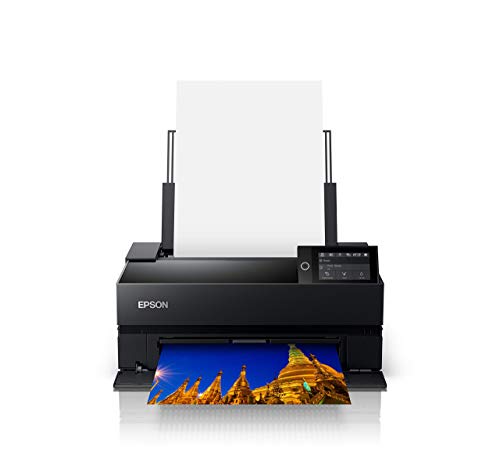
2. Epson SureColor P700 13-Inch Printer — Best Premium Wide-Format
The Epson SureColor P700 is the machine photographers and fine art printers reach for, and it earns a strong place on this rice paper list because of one key specification: dedicated nozzles for both Photo Black and Matte Black inks, eliminating the ink-switching delay that makes lesser Epson models frustrating in production workflows. When decorators need to switch between different edible sheet types — glossy icing sheets versus matte wafer paper — there's no purge cycle, no wasted ink, and no wait time.
The UltraChrome PRO10 ink set with Violet channel produces one of the widest color gamuts available in a 13-inch printer. On standard photo media the difference is immediately visible in skin tones and deep saturated hues. On edible substrates with compatible edible ink conversions, users report that the additional violet channel improves purple and blue tonal range compared to 6-color setups — meaningful for decorators printing floral designs, ocean themes, or portraits with cool skin undertones. The 10-channel MicroPiezo AMC printhead is also exceptionally consistent, with print-to-print color accuracy that holds steady over long sessions.
The P700 is a professional tool with a professional price. It's overkill for a home baker printing occasional cupcake toppers, but for a bakery processing dozens of edible photo orders per week, or a decorator who also prints fine art prints for sale, the P700 justifies its position at the premium tier. Anyone comparing Epson's pigment versus dye-based offerings for edible work should also read our breakdown of Epson solvent printers vs. inkjet printers for additional context on ink chemistry.
Pros:
- Dedicated Photo Black and Matte Black nozzles — no switching, no purge waste
- 10-color UltraChrome PRO10 with Violet for an exceptionally wide gamut
- Excellent print consistency across long production runs
- Handles 13"×19" media for large cake toppers
Cons:
- Highest price point on this list — significant upfront investment
- Pigment-based ink is less ideal for edible substrates than dye-based systems
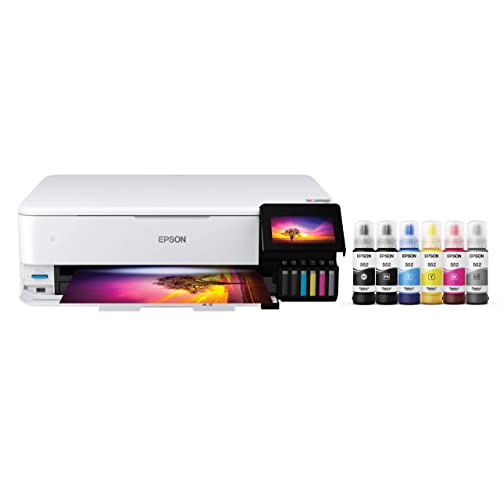
3. Epson EcoTank Photo ET-8550 Wireless Wide-Format All-in-One — Best Supertank Value
The Epson EcoTank ET-8550 presents a compelling case for volume-focused decorators who want to keep per-print costs as low as possible. Its supertank refillable ink system eliminates cartridges entirely — ink tanks are refilled from bottles, dropping the cost of a 4×6 photo to roughly 4 cents versus 40 cents with traditional cartridge systems. For a bakery running 50+ edible photo prints per week, that cost difference is significant across a year of operation.
The ET-8550 is also the only all-in-one on this list with a built-in scanner and copier, borderless printing to 13"×19", support for specialty media up to 1.3mm thick, and auto duplex — features that make it genuinely versatile beyond dedicated edible printing duty. Its Claria ET Premium 6-color dye-based ink system produces rich, accurate colors, and the high-accuracy printhead places those colors cleanly on icing sheets without the bleed or halo effect that mismatched ink-media combinations often produce.
Print speed is fast — a 4×6 completes in about 15 seconds. The 4.3-inch color touchscreen makes tray and media configuration accessible without digging through menus. The tradeoff is that as a refillable tank printer, the ET-8550 requires careful handling when filling tanks to avoid contamination — a critical consideration in any food-preparation environment. Tank filling must happen away from edible substrates and with clean tools. With that discipline in place, the ET-8550 is one of the most cost-efficient rice paper printers available in 2026.
Pros:
- Supertank system drops per-print cost dramatically — excellent for high-volume edible work
- 6-color dye-based Claria ET Premium inks produce vibrant, food-compatible output
- Borderless printing to 13"×19" with specialty media support up to 1.3mm thick
- Built-in scanner, copier, and auto-duplex add versatility
- Fast 15-second 4×6 print speed
Cons:
- Tank refilling requires discipline to maintain food-safe environment
- Larger footprint than compact models

4. Epson Expression Photo XP-8700 Wireless All-in-One — Best Compact All-in-One
The Epson XP-8700 is our pick for home bakers and hobbyist decorators who need a capable rice paper printer without the footprint or cost of a wide-format professional model. It delivers 6-color Claria Photo HD inks at a maximum resolution of 5760×1440 dpi — more than sufficient for portrait-quality edible images on standard icing sheets up to 8.5"×11". The 4.3-inch color touchscreen makes operation intuitive, and wireless connectivity means it fits into any kitchen workspace.
The XP-8700 handles borderless prints up to 8.5"×11", which covers the vast majority of standard edible sheet sizes used for cupcake toppers and quarter-sheet cake images. It does not reach 13"×19", so decorators who regularly produce large full-sheet cake toppers will need to look at the wide-format models above. For the more common use case of cupcake and half-sheet work, however, the XP-8700 is a clean, compact solution with excellent color output.
Epson's ink system compatibility with widely available edible cartridge replacement sets is a practical advantage. The XP-8700 cartridge series is well-supported by edible ink suppliers, meaning sourcing replacements is straightforward without sourcing from a single specialty vendor. Maintenance is simple: the 4.3-inch touchscreen walks through head cleaning and alignment, and the printer's footprint keeps bench space available in smaller work areas.
Pros:
- Compact footprint — ideal for home kitchens and small studio setups
- 6-color Claria Photo HD inks at 5760×1440 dpi for crisp edible photo detail
- Edible cartridge kit availability is broad for this cartridge series
- 4.3-inch color touchscreen simplifies operation and maintenance
Cons:
- Maximum print width of 8.5"×11" — no large cake topper support
- Cartridge-based ink system drives higher per-print cost than tank alternatives
5. Epson Expression Photo HD XP-15000 Wireless Color Wide-Format Printer — Best Budget Wide-Format
The Epson XP-15000 sits at a strategic price point: it delivers 13"×19" borderless wide-format printing at a considerably lower cost than the SureColor P700 or PRO-200S, making it the budget-conscious entry point for decorators who need full-sheet cake topper capability without a professional-tier investment. Its 6-color Claria Photo HD ink set includes dedicated Red and Gray cartridges — the Gray channel notably improves black-and-white portrait rendering, and the Red channel extends gamut in warmer hue ranges.
The XP-15000 uses Amazon Dash Replenishment, which is a useful feature for decorators who want to automate standard ink restocking and get notified before running dry. In practice, the printer's cartridge-based system means per-print costs are higher than the EcoTank, but the upfront price is competitive. Print quality at 5760×1440 dpi is excellent for edible applications — fine detail in portrait images and smooth gradients in sky or background fields reproduce accurately on standard icing sheets.
One point to flag: the XP-15000 is a print-only model, with no scanner or copier. For decorators who only need a dedicated edible printer and already have scanning covered elsewhere, that's a non-issue. Those looking for a single multi-function device should look at the ET-8550 or XP-8700 instead. The printer's noise level (49 dB) is typical for its class — noticeable but not disruptive in a normal kitchen or studio environment.
Pros:
- 13"×19" borderless wide-format at a lower price than professional-tier models
- 6-color system with Red and Gray for extended gamut and superior B&W output
- Amazon Dash Replenishment for automatic ink restocking
- 5760×1440 dpi produces sharp, detailed edible photos
Cons:
- Print-only — no built-in scanner or copier
- Cartridge-based system has higher per-print cost than tank alternatives

6. Canon PIXMA G620 Wireless MegaTank Photo All-in-One — Best High-Volume Tank Printer
The Canon PIXMA G620 is Canon's answer to the Epson EcoTank concept — a refillable MegaTank system that eliminates cartridge replacements and dramatically cuts per-print cost for decorators printing in high volume. The headline specification is up to 3,800 4"×6" color photos from a single full set of ink, which translates to a print-per-day workflow for months without refilling. For bakeries running consistent edible photo orders, this kind of ink endurance changes the economics of the operation meaningfully.
The G620 includes Alexa integration with smart reorder capability — when tanks run low, Alexa can notify and even automatically place a reorder with no subscription required. In a busy bakery environment, that kind of proactive supply management prevents the frustrating scenario of running out of ink mid-batch. Print, copy, and scan functions are all present, making the G620 a genuinely versatile studio machine rather than a single-purpose edible printer.
Color output from Canon's dye-based ink system is vivid and well-suited for edible applications — Canon's FINE print head technology produces clean droplet placement on icing sheets without oversaturation or bleeding at the edges. The G620 doesn't reach 13-inch wide format, so large cake toppers remain outside its range, but for standard icing sheet sizes and high-volume cupcake topper work, it's a strong, economical choice backed by the reliability Canon's tank printers have earned in the field.
Pros:
- MegaTank system delivers up to 3,800 4×6 prints per ink set — exceptional volume
- Alexa smart reorder integration prevents supply interruptions
- All-in-one: print, copy, scan in a single compact footprint
- Canon FINE print head produces clean, accurate color on edible substrates
Cons:
- Does not support 13"×19" wide-format printing
- Tank filling requires care to maintain food-safe conditions
7. Canon Pixma iX6820 Wireless Business Printer — Best Wide-Format on a Budget
The Canon Pixma iX6820 is the entry-level wide-format option on this list, and it earns its place through AirPrint and Google Cloud Print compatibility combined with 13-inch-wide media support at a price that significantly undercuts every other wide-format model we reviewed. For home bakers or small operations just getting started with edible photo printing who want 13-inch width without a major investment, the iX6820 is a logical starting point.
Canon's FINE print head technology (Full photolithography inkjet nozzle engineering) is shared across the Canon lineup, and it performs well on specialty media when paired with compatible edible ink cartridges. The iX6820 uses a 5-ink system — PGBK, C, M, Y, and a dedicated Gray — which produces good color accuracy and decent neutral tones on both standard and edible substrates. Print resolution reaches 9600×2400 dpi, which is sufficient to render fine portrait detail on large icing sheets and wafer paper.
The limitations are real: this is an older model, and its OS compatibility list — Windows Vista, 7, 8 — reflects its age. Modern Windows 10 and 11 users report successful setup via current Canon drivers, but it's worth confirming driver availability before purchasing. It's also a print-only machine, with no scanner or copier, and lacks the 3-color LCD found on newer models. As a dedicated edible printing workhorse for someone on a strict budget who needs 13-inch width, it remains a viable option. For a deeper look at postcard and wide-format printing across different paper stocks, our best postcard printer roundup covers additional models in this size range.
Pros:
- 13-inch wide-format capability at the lowest price point on this list
- AirPrint and Google Cloud Print for wireless printing from any device
- Canon FINE print head with 9600×2400 dpi delivers sharp edible photo detail
- Compact relative to its wide-format peers
Cons:
- Older model — OS compatibility documentation is dated, verify drivers before buying
- Print-only — no scanner or copier
- No LCD or touchscreen interface
Choosing the Right Rice Paper Printer: A Buying Guide
Selecting a rice paper printer involves a different set of priorities than picking a standard photo or document printer. Food safety, ink compatibility, media handling, and format size all factor into the decision in ways that standard photo printer reviews don't address. Here's what our team focuses on when evaluating these machines for edible printing use.

Ink Type: Dye-Based vs. Pigment-Based
This is the most important technical decision in the entire selection process. Dye-based inks produce better results on edible substrates for two reasons: they dissolve fully in water (which means they absorb into icing sheets and wafer paper rather than sitting on the surface), and they produce more vibrant, saturated color output. The Canon PIXMA PRO-200S and the Canon G620 both use dye-based systems, as do the Epson EcoTank and XP-series models with Claria inks.
Pigment-based inks — used in the Epson SureColor P700 — sit on the surface of media rather than absorbing into it. On photo paper and fine art paper this is an advantage (better longevity, sharper edges). On edible substrates, however, pigment ink can produce a slightly raised surface feel and may not achieve the same vibrancy as dye alternatives. The P700 is included on this list because its edible ink conversion kits use dye-based edible inks that replace the standard pigment cartridges — so the standard pigment system is irrelevant for edible use. What matters is what edible ink supplier supports the printer model.
Print Width and Media Size
Standard icing sheets are available in 8.5"×11" (letter) and A4 sizes, which are handled by any printer on this list. Full-sheet cake toppers — for quarter-sheet and half-sheet cakes — require 13"×19" (A3+) capability. The Canon PRO-200S, Epson SureColor P700, Epson ET-8550, Epson XP-15000, and Canon iX6820 all reach this wider format. The Epson XP-8700 and Canon G620 top out at letter/A4 size.
Anyone printing large cake imagery for events, wedding cakes, or high-volume bakery orders should prioritize wide-format capability regardless of other tradeoffs. Trimming an 8.5"×11" print to fit a 12-inch cake round involves losing edge detail and requires precise cutting — investing in a 13-inch printer eliminates these workflow compromises and produces cleaner, professional results.
Ink System Economics: Cartridges vs. Tanks
The cartridge-based models — Canon PRO-200S, Epson P700, Epson XP-8700, Epson XP-15000, Canon iX6820 — offer lower upfront cost and simpler edible ink sourcing, since most edible ink suppliers package their products in standard replacement cartridge form. The tradeoff is higher per-print cost, which adds up quickly under production volume.
The tank-based models — Epson ET-8550 and Canon G620 — require edible ink in bottle form, which most major edible ink suppliers offer. The per-print cost advantage is significant over any sustained volume. One consideration specific to food environments: tank filling must occur away from edible substrates and with clean, food-safe equipment to prevent cross-contamination. Maintain a separate filling station and use fresh bottles from reputable suppliers. Anyone curious about how paper thickness and media weight interacts with printer feeding should also check out our overview of how to measure the thickness of paper, since icing sheet thickness varies by brand and affects tray settings.
Connectivity and Ease of Use
Every model on this list supports Wi-Fi wireless printing, which is the minimum acceptable standard in 2026 for any professional or home studio setup. AirPrint support (Canon iX6820, Canon G620, Canon PRO-200S) allows printing directly from iOS devices — useful for decorators who design on iPad. The Epson models use Epson's own wireless printing ecosystem, which is equally reliable.
Color touchscreen displays — present on the ET-8550 (4.3"), XP-8700 (4.3"), and Canon PRO-200S (3.0") — simplify media type selection and head cleaning maintenance. For edible printing specifically, frequent head cleaning is part of the regular maintenance routine, and navigating those menus through a touchscreen versus button arrays is a meaningful quality-of-life difference over months of use. The Canon iX6820 lacks any LCD, which makes it less convenient for routine maintenance but not unusable.
What People Ask
Can any inkjet printer print on rice paper?
Technically, most inkjet printers can feed standard edible icing sheets if they accept thin specialty media. However, the key requirement is replacing standard ink with food-safe edible ink — standard printer inks are not food-safe and must never be used on edible substrates. Our team recommends purchasing a printer with well-documented edible ink cartridge support from suppliers like Ink4Cakes or Icinginks, rather than attempting to adapt any random inkjet model.
What is the difference between rice paper and wafer paper for printing?
Rice paper and wafer paper are often used interchangeably in the cake decorating world, but they're slightly different products. Traditional rice paper is made from the pith of the rice paper plant or from starch. Wafer paper is made from potato starch, water, and vegetable oil — it's thin, slightly translucent, and highly receptive to edible ink. Both work with the printers on this list, though wafer paper is thinner and requires a printer with gentle media handling to avoid feeding problems.
Do we need to clean a rice paper printer differently than a regular printer?
Yes. Edible ink requires more frequent head cleaning cycles than standard inks, particularly if the printer sits unused for several days. Sugar-based edible inks can dry faster than standard inks and clog nozzles. Our team recommends running a head cleaning cycle before each session if the printer hasn't been used in 48 hours or more, and printing a nozzle check pattern to confirm clean output before feeding any edible media.
Is dye-based or pigment-based ink better for edible printing?
Dye-based ink is the clear choice for edible printing. Dye inks absorb into the icing sheet or wafer paper surface rather than sitting on top of it, producing more vibrant color and a more natural finish. Pigment-based inks can produce a slightly raised, powdery surface feel on edible media that is less appealing in finished cake decoration work. The Canon PRO-200S and the Epson EcoTank ET-8550 both use dye-based inks and are the stronger choices for this reason.
What print resolution is needed for edible photo printing?
For edible photo prints that look sharp from a normal viewing distance — which for a decorated cake is roughly 12 to 24 inches — a resolution of 1440 dpi is sufficient and 2880 dpi is more than adequate. The high maximum resolutions quoted by printer manufacturers (5760×1440, 9600×2400) represent optimal conditions on premium photo media. On edible substrates, the substrate's texture and ink absorption are the limiting factors, not the printer's maximum dpi. Any printer on this list delivers resolution well beyond what edible media can actually resolve.
Can the same printer be used for both edible and non-edible printing?
Our team strongly advises against mixing edible and non-edible use in the same printer. Once a printer is loaded with edible ink, it should be dedicated exclusively to edible printing. Standard inks contain chemical compounds that are not food-safe, and cross-contamination between ink types creates a genuine food safety risk. The practical and hygienic solution is to maintain a dedicated edible printer separate from any standard document or photo printing setup.
Buy on Walmart
- Canon PIXMA PRO-200S Professional 13" Wireless Inkjet Photo — Walmart Link
- Epson SureColor P700 13-Inch Printer,Black — Walmart Link
- Epson EcoTank Photo ET-8550 Wireless Wide-format Color All-i — Walmart Link
- Epson Expression Photo XP-8700 Wireless All-in-One Printer w — Walmart Link
- Epson Expression Photo HD XP-15000 Wireless Color Wide-Forma — Walmart Link
- Canon PIXMA G620 Wireless MegaTank Photo All-in-One Printer — Walmart Link
- Canon Pixma iX6820 Wireless Business Printer with AirPrint a — Walmart Link
Buy on eBay
- Canon PIXMA PRO-200S Professional 13" Wireless Inkjet Photo — eBay Link
- Epson SureColor P700 13-Inch Printer,Black — eBay Link
- Epson EcoTank Photo ET-8550 Wireless Wide-format Color All-i — eBay Link
- Epson Expression Photo XP-8700 Wireless All-in-One Printer w — eBay Link
- Epson Expression Photo HD XP-15000 Wireless Color Wide-Forma — eBay Link
- Canon PIXMA G620 Wireless MegaTank Photo All-in-One Printer — eBay Link
- Canon Pixma iX6820 Wireless Business Printer with AirPrint a — eBay Link
Key Takeaways
- The Canon PIXMA PRO-200S is the best overall rice paper printer for 2026 — its 8-color dye-based ink system and wide media support deliver professional-grade edible photo results across all common icing sheet formats.
- Volume-focused operations get the lowest per-print cost from the Epson EcoTank ET-8550 or Canon PIXMA G620 MegaTank, both of which dramatically reduce ink expense compared to cartridge-based alternatives.
- Decorators who regularly produce full-sheet large cake toppers need a printer that handles 13"×19" borderless media — the PRO-200S, Epson SureColor P700, ET-8550, XP-15000, and iX6820 all qualify; the XP-8700 and G620 do not.
- Any printer used for edible printing must be dedicated exclusively to that purpose — never mix edible and standard inks in the same machine, and always source edible ink from reputable, food-safe suppliers.



About Chris & Marry
Chris and Mary are a couple with a shared background in graphic design and print production who have spent years working with printers across creative and professional contexts — from art printing and photo output to label production and professional document work. Their combined experience evaluating printer performance, color accuracy, and paper handling across inkjet and laser platforms gives them a practical, hands-on perspective on what makes a printer worth buying. At ShopChrisAndMary, they cover printer reviews, buying guides, and recommendations for artists, photographers, and professional users.
Time to get FREE Gifts. Or latest Free printers here.
Disable Ad block to reveal all the info. Once done, hit a button below